
Worksheet 1 · Phenomenon exploration
The Ball That Got Heavier: Is Air Something?
I can describe a puzzling observation about air and mass, and write a first explanation that I can test later.
Teacher only
 Angela's Wand
Chapter 01 · Unit 1: The Composition of Matter · Segment 1
What are the smallest pieces of matter, how do we know they exist, and how do scientists keep track of the different kinds?
Students figure out that every bit of matter, including invisible air, is built from atoms that are far too small to see, and that fewer than a hundred kinds of atoms occur in nature. They learn how two physicists defined criteria and constraints to invent a microscope that maps surfaces atom by atom, and how chemists a century earlier found patterns in properties and atomic mass that grew into the periodic table. By the end they can read an element's symbol, mass and position on the table and use that position to predict how the element behaves. This chapter is the foundation for modeling molecules in Lesson 2 and for every chemistry lesson that follows.
Estimated class time: presentation about 142 minutes · worksheets about 375 minutes in total · labs 4 sessions. Six to seven 50-minute periods: two for the phenomenon, scale and the atom/element distinction; two for the STM engineering story and the touch-probe design lab; two for classification history, the periodic table and the mystery-card lab; one for synthesis and mastery.
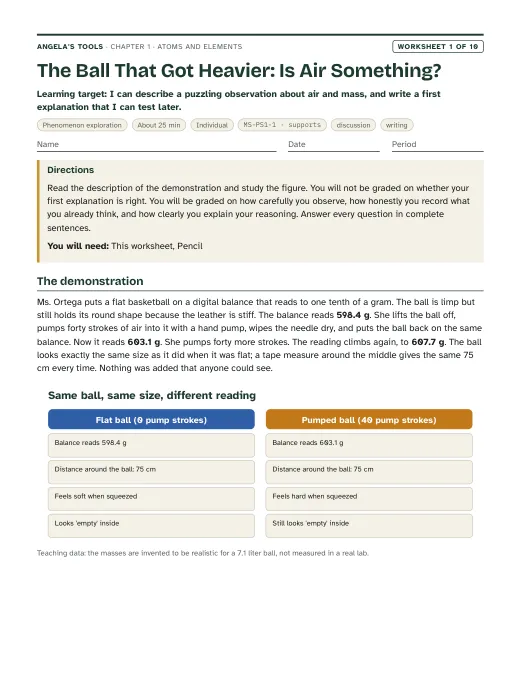
A limp party balloon sits on a sensitive balance and reads 1.85 grams. A student pumps it full of air with a hand pump, ties it off, dries the outside, and puts it back. Now the balance reads 1.89 grams. (The readings are illustrative values, realistic for a small party balloon.) Nothing visible was added, yet the balloon is measurably heavier. If the stuff inside has mass, what is it made of, how small are its pieces, and why can we not see them?
Notice and wonder prompts
California NGSS, Grade 7 Preferred Integrated Course Model. Each entry says whether this chapter's work assesses the performance expectation, gives practice toward it, or supports it as background; the resource lists below repeat this for every worksheet and lab.
Develop models to describe the atomic composition of simple molecules and extended structures.
This lesson establishes that substances are made of different kinds of atoms and introduces the periodic table as the catalog of those kinds. Students build and use models of atomic scale and of the table, which prepares them to model molecules and extended structures in Lesson 2; no slide or task here asks for a molecule model, so the role is practice, not assesses.
Assessment boundary: Assessment does not include valence electrons and bonding energy, discussing the ionic nature of subunits of complex structures, or a complete description of all individual atoms in a complex molecule or extended structure is not required.
Define the criteria and constraints of a design problem with sufficient precision to ensure a successful solution, taking into account relevant scientific principles and potential impacts on people and the natural environment that may limit possible solutions.
The lesson's engineering spread tells how Rohrer and Binnig stated what their microscope had to do and what limited them. Lab 3 and Worksheet 9 require students to write their own criteria and constraints for a probe-based mapping tool, with measurable precision, before designing, which is direct evidence toward this PE.
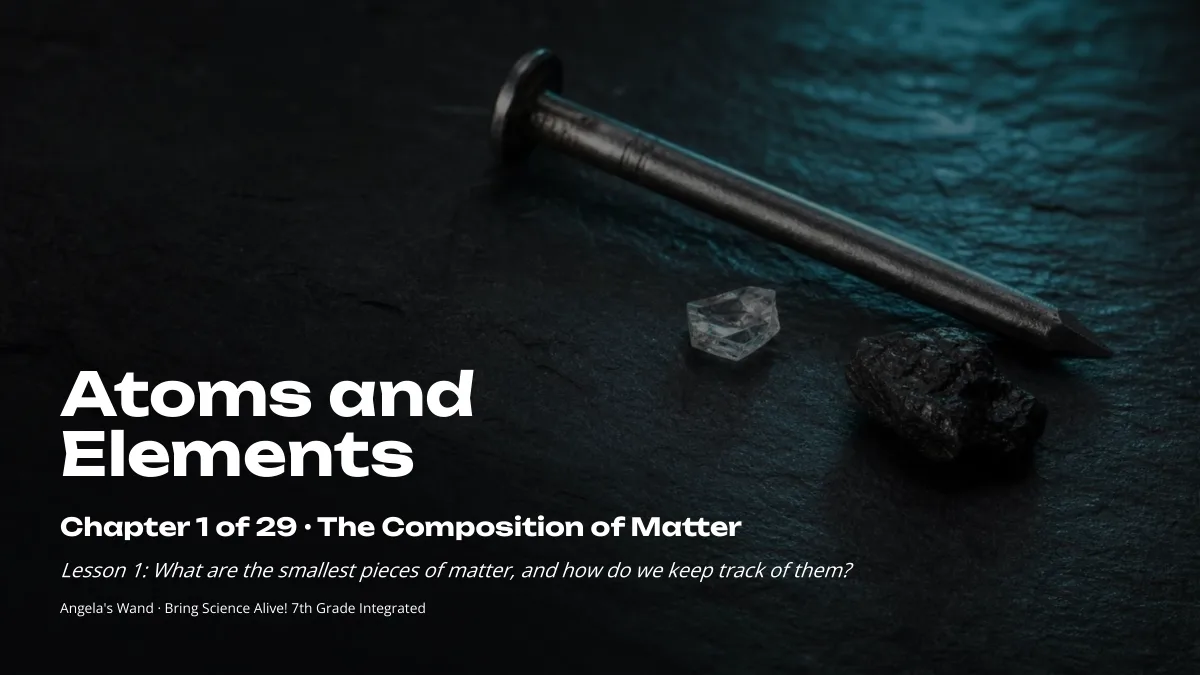
Atoms and Elements: the smallest pieces of matter. Original, editable slides with speaker notes: a phenomenon opener, learning targets, the chapter's concepts with diagrams, vocabulary in context, 4 checks for understanding, 2 discussion prompts, an application task, a misconception check, a synthesis and an exit ticket.
Ten different tasks, one per instructional blueprint. Each has a student PDF (low ink, US Letter), an editable DOCX, an HTML preview, and a separate teacher answer key with reasoning.
I can describe a puzzling observation about air and mass, and write a first explanation that I can test later.
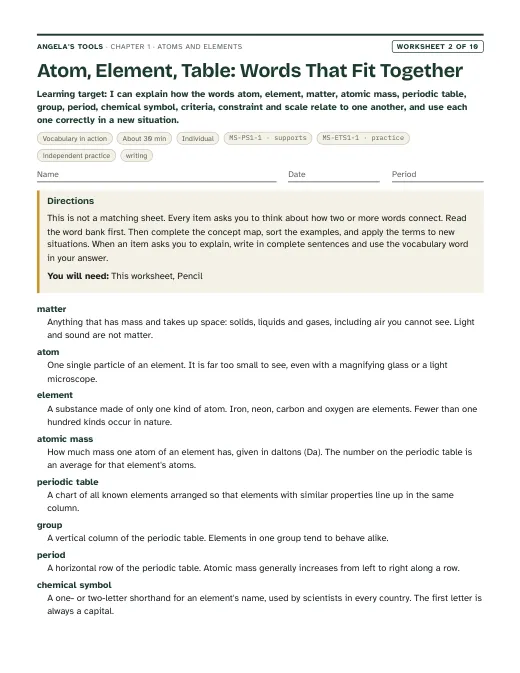
I can explain how the words atom, element, matter, atomic mass, periodic table, group, period, chemical symbol, criteria, constraint and scale relate to one another, and use each one correctly in a new situation.
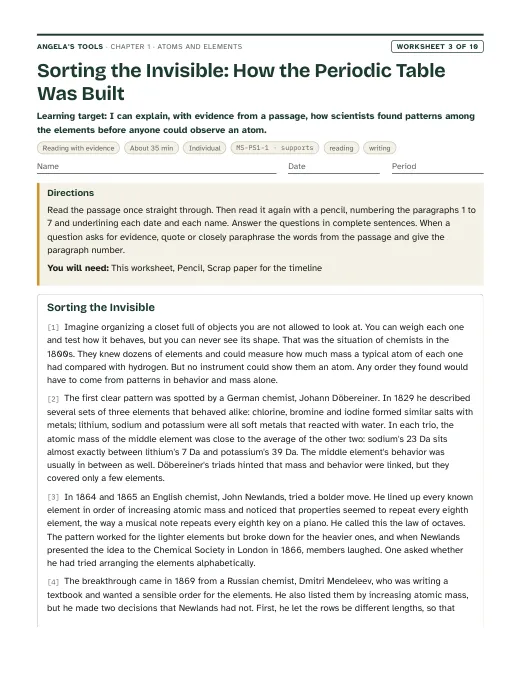
I can explain, with evidence from a passage, how scientists found patterns among the elements before anyone could observe an atom.
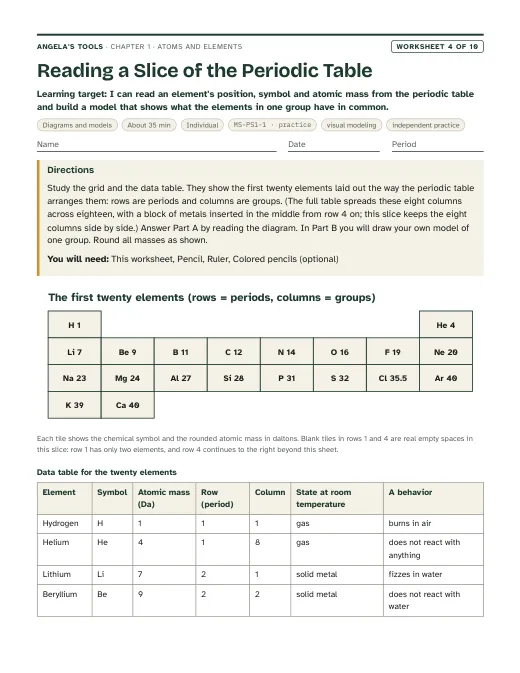
I can read an element's position, symbol and atomic mass from the periodic table and build a model that shows what the elements in one group have in common.
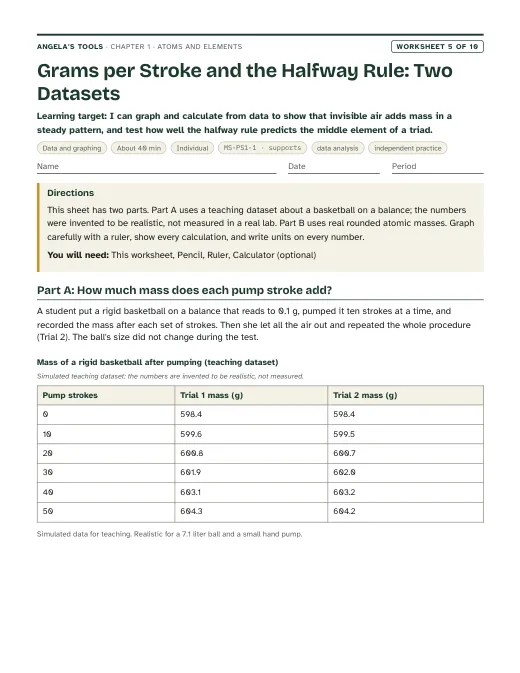
I can graph and calculate from data to show that invisible air adds mass in a steady pattern, and test how well the halfway rule predicts the middle element of a triad.
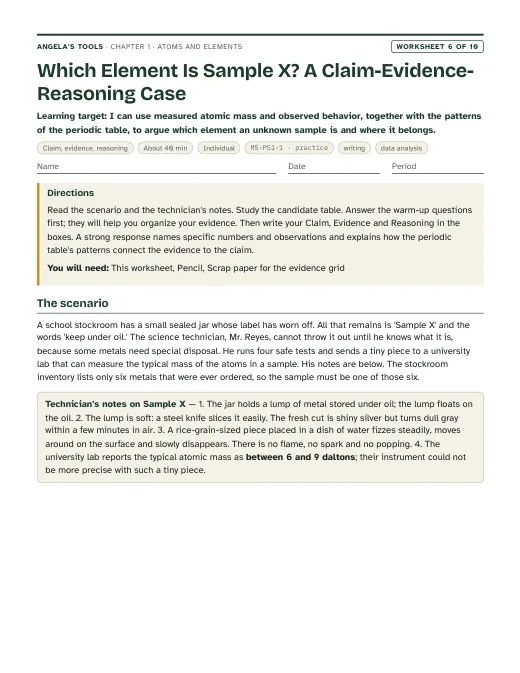
I can use measured atomic mass and observed behavior, together with the patterns of the periodic table, to argue which element an unknown sample is and where it belongs.
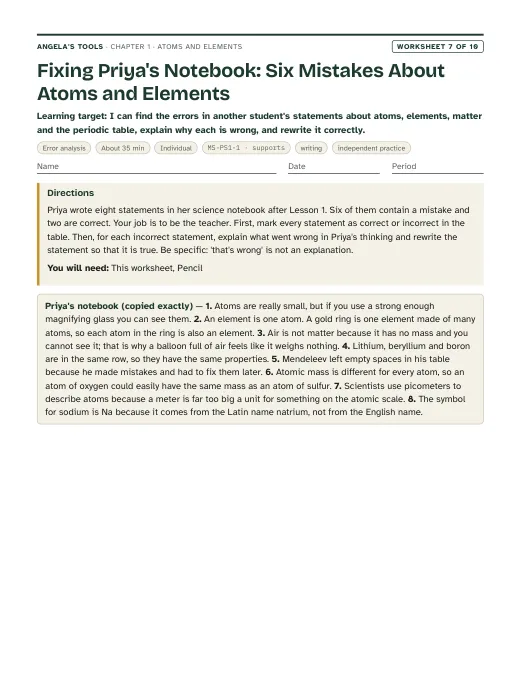
I can find the errors in another student's statements about atoms, elements, matter and the periodic table, explain why each is wrong, and rewrite it correctly.
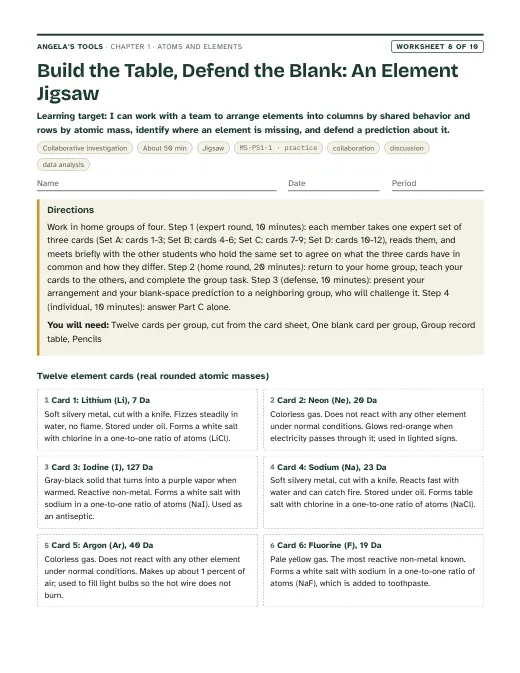
I can work with a team to arrange elements into columns by shared behavior and rows by atomic mass, identify where an element is missing, and defend a prediction about it.
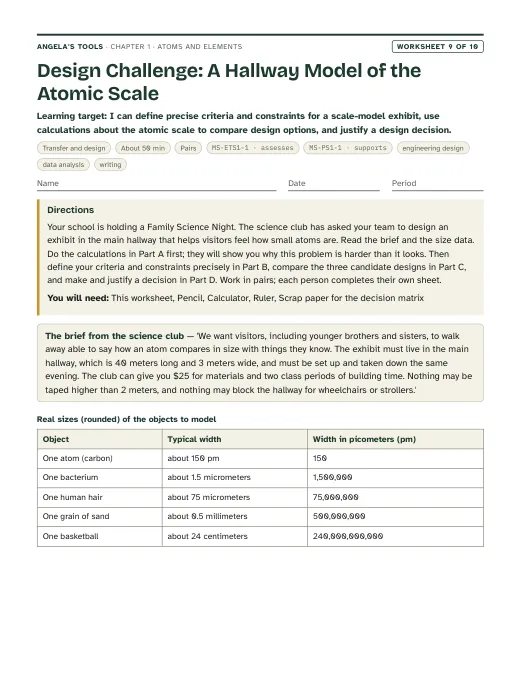
I can define precise criteria and constraints for a scale-model exhibit, use calculations about the atomic scale to compare design options, and justify a design decision.
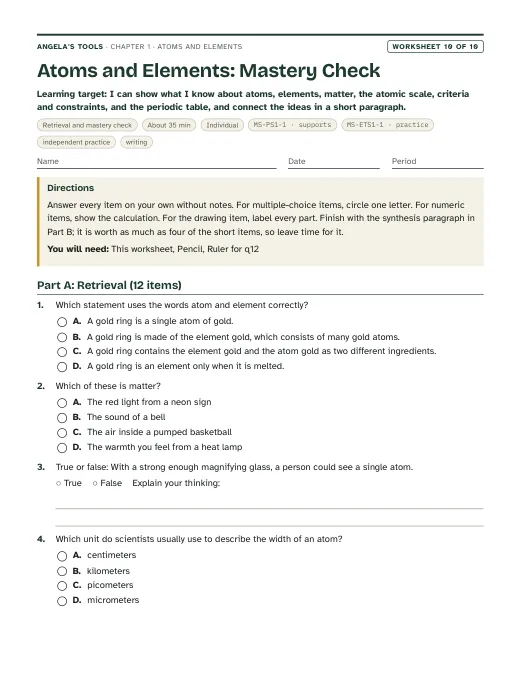
I can show what I know about atoms, elements, matter, the atomic scale, criteria and constraints, and the periodic table, and connect the ideas in a short paragraph.
Three different investigation approaches. Each has a teacher guide (purpose, materials with quantities, estimated cost, prep, safety, procedure, expected observations, debrief, answer key, assessment criteria, accessibility adaptations, low-cost alternative) and a student recording sheet.
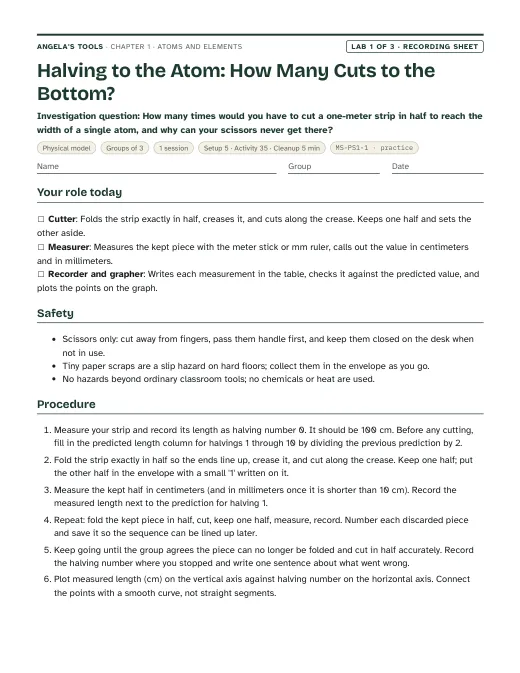
How many times would you have to cut a one-meter strip in half to reach the width of a single atom, and why can your scissors never get there?
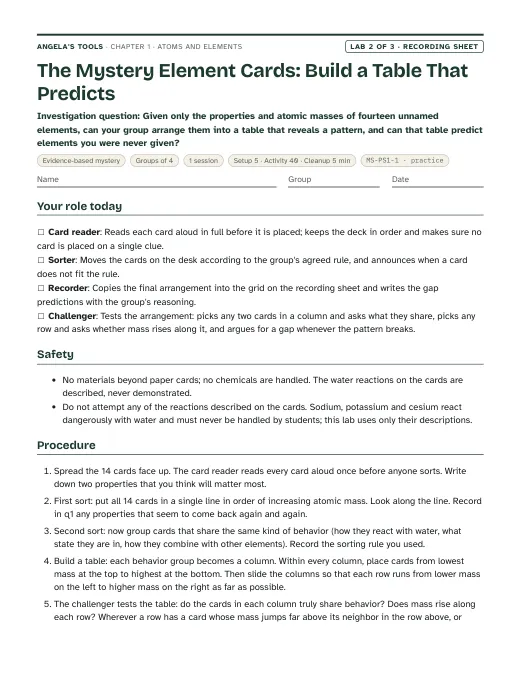
Given only the properties and atomic masses of fourteen unnamed elements, can your group arrange them into a table that reveals a pattern, and can that table predict elements you were never given?
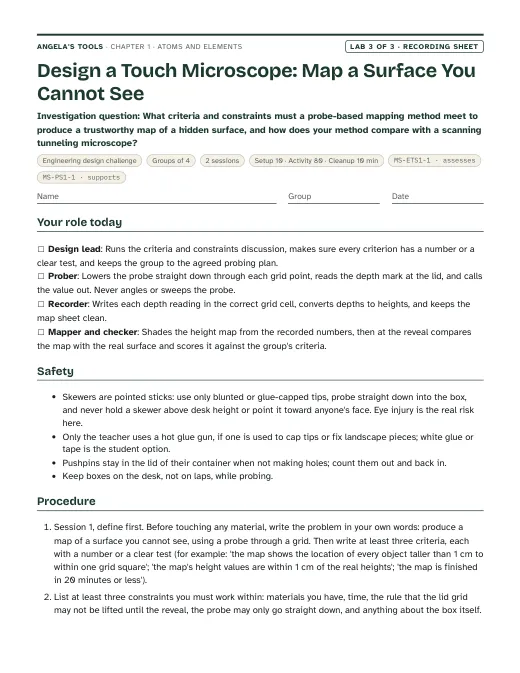
What criteria and constraints must a probe-based mapping method meet to produce a trustworthy map of a hidden surface, and how does your method compare with a scanning tunneling microscope?
Materials overview: No chemicals and no open flames anywhere in the chapter. Lab 1 uses paper strips, rulers and graph paper. Lab 2 uses printed mystery element cards. Lab 3 uses shoeboxes, cardboard, modeling clay or glued-on objects, bamboo skewers and grid paper. A digital balance reading to 0.01 g and a hand pump make the balloon phenomenon a live demonstration; otherwise describe it with the numbers in the phenomenon text.
Review status: reviewed · 2026-10-18 · Re-solved every numeric and multiple-choice item in W1-W10 and Labs 1-3 (68 keyed items plus the slide checks); all keys agreed with independent solutions except as noted below. Lab 2: corrected the claim that all three gaps fall in one row (bromine's gap is in the potassium/krypton row; rubidium and strontium's gaps are in the iodine/xenon row) and fixed a row/column mix-up in likelyDifficulties. Presentation: Newlands' medal came from the Royal Society (Davy Medal, 1887), not the Chemical Society; light-microscope limit restated as a few hundred nanometers rather than 'the size of a bacterium'; halving count for a 10 cm nail corrected to about 30; the slide-24 task now says its names and masses are the Lab 2 cards rounded, to be used after the lab. Grand Canyon accuracy note made consistent with the W9 extension arithmetic (about 400-600 canyon-fulls). Balloon phenomenon readings labeled as illustrative values in the chapter and the slide notes. W10 q6 switched from the Cl/Br/I triad (already the computation in W5 q8 and W8 q2) to the Ca/Sr/Ba triad so the quiz is not a third repeat. Originality sweep: four short phrases shared with the lesson text reworded (W3 passage, W7 key, W9 extension, W10 key, Lab 2 debrief, two teacher accuracy notes); remaining matches are section titles in sourceReferences. W4 grid diagram converted from 'categories' to 'items' with labels, the field the authoring guide specifies for grid. Lab cost bases now say they are estimates; Lab 2 safety line reworded so it does not overstate classroom practice. Not changed, flagged for authors: W8 (jigsaw) and Lab 2 (mystery cards) share the same core reasoning (sort cards into behavior columns, find a hole, average to predict bromine); they differ in format and card count but a student doing both will repeat the exercise.
Verified against the student edition of Bring Science Alive! 7th Grade Integrated (Student Edition). Printed page numbers appear in the book; PDF pages are the physical pages of the 524-page scan (printed + 36). The textbook is not reproduced on this site.
| Section | Printed pages | PDF pages | Used for |
|---|---|---|---|
| Introduction: the neon tube that looks empty | 8, 9 | 44, 45 | Lesson question, the 'empty' tube idea, vocabulary list, standards listed by the publisher. |
| 1. Atoms: halving a nail, the sand-grain count, scale and the picometer | 10, 11 | 46, 47 | Lab 1 halving model, scale-ladder diagram, the atom/element distinction, slide content on scale. |
| 2. Engineering Tools to Observe Atoms: criteria, constraints and the STM | 12, 13 | 48, 49 | Engineering story, criteria vs. constraints compare diagram, STM flow diagram, Lab 3 design challenge. |
| 3. Classifying Elements: Döbereiner's trios and atomic mass | 14 | 50 | Trio pattern, dalton unit, the averaging idea used in Lab 2 and W5. |
| 4. The Periodic Table: Newlands, Mendeleev and the blank spaces | 15 | 51 | Timeline diagram, the prediction of gallium, scandium and germanium, Lab 2 blank-space reasoning. |
| Key Science Concept: The Periodic Table of Elements | 16, 17 | 52, 53 | The clearer element definition, element masses and symbols used for table-reading tasks. |
| 5. Using the Periodic Table: groups, periods, symbols | 18, 19 | 54, 55 | Group and period patterns, noble gases and alkali metals, chemical-symbol origins, lesson summary. |