Chapter 02 · Unit 1: The Composition of Matter · Segment 1

Molecules and Extended Structures

How can fewer than a hundred kinds of atoms build millions of different substances, and how do scientists model the ways atoms join?

Overview

Students figure out how fewer than a hundred kinds of atoms can build millions of different substances: atoms join through chemical bonds, and the two things that make a substance what it is are which atoms it contains in what numbers (composition) and how those atoms are connected (structure). They learn to read and build ball-and-stick models and chemical formulas, and they discover that a formula means two different things: an exact count for a molecule such as H₂O, and a fixed ratio for an extended structure such as salt, which has no set size. By the end they can explain visible patterns, such as cube-shaped salt grains and sliding pencil marks, from atomic-level structure. This chapter builds on the atoms and elements of Lesson 1 and feeds every later lesson on properties, reactions and particle motion.

Estimated class time: presentation about 127 minutes · worksheets about 395 minutes in total · labs 3 sessions. Seven 50-minute periods: two for bonds, molecules, formulas and the model-building lab; two for composition versus structure and the molecule/extended-structure distinction; two for crystals, polymers, visible patterns and the two remaining labs; one for synthesis and mastery. Six periods are possible if Lab 3 is replaced by W9.

Phenomenon

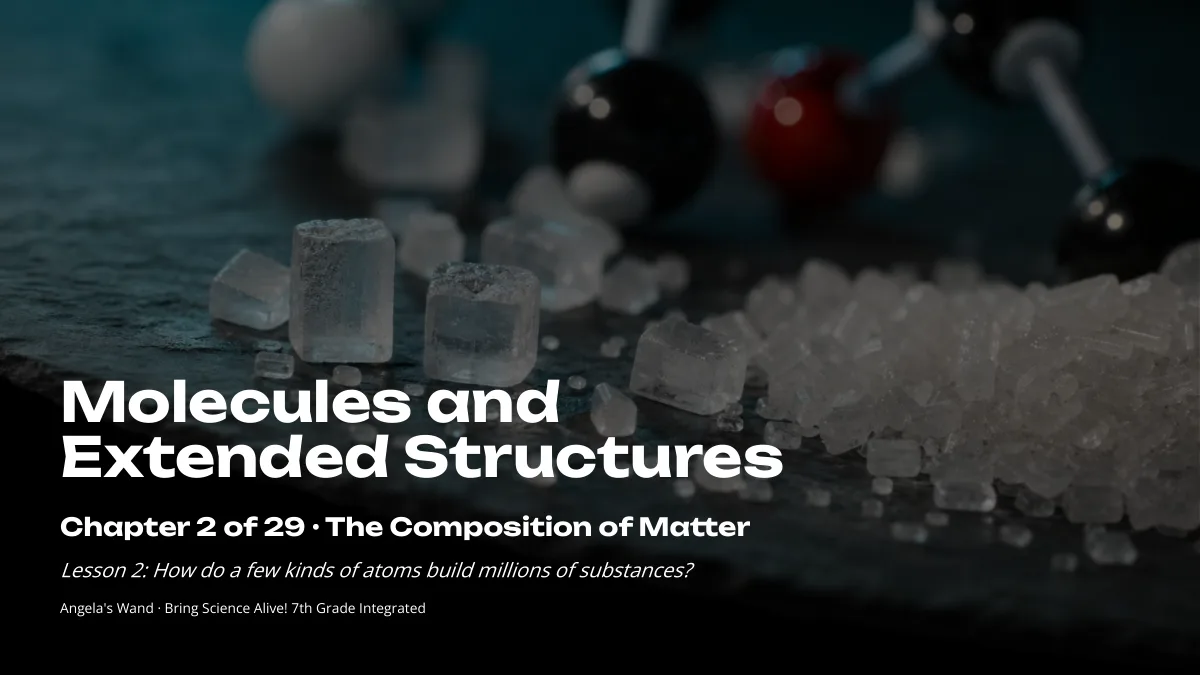
Salt cubes and sugar slants

Pour a pinch of table salt and a pinch of granulated sugar onto a dark sheet of paper and look through a hand lens. Nearly every salt grain is a tiny cube with square faces and sharp corners. The sugar grains are angular blocks too, but they are slanted and never square, more like tilted bricks. Both are white, both dissolve in water, both come out of a shaker, and neither grain looks anything like the one next to it in size. Something inside each grain, far too small to see, is deciding its outside shape.

Notice and wonder prompts

  • What do all the salt grains have in common, no matter how big or small they are?
  • If you crushed a salt grain, would the pieces still be cubes? What would decide that?
  • Sugar and salt are both crystals. What might be different about the pieces they are built from?
  • Could you predict a grain's shape without a lens if you knew how its atoms are arranged?

Learning targets

  • I can explain that atoms join through chemical bonds to form molecules, and read a ball-and-stick model or chemical formula to tell which atoms a molecule has and how many.
  • I can explain how a molecule's composition and its structure together decide which substance it is, using pairs like water and hydrogen peroxide or butane and isobutane.
  • I can tell a molecule, which has an exact number of atoms, from an extended structure, which repeats a subunit and is described by a ratio.
  • I can develop a model (drawing or 3-D build) of a simple molecule and of an extended structure such as table salt, and explain what each part of the model stands for.
  • I can use atomic-level structure to explain patterns I can see, such as cube-shaped salt grains, pencil marks and the hardness of diamond.

What shows the learning happened

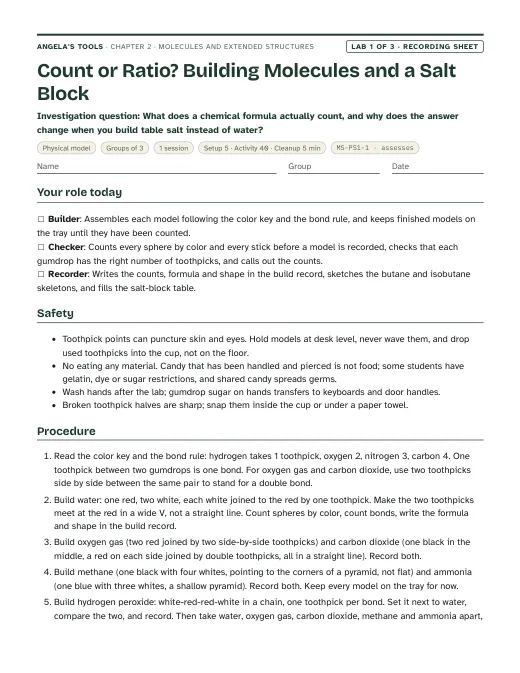
  • A completed build record (Lab 1) with correct atom counts and formulas for at least five molecules, plus a salt-block table showing that the total count grows while the ratio stays 1:1.
  • A labeled drawing (W4 or W10) of a simple molecule and of a slice of a salt lattice, with a sentence explaining what each sphere, stick and color stands for and what the model cannot show.
  • A decision table (Lab 2) matching five substances to structure types using station observations and fragment-count data, with a justified material choice for at least two jobs.
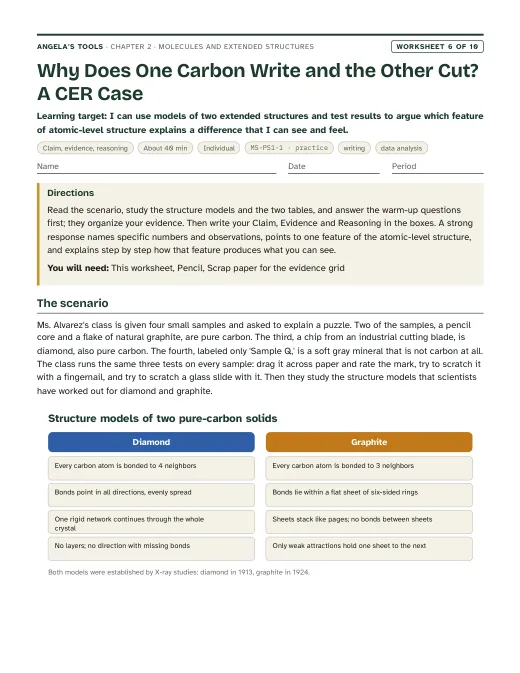
  • A Claim-Evidence-Reasoning paragraph (W6) arguing from structure models, bond distances and test results that graphite's unbonded sheets, not its atoms, explain why it marks paper while diamond does not.
  • A tested and revised toothpick structure (Lab 3) with a data table and a written comparison to graphite sheets and the diamond network.
  • A short answer that correctly reads a formula two ways: as an exact count for a molecule and as a ratio for an extended structure.

Key vocabulary 12 terms

chemical bondA strong connection that holds two atoms together inside a particle. Bonds are what turn separate atoms into a molecule or an extended structure.Each of the two bonds in a water molecule joins one hydrogen atom to the oxygen atom; the two hydrogens are not bonded to each other.
moleculeA particle built from a definite number of atoms (at least two) joined to one another by chemical bonds, so every particle of a substance has the same count of each kind of atom. The atoms can all be one element (O₂) or several elements (H₂O).Every molecule of carbon dioxide has exactly one carbon atom and two oxygen atoms, no matter where the gas came from.
chemical formulaShorthand that lists a substance's elements by symbol. For a molecule the small numbers count the atoms in one molecule (no number means one); for an extended structure the numbers give the ratio of the elements instead.The formula CH₄ tells a chemist that one methane molecule holds one carbon atom and four hydrogen atoms.
modelA simplified stand-in for something too small, too large or too complex to see directly, built to make the important features easy to notice and reason about.A gumdrop-and-toothpick model of ammonia shows which atoms are bonded, even though real atoms are not sticky spheres.
ball-and-stick modelA model of a molecule or extended structure in which spheres stand for atoms, sticks stand for bonds, and a color key tells which element each sphere represents.In the ball-and-stick model of methane, four white spheres surround one black sphere, and each stick marks one carbon-hydrogen bond.
atomic compositionWhich elements a substance contains and how many atoms of each (for a molecule) or in what ratio (for an extended structure).Water and hydrogen peroxide have the same two elements but different compositions: two hydrogens per oxygen in water, one per oxygen in hydrogen peroxide.
chemical structureThe way the atoms in a substance are connected and arranged in space.Butane and isobutane share the composition C₄H₁₀, but their structures differ: a straight chain of carbons versus a central carbon with three branches.
extended structureA structure built by repeating the same small subunit over and over, so it has no fixed size but keeps a constant ratio of its elements. Crystals and polymers are extended structures.A grain of salt is one extended structure; a bigger grain simply repeats the sodium-chlorine pattern more times.
repeating subunitThe small group of atoms or molecules that is copied again and again to build an extended structure.The smallest cube of table salt holds four sodium and four chlorine particles, and that subunit repeats in every direction.
crystalA solid whose atoms or molecules sit in a regular pattern that repeats in all three directions. Diamond, quartz, salt, ice and table sugar are all crystals.Salt grains are little cubes because the crystal pattern inside them repeats at right angles.
polymerAn extended structure made of many small repeating units linked into a long chain. Polyethylene bags, PET bottles and PVC pipes are polymers.When you stretch a polyethylene bag, its long polymer chains straighten and line up, which is why the strip gets narrower and turns whitish.
ratioA comparison of two amounts, written with a colon. In quartz the silicon-to-oxygen ratio is 1:2, so any quartz crystal has twice as many oxygen atoms as silicon atoms.A chemist who counts 500 silicon atoms in a quartz fragment expects about 1,000 oxygen atoms, because the ratio is fixed.


Standards alignment

California NGSS, Grade 7 Preferred Integrated Course Model. Each entry says whether this chapter's work assesses the performance expectation, gives practice toward it, or supports it as background; the resource lists below repeat this for every worksheet and lab.

MS-PS1-1Assesses: developing models that describe the atomic composition of simple molecules and of extended structuresCA Grade 7

Develop models to describe the atomic composition of simple molecules and extended structures.

This is the lesson's home standard. Students build gumdrop models of water, oxygen, carbon dioxide, methane, ammonia and the butane/isobutane pair (Lab 1), draw and label molecule and lattice models (W4, W10), and model table salt and a polymer chain as repeating structures. The assessment boundary is respected: no valence electrons, no bond energies, and the charged nature of salt's particles is mentioned only as a teacher note.

Assessment boundary: Assessment does not include valence electrons and bonding energy, discussing the ionic nature of subunits of complex structures, or a complete description of all individual atoms in a complex molecule or extended structure is not required.

MS-ETS1-2Practice toward: evaluating competing designs against stated criteria and constraintsCA Grade 6-8

Evaluate competing design solutions using a systematic process to determine how well they meet the criteria and constraints of the problem.

The textbook lesson has no engineering spread; the engineering practice comes from Lab 3, where groups test layered and three-dimensional toothpick structures against load, push and drop criteria under a material budget, and from W9, where students score three salt-model prototypes against criteria and constraints they wrote. Both build the practice; neither is a full assessment of the PE.

MS-ETS1-1Practice toward: turning a client's wishes into testable criteria and constraintsCA Grade 6-8

Define the criteria and constraints of a design problem with sufficient precision to ensure a successful solution, taking into account relevant scientific principles and potential impacts on people and the natural environment that may limit possible solutions.

In W9 students convert a Science Night committee's brief into criteria with numbers or tests and constraints with limits, including a safety limit for young visitors. This is practice toward the PE; impacts on people and the environment are only touched on.

MS-ETS1-3Practice toward: using test data from several designs to combine their best featuresCA Grade 6-8

Analyze data from tests to determine similarities and differences among several design solutions to identify the best characteristics of each that can be combined into a new solution to better meet the criteria for success.

Lab 3 pools push, load and drop results across the class and asks groups to name the features shared by the designs that passed and build a second version; W9 uses drop-test and cost data from three prototypes the same way. Practice, not assessment, because the problems are small and the data are partly simulated.

MS-PS1-3Supports: background on synthetic polymers such as polyester, PET and PVCCA Grade 7

Gather and make sense of information to describe that synthetic materials come from natural resources and impact society.

The polymer section names three human-made materials and the natural polymers in living things. This chapter only introduces what a polymer is; the natural-resource origins and societal impacts that MS-PS1-3 requires are taught in Lesson 15.

Assessment boundary: Assessment is limited to qualitative information.

Science and engineering practices

  • Developing and Using Models. Students build ball-and-stick molecules and a growing salt block from gumdrops (Lab 1), draw and label molecule and lattice models (W4), and build toothpick sheets and networks to model why graphite flakes and diamond does not (Lab 3). Each time they say what the model shows and where it fails.
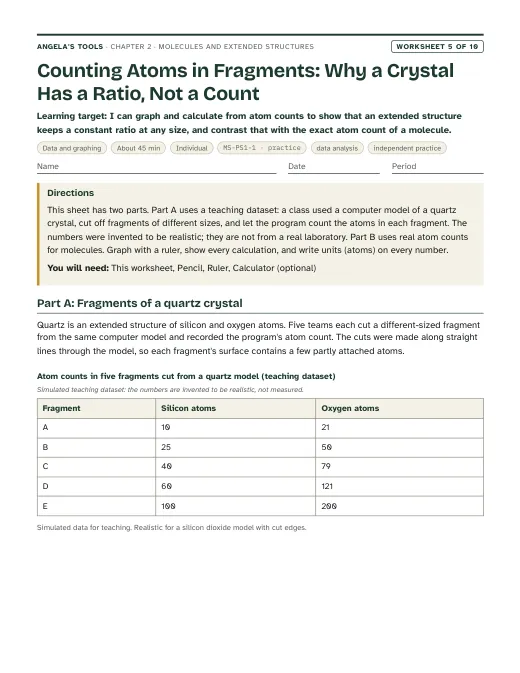
  • Analyzing and Interpreting Data. Students read simulated atom counts from fragments of different sizes (presentation task, W5, Lab 2) to decide whether a substance is a molecule or an extended structure and to find its formula or ratio.
  • Constructing Explanations. Students explain visible patterns, such as cube-shaped salt grains, pencil marks and stretchy plastic, from atomic-level structure (Lab 2, W6, W9).

Disciplinary core ideas

  • PS1.A Structure and Properties of Matter. Substances are made from different kinds of atoms that combine in many ways; atoms form molecules from two to thousands of atoms; solids may be made of molecules or may be extended structures with repeating subunits such as crystals.
  • ETS1.B Developing Possible Solutions. In Lab 3 students test competing structural designs against criteria and constraints and use the results to improve a second build; in W9 they score three prototype salt models against criteria they wrote and recommend a combined design.

Crosscutting concepts

  • Scale, Proportion, and Quantity. Students use proportional models to reason about particles far too small to see, and use ratios to predict atom counts in extended structures of any size.
  • Patterns. Students connect the pattern inside a crystal (right-angle repeats in salt, hexagons in ice and graphite) to the shapes and behaviors they can see.
  • Structure and Function. Students explain why the same element, carbon, writes as graphite and cuts as diamond, and why a polymer stretches, from how its atoms are connected.

Presentation 27 slides

Molecules and Extended Structures: how atoms join up. Original, editable slides with speaker notes: a phenomenon opener, learning targets, the chapter's concepts with diagrams, vocabulary in context, 4 checks for understanding, 2 discussion prompts, an application task, a misconception check, a synthesis and an exit ticket.

Worksheets 10 of 10

Ten different tasks, one per instructional blueprint. Each has a student PDF (low ink, US Letter), an editable DOCX, an HTML preview, and a separate teacher answer key with reasoning.

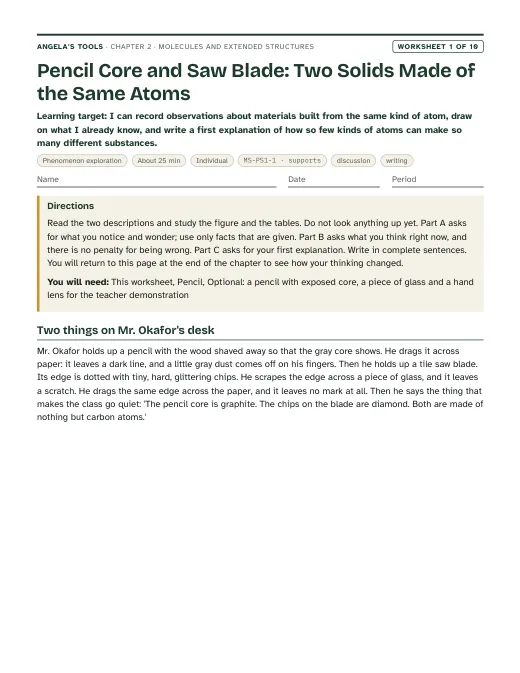
First page of Pencil Core and Saw Blade: Two Solids Made of the Same Atoms
Worksheet 1 · Phenomenon exploration

Pencil Core and Saw Blade: Two Solids Made of the Same Atoms

I can record observations about materials built from the same kind of atom, draw on what I already know, and write a first explanation of how so few kinds of atoms can make so many different substances.

25 minindividualActivates prior knowledgeDiscussionWriting MS-PS1-1 · supports
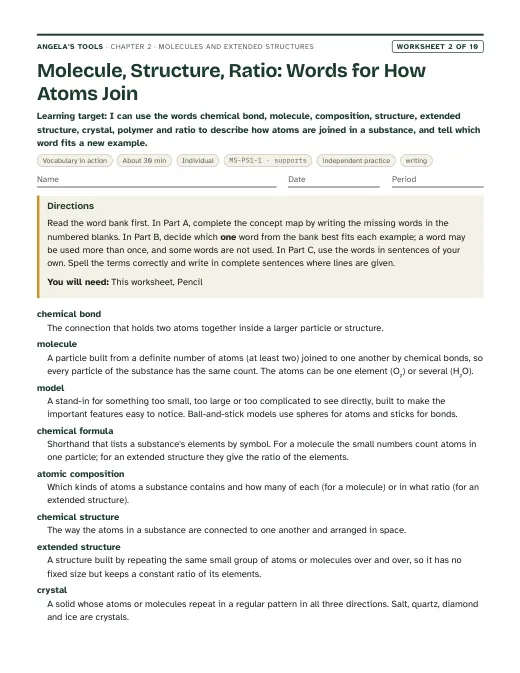
First page of Molecule, Structure, Ratio: Words for How Atoms Join
Worksheet 2 · Vocabulary in action

Molecule, Structure, Ratio: Words for How Atoms Join

I can use the words chemical bond, molecule, composition, structure, extended structure, crystal, polymer and ratio to describe how atoms are joined in a substance, and tell which word fits a new example.

30 minindividualBuilds understandingIndependent practiceWriting MS-PS1-1 · supports
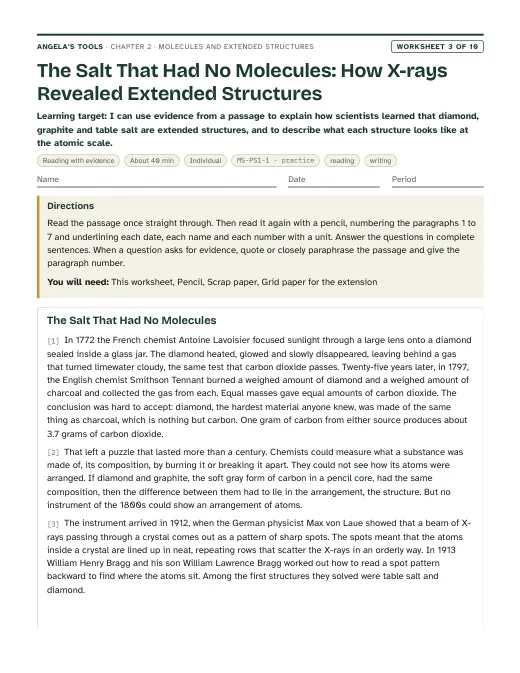
First page of The Salt That Had No Molecules: How X-rays Revealed Extended Structures
Worksheet 3 · Reading with evidence

The Salt That Had No Molecules: How X-rays Revealed Extended Structures

I can use evidence from a passage to explain how scientists learned that diamond, graphite and table salt are extended structures, and to describe what each structure looks like at the atomic scale.

40 minindividualBuilds understandingReadingWriting MS-PS1-1 · practice
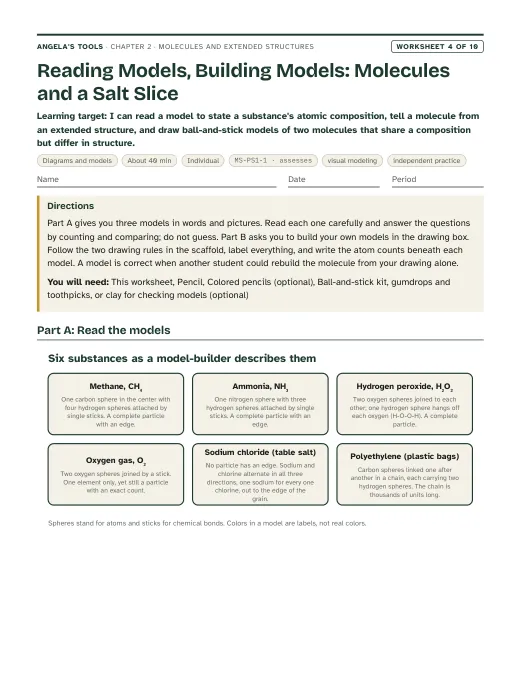
First page of Reading Models, Building Models: Molecules and a Salt Slice
Worksheet 4 · Diagrams and models

Reading Models, Building Models: Molecules and a Salt Slice

I can read a model to state a substance's atomic composition, tell a molecule from an extended structure, and draw ball-and-stick models of two molecules that share a composition but differ in structure.

40 minindividualBuilds understandingVisual modelingIndependent practice MS-PS1-1 · assesses
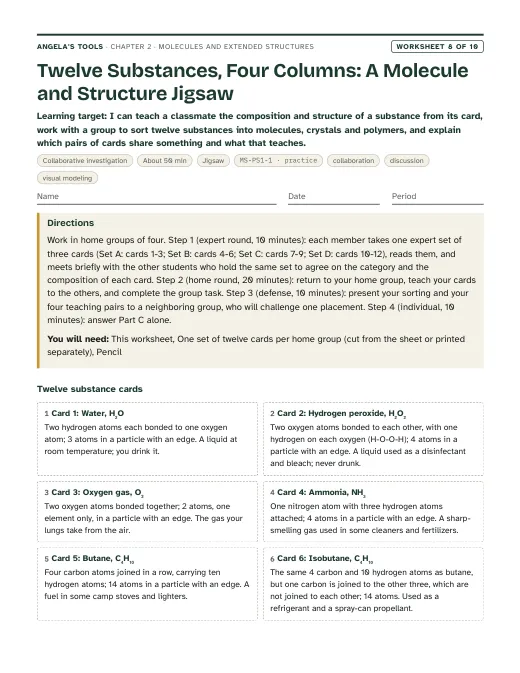
First page of Twelve Substances, Four Columns: A Molecule and Structure Jigsaw
Worksheet 8 · Collaborative investigation

Twelve Substances, Four Columns: A Molecule and Structure Jigsaw

I can teach a classmate the composition and structure of a substance from its card, work with a group to sort twelve substances into molecules, crystals and polymers, and explain which pairs of cards share something and what that teaches.

50 minjigsawPracticeCollaborationDiscussionVisual modeling MS-PS1-1 · practice
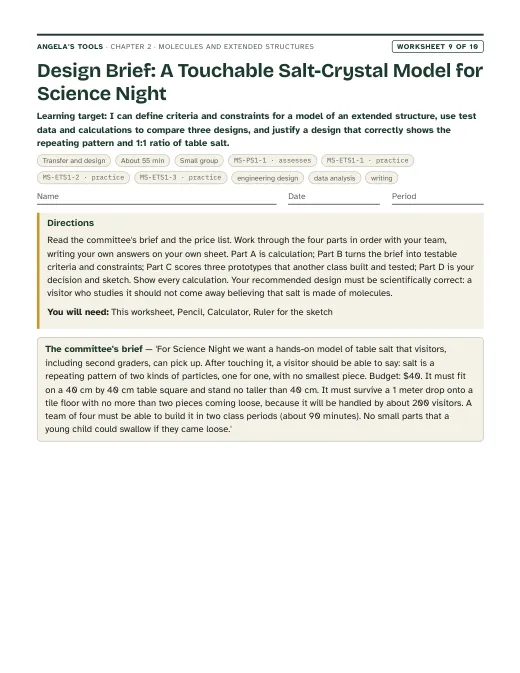
First page of Design Brief: A Touchable Salt-Crystal Model for Science Night
Worksheet 9 · Transfer and design

Design Brief: A Touchable Salt-Crystal Model for Science Night

I can define criteria and constraints for a model of an extended structure, use test data and calculations to compare three designs, and justify a design that correctly shows the repeating pattern and 1:1 ratio of table salt.

55 minsmall groupExtensionEngineering designData analysisWriting MS-PS1-1 · assessesMS-ETS1-1 · practiceMS-ETS1-2 · practiceMS-ETS1-3 · practice
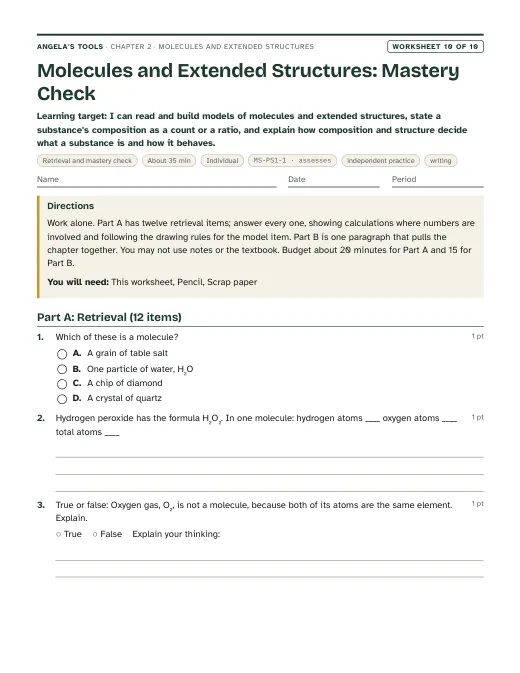
First page of Molecules and Extended Structures: Mastery Check
Worksheet 10 · Retrieval and mastery check

Molecules and Extended Structures: Mastery Check

I can read and build models of molecules and extended structures, state a substance's composition as a count or a ratio, and explain how composition and structure decide what a substance is and how it behaves.

35 minindividualAssessmentIndependent practiceWriting MS-PS1-1 · assesses

Collaborative labs 3 of 3

Three different investigation approaches. Each has a teacher guide (purpose, materials with quantities, estimated cost, prep, safety, procedure, expected observations, debrief, answer key, assessment criteria, accessibility adaptations, low-cost alternative) and a student recording sheet.

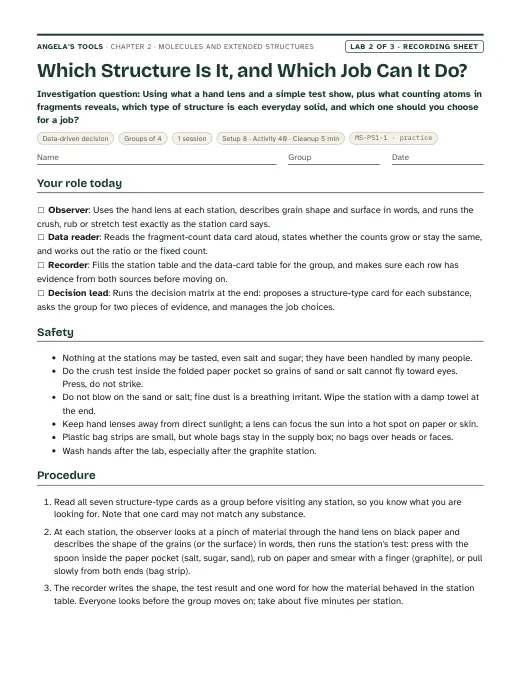
First page of the Which Structure Is It, and Which Job Can It Do? recording sheet
Lab 2 · Data-driven decision

Which Structure Is It, and Which Job Can It Do?

Using what a hand lens and a simple test show, plus what counting atoms in fragments reveals, which type of structure is each everyday solid, and which one should you choose for a job?

Groups of 41 session40 min activityEst. 6 to 10 per classHand lens (5x to 10x)Black construction paper squaresTable salt (coarse kosher salt shows cubes best) MS-PS1-1 · practice
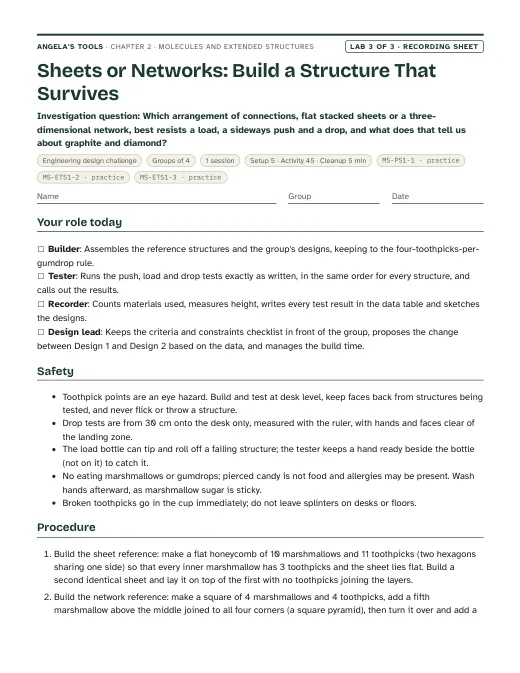
First page of the Sheets or Networks: Build a Structure That Survives recording sheet
Lab 3 · Engineering design challenge

Sheets or Networks: Build a Structure That Survives

Which arrangement of connections, flat stacked sheets or a three-dimensional network, best resists a load, a sideways push and a drop, and what does that tell us about graphite and diamond?

Groups of 41 session45 min activityEst. 8 to 12 per classRound toothpicksMini marshmallows or small gumdropsFull 500 mL water bottle (about 500 g) for the load test MS-PS1-1 · practiceMS-ETS1-2 · practiceMS-ETS1-3 · practice

Teacher guidance

Suggested sequence (7 steps)
  1. Period 1: Presentation slides 1-8 (salt-and-sugar phenomenon with hand lenses, targets, why so many substances, bonds and molecules, reading a ball-and-stick model). W1 phenomenon worksheet as the opener; W2 vocabulary relationships as the exit activity.
  2. Period 2: Lab 1, the gumdrop build (one session): six molecules, the butane/isobutane pair, and a salt block that grows while its ratio stays fixed. Follow with slides 9-13 (composition, structure, the formula-is-not-enough discussion) if time remains, otherwise open Period 3 with them.
  3. Period 3: Slides 9-19 (water vs. hydrogen peroxide, butane vs. isobutane, molecules stop but extended structures keep going, the salt lattice, quartz ratio check, crystals, polymers). W3 reading passage in class or for homework; W4 diagram worksheet to draw and label models.
  4. Period 4: Lab 2, the structure-and-job decision stations (one session): hand-lens observations of salt, sugar, graphite, a polyethylene bag and quartz sand plus fragment-count data cards. W5 data worksheet follows, using the same count-versus-ratio logic.
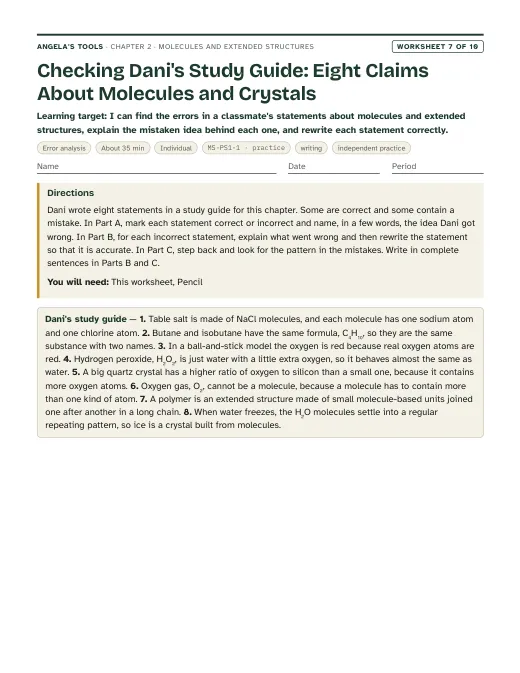
  5. Period 5: Slides 20-24 (California salt ponds and Sierra snow, diamond vs. graphite discussion and compare diagram, the fragment-count evidence task, the snowflake check). W7 misconception repair and W8 collaborative evidence sort.
  6. Period 6: Lab 3, the sheets-versus-networks engineering challenge (one session): two reference builds, a design brief with load, push and drop criteria, one revision. W9 transfer task can replace the lab when materials or time are short.
  7. Period 7: Slides 25-27 (the NaCl-molecule misconception, synthesis, exit ticket). W6 CER on why graphite writes and diamond cuts as the written assessment, then W10 mastery as the quiz.

Materials overview: No chemicals, flames or glassware anywhere in the chapter. Lab 1 and Lab 3 use gumdrops or mini marshmallows (or foam balls) and toothpicks. Lab 2 uses hand lenses, table salt, granulated sugar, pencils, a polyethylene grocery bag, clean sand, dark paper and printed data cards. The phenomenon needs only hand lenses, salt, sugar and dark paper. Keep a no-tasting rule for all food items and offer non-food substitutes for allergies.

Common misconceptions (5)
“Table salt is made of NaCl molecules, each with one sodium and one chlorine.”
Why it happens: Every formula students have met so far (H₂O, CO₂) named a molecule, so NaCl looks like one more molecule name.
Correction: Solid salt has no separate two-particle units. Each sodium particle touches six chlorine particles and each chlorine touches six sodiums in a pattern that repeats in every direction. NaCl states the 1:1 ratio, not a molecule.
“If two substances have the same formula, they are the same substance.”
Why it happens: The formula is the only identifier students have used, and it works for every molecule they have met until now.
Correction: A formula gives composition, not structure. Butane and isobutane are both C₄H₁₀ but their carbon atoms are connected differently, so they are different substances with different properties. Identity needs composition and structure.
“A formula like H₂O shows the atoms lined up in the order written: hydrogen, hydrogen, oxygen.”
Why it happens: Students read a formula left to right like a word and assume the letters show the arrangement.
Correction: A formula counts atoms; it does not show which atom is bonded to which. In water both hydrogens are bonded to the oxygen in a bent shape. Only a model or structural drawing shows the connections.
“The colors in a molecule model are the real colors of the atoms.”
Why it happens: Models use the same colors so consistently (white hydrogen, red oxygen) that the colors feel like facts about the atoms.
Correction: Single atoms are far smaller than the wavelengths of visible light and have no color of their own. The colors are a shared labeling convention; many references draw carbon gray rather than black.
“Bigger crystals have a different formula, or a higher ratio, than small ones.”
Why it happens: Students confuse total count with ratio: more atoms feels like it should mean a bigger number in the formula.
Correction: An extended structure of any size has the same ratio because it repeats the same subunit. A quartz grain with 100 silicon atoms has 200 oxygens; one with 10,000 silicons has 20,000 oxygens; both are SiO₂.
Differentiation suggestions (6)
  • Multilingual learners: Pre-teach molecule, bond, formula, ratio and repeat with a picture-and-gesture card set (fist-to-fist for bond, open-and-close hands for repeat). Post the color key with element names in students' home languages beside English. Pair students during Lab 1 so the builder narrates each bond aloud.
  • Students who need more support: Give a partly completed build record in Lab 1 (water and oxygen rows filled), a formula frame ('one molecule has ___ C, ___ H, ___ O, so the formula is ___'), and a two-column sort card (fixed count / fixed ratio) to tape into the notebook. Limit the salt block to two sizes.
  • Students ready for extension: Ask them to explain why solid salt has no molecules while sugar crystals do, to find the ratio in a polymer such as polyethylene from a repeat unit, to compare the atom counts of caffeine and vitamin C, or to research why diamond tools wear quickly on steel.
  • Students who need movement or alternative output: Run the salt lattice as a human model: students in two colors of shirts stand in a checkerboard and link elbows only with neighbors of the other color; add rows to show the ratio staying 1:1. Accept a photographed gumdrop model with voice-recorded labels instead of a drawing.
  • Students with food allergies or sensory issues: Use foam craft balls, modeling clay or colored beads instead of candy in Labs 1 and 3; store candy in sealed bags and keep a no-eating rule for everyone so no student is singled out.
  • Students with low vision: Use large foam balls with high-contrast colors and raised texture tape on one element; provide tactile lattice cards with raised dots in two heights; allow a partner to read the fragment-count cards aloud in Lab 2 while the student makes the decision.
Accuracy notes: where the textbook simplifies (18)
  • Natural element count: the lesson says 92 elements occur in nature (p. 22). Trace plutonium in uranium ore makes the count 94 by some conventions, and two lighter elements occur only as fleeting traces. Teach 'fewer than a hundred' and never assess an exact number.
  • Quartz ratio: the Figure 3A caption (p. 26) says quartz has one oxygen atom to one silicon atom. That is a printing error; the page's own text correctly gives silicon to oxygen as 1:2 (silicon dioxide, SiO₂). Every resource here uses 1:2.
  • Hydrogen peroxide on cuts (p. 24): current first-aid guidance (for example MedlinePlus) is to wash a minor cut with mild soap and water; hydrogen peroxide damages healthy cells and slows healing. Say only that hydrogen peroxide is a different substance from water, sold as a disinfectant, and never something to drink.
  • Isobutane's shape: the book calls it 'triangle-like' and 'pyramid-like' (p. 25). Isobutane is branched: one central carbon bonded to three other carbons, which are not bonded to one another. Describe it as a branch, never a triangle.
  • 'Line-angle formula' (p. 23): a flat drawing that shows every atom by symbol with lines for bonds is a structural formula. Real line-angle (skeletal) drawings leave out carbon symbols and most hydrogens. Use 'structural formula' or 'flat drawing'.
  • Model colors (p. 23): white hydrogen and red oxygen are a widely shared convention (the CPK scheme), but shades vary and carbon is often drawn gray rather than black. Always post a color key and label atoms by symbol in drawings; colors are labels, not properties of atoms.
  • Multiple sticks (p. 23): two or three sticks between the same two atoms mark a double or triple bond, which is stronger than a single bond between those atoms, but stick count is not a general strength scale across different molecules, and dotted lines usually mark weak attractions between molecules, not weak bonds. Resources here use single sticks except for O₂ (double) and CO₂ (two doubles), which are named as double bonds and not assessed.
  • Polymers (pp. 27-28): chemists usually treat one polymer chain as a single very large molecule, and polyester's repeat unit comes from two different starting molecules joined by ester links (PET is made from ethylene glycol and terephthalic acid). Proteins and DNA are polymers but mix several kinds of units in a set order, so they do not have one simple repeating ratio. Keep the lesson's picture (polymer = chain of repeating units) with polyethylene, PET and PVC as examples, and say proteins and DNA are chains of mixed units.
  • Salt particles (pp. 26, 28): the book calls them sodium and chlorine atoms. In solid salt they carry electric charges (sodium ions and chloride ions), which is why salt forms no molecules and melts at about 801 °C. The MS-PS1-1 assessment boundary leaves the ionic nature of subunits out, so say 'sodium and chlorine particles' or 'atoms' with students and keep ions as an answer for the curious.
  • Salt's repeating cube (p. 26): the book draws a cube of four sodium and four chlorine particles. In the real lattice each sodium particle has six chlorine neighbors and each chlorine six sodium neighbors; the eight-particle cube is the smallest block that shows the alternation. The ratio is 1:1 either way.
  • Cholesterol (p. 28): its atom counts (27 C, 46 H, 1 O, which is 74 atoms) are correct, but its core is four fused rings, three six-membered and one five-membered, plus a side chain, not simply 'six-sided rings and long chains.' Use only the atom counts.
  • Snowflakes and salt grains (p. 29): ice's hexagonal structure gives snow crystals six-fold symmetry, but many snow crystals grow as columns, needles or irregular fragments, and salt grains can be chipped or grow as hollow 'hopper' cubes. Say 'tend to' rather than 'always'.
  • Diamond's bonding (pp. 26, 29): each carbon atom in diamond is bonded to four neighbors, so bonding is strong in every direction; 'cubic' describes the crystal as a whole, not each bond. Graphite's sheets are held to each other only by weak attractions, which is why they slide.
  • Diamond cutting steel (p. 29): diamond is hard enough, but at cutting temperatures its carbon reacts with iron, so diamond tools wear quickly on steel; industry uses cubic boron nitride for steel and diamond for stone, glass, concrete and non-iron metals. Say 'hard enough to tip saws and drills for stone and glass'.
  • Hydrogen in air (p. 22): dry air is about 78 percent nitrogen and 21 percent oxygen; hydrogen gas is only about half a part per million. Do not list hydrogen as a gas in the air we breathe.
  • Vitamin C (p. 21): a vitamin C molecule (C₆H₈O₆) has 20 atoms and is small, but it is not 'one of the smaller molecules in the world'; oxygen gas has two atoms and water three. The 'millions of times smaller than a period' comparison is loose; avoid both claims.
  • Molecule sizes named in the lesson are correct: ammonia NH₃ (4 atoms), methanol CH₃OH (6 atoms), caffeine C₈H₁₀N₄O₂ (24 atoms), sucrose and maltose C₁₂H₂₂O₁₁ (45 atoms each), butane and isobutane C₄H₁₀ (14 atoms each).
  • Water's shape: the two bonds in H₂O meet at about 104.5 degrees, so the molecule is bent, not straight. Carbon dioxide (O=C=O) is straight, methane is a three-dimensional tetrahedron, and ammonia is a shallow pyramid. Gumdrop models can show bent versus straight even if the angles are rough.

Review status: reviewed · 2026-10-18 · Re-solved every numeric and multiple-choice item in W1-W10 and Labs 1-3 (84 keyed items); all keys agreed except W5 q5, whose prompt wrongly said only fragments A and C deviate from 2.00 (D does too); prompt and key fixed. Presentation slide 15 grid had no items and would render empty; added the 16 Na/Cl cells. W4 grid switched from categories to items. Slide 18 flow nodes rewritten as repeat units. chapter.json evidenceOfLearning, Period 7 sequence and three slide links described W6 as a fragment-count CER; W6 is the graphite/diamond CER. All references corrected. Added MS-ETS1-1 and MS-ETS1-3 (practice) to chapter standards to match W9 and Lab 3; ETS1-2 note now names W9. W9 key: a bag of loose 2 cm bricks is a small-parts hazard for second graders; q6, q8 and teacher notes now say Design 2 passes only with that fixed. Lab 1: red gumdrops raised 6 to 8 and methane added to the mid-lab take-apart step so the group has enough red and white pieces for every build. Lab 3: network reference changed from a stacked double pyramid (six toothpicks in one node, point top) to an octahedron (six marshmallows, every node exactly four toothpicks, flat triangular top for the bottle). Originality: molecule definition (chapter, W2, W7, W10 keys) and five other 6-word echoes of the lesson text rewritten; W3 passage trimmed from 722 to under 700 words. Science checked against the prior reviewed notes (L02 reviewFlags RF1-RF16), OpenStax Chemistry 2e and PubChem formulas. Labs have not been physically tested; see each lab's modelLimitations.

Source references

Verified against the student edition of Bring Science Alive! 7th Grade Integrated (Student Edition). Printed page numbers appear in the book; PDF pages are the physical pages of the 524-page scan (printed + 36). The textbook is not reproduced on this site.

SectionPrinted pagesPDF pagesUsed for
Introduction: the vitamin C model and the lesson question20, 2156, 57Lesson question, the 20-atom vitamin C example, vocabulary list and the publisher's NGSS box.
1. Molecules and Chemical Bonds: few elements, many substances; the water molecule; how scientists model molecules22, 2358, 59Bonds and molecules, the water model, ball-and-stick conventions and the color key used in Lab 1 and the model-reading slides.
2. Composition and Structure of Molecules: water vs. hydrogen peroxide; butane vs. isobutane; sucrose vs. maltose24, 2560, 61Composition and structure definitions, the same-formula-different-substance idea, slides 9-13, the W7 misconception and Lab 1's butane/isobutane build.
3. Crystals and Polymers: diamond, salt, quartz, sugar and ice crystals; polyester, PET and PVC; extended structures and ratios26, 2762, 63The ratio idea, the salt lattice, crystal types, polymers, the Lab 1 salt block and Lab 2 structure cards.
Key Science Concept: Modeling Molecules and Extended Structures2864The molecule/extended-structure contrast and the atom counts for oxygen gas, butane and cholesterol used in slides and keys.
4. Patterns You Can See: graphite vs. diamond, snow crystals, salt grains; lesson summary2965The structure-explains-pattern idea behind the phenomenon, Lab 2 observations, Lab 3 and the connection slide.

External references used for accuracy checks

Related chapters