Chapter 03 · Unit 1: The Composition of Matter · Segment 1

Substances and Their Properties

How can you tell one substance from another when they look the same, and which measurements can be trusted to do it?

MS-PS1-2 · practiceMS-PS1-1 · supportsMS-ETS1-2 · practiceMS-ETS1-3 · practice Textbook pp. 30–39 1 presentation · 10 worksheets · 3 labs

Overview

Students figure out how to tell one substance from another when looks are not enough. They separate properties that describe one particular object (mass, volume, shape) from properties that belong to the substance itself (density, melting point, boiling point, solubility, flammability), and they learn that a single test rarely settles an identity, so scientists combine several tests and compare the results with a table of known substances. Along the way they see that most everyday materials, from air to a gold coin, are mixtures of pure substances. This property toolkit is exactly the evidence students will use in Lesson 12 to decide whether a chemical reaction has produced new substances.

Estimated class time: presentation about 134 minutes · worksheets about 380 minutes in total · labs 4 sessions. Six 50-minute periods: one for the phenomenon, substances and mixtures; one for object properties versus substance properties and density; one for Lab 1 (identify the liquids); one for melting point, solubility and flammability with the identification task; one for Lab 2 (choose a material) with Lab 3 data collected at home in between; one for the Lab 3 pooling session, synthesis and mastery.

Phenomenon

Four objects, four stopping points

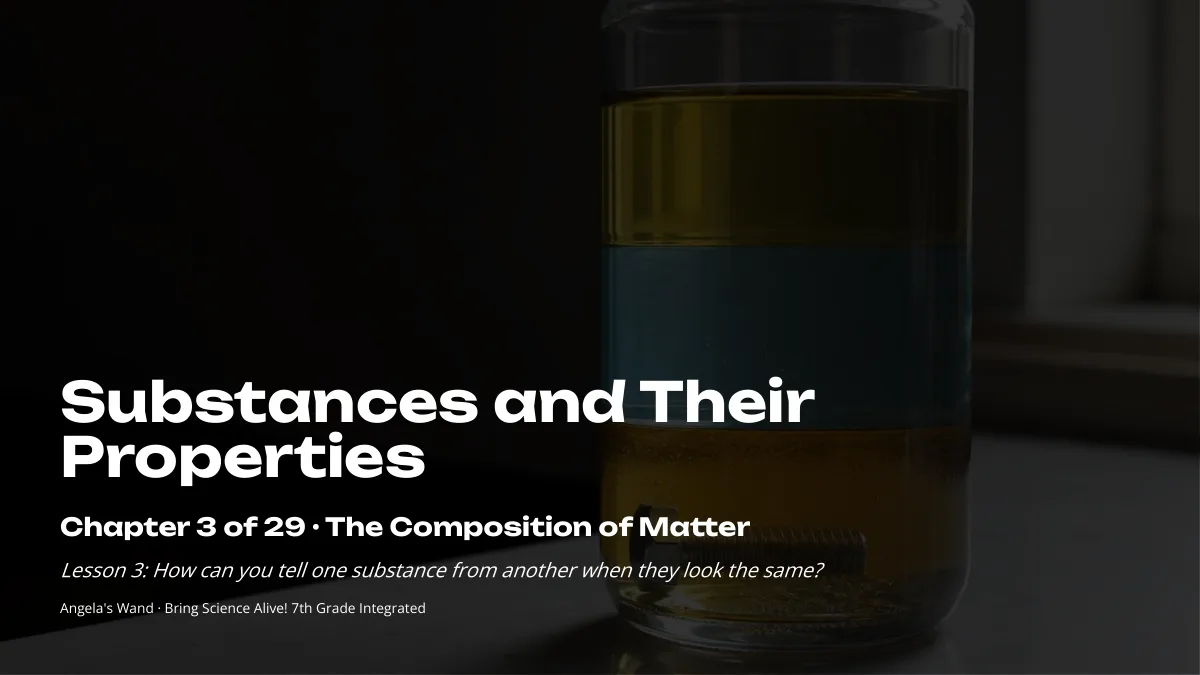
A tall jar holds three clear liquids that refuse to blend: corn syrup on the bottom, blue-tinted water in the middle and vegetable oil on top. A steel bolt, a grape, a shaving from a milk-jug cap and a cork are dropped in one at a time. The bolt sinks to the bottom. The grape stops on the syrup. The cap shaving sinks through the oil but floats on the water. The cork never gets below the oil. Nothing is touching the objects or holding them up, yet each one stops at a different place. What property of each liquid and each object decides where it stops, and why do the liquids stay in layers at all?

Notice and wonder prompts

  • Which liquid is on the bottom and which is on top? What would happen if you poured them in the opposite order?
  • The grape stops on the syrup but the bolt goes through it. What is different about the grape and the bolt that could explain that?
  • If you shook the jar hard, which layers would mix and which would separate again?
  • Could you predict where a new object, say a paper clip or an ice cube, would stop before you dropped it in?

Learning targets

  • I can explain what a substance is, give examples that include invisible gases, and tell a pure substance from a mixture.
  • I can sort properties into those that describe one object (mass, volume, shape) and those that identify a substance (density, melting point, boiling point, solubility, flammability).
  • I can calculate density from mass and volume, compare samples fairly, and use density to rule a substance in or out.
  • I can explain what melting point, boiling point, solubility and flammability each depend on, and which tests change the substance into something new.
  • I can combine several test results with a reference table to identify an unknown, and use property data to choose a material for a design need.

What shows the learning happened

  • A completed Lab 1 recording sheet that identifies four unknown liquids using density plus a second property, with every identification justified by two measurements.
  • A density calculation (W5, Lab 2 or the slide task) that shows mass ÷ volume with units and uses the result to rule a substance in or out against a reference table.
  • A property sort (W2, W4) that places mass, volume and shape on the 'describes one object' side and density, melting point, boiling point, solubility and flammability on the 'identifies the substance' side, with a sentence explaining the difference.
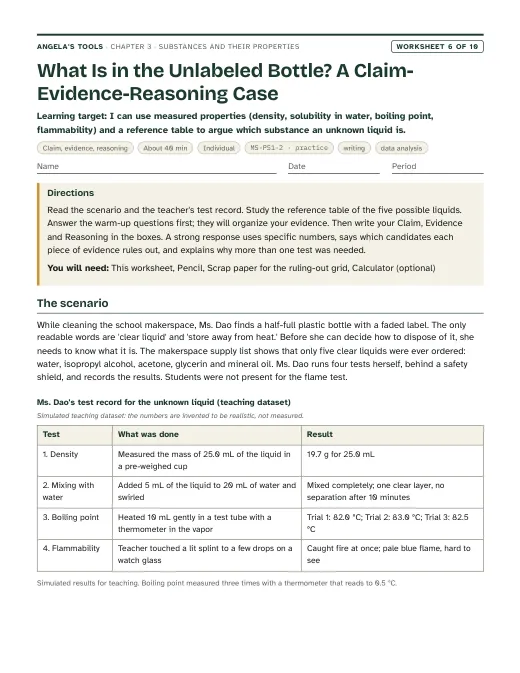
  • A Claim-Evidence-Reasoning paragraph (W6) arguing which of two lookalike samples is which, citing at least two properties and explaining why one property alone was not enough.
  • A Lab 2 decision matrix that screens candidates on must-pass criteria before scoring, plus a written recommendation that names the trade-off the chosen material still has.
  • A class identification key (Lab 3) built from pooled solubility and vinegar-test data, and a correct identification of the teacher's unknown powder using that key.

Key vocabulary 12 terms

substanceA kind of matter with one fixed makeup throughout, such as water, oxygen gas or pure copper. Every pure sample of a substance shares the same identifying properties.A chemist calls table salt a substance because every grain, from any shaker in the world, has the same makeup and the same properties.
macroscopicAt the everyday scale of things you can see, hold or measure directly, which means trillions upon trillions of atoms or molecules acting together.Density is a macroscopic property: it belongs to a whole sample, not to a single atom.
propertyA trait of matter that can be observed or measured, such as color, mass, density or melting point.Before naming the gray metal, the technician listed every property she could measure without destroying the sample.
massHow much matter an object or sample contains, measured in kilograms or, for small samples, in grams. Mass depends on how big the sample is.The silver necklace and the silver earring differ in mass, so mass alone cannot tell you what either is made of.
volumeHow much space an object or sample takes up, often measured in cubic centimeters (cm³) or milliliters (mL); 1 mL equals 1 cm³.She found the volume of the bolt by reading how far the water level rose when she lowered it into the cylinder.
densityHow much mass is packed into each unit of volume: density = mass ÷ volume, usually in g/cm³. Every pure sample of a substance has the same density at the same temperature.Both blocks had a density of 2.7 g/cm³, so both were almost certainly aluminum, even though one block was four times the size of the other.
melting pointThe temperature at which a solid turns into a liquid. A large sample takes longer to melt than a small one, but both melt at the same temperature.The lab recorded the melting point as the temperature on the thermometer at the moment the first liquid appeared.
boiling pointThe temperature at which a liquid boils into a gas. Tables list it at normal sea-level air pressure, because lower air pressure lowers the boiling point.At a camp near Lake Tahoe the water boiled at about 94 °C, so the campers compared it with the sea-level boiling point before deciding whether their water was pure.
solubilityThe amount of a substance that can spread out, particle by particle, into a particular liquid until the mixture looks like one clear liquid. Solubility always names a pair: the substance that dissolves and the liquid it dissolves in.Sugar has a high solubility in water but almost none in cooking oil, so the same spoonful behaves differently in the two liquids.
flammabilityWhether, and how easily, a substance burns. Burning turns the substance into new substances, so flammability is a chemical property and the test uses up the sample.Because magnesium's flammability is so high, the wire burned with a white flame before it ever reached its melting point.
mixtureTwo or more substances mingled together without becoming one new substance. Each part keeps its own properties and can, in principle, be separated out again.Seawater is a mixture: let the water evaporate and the dissolved salt is left behind, unchanged.
alloyA mixture of a metal with other metals or elements, made to give useful properties such as hardness. Steel, brass and the gold used in coins are alloys.The jeweler explained that a 14-karat ring is an alloy, a bit more than half gold mixed with copper and silver to make it hard enough to wear.


Standards alignment

California NGSS, Grade 7 Preferred Integrated Course Model. Each entry says whether this chapter's work assesses the performance expectation, gives practice toward it, or supports it as background; the resource lists below repeat this for every worksheet and lab.

MS-PS1-2Practice toward: the property-analysis half: density, melting point, boiling point, solubility and flammability as data that identify a substanceCA Grade 7

Analyze and interpret data on the properties of substances before and after the substances interact to determine if a chemical reaction has occurred.

The PE asks students to compare properties before and after substances interact to decide whether a reaction happened. This lesson builds the property toolkit the PE names in its assessment boundary and has students analyze and interpret property data to identify unknowns; the before-and-after comparison itself is the work of Lesson 12, so the role here is practice. Lab 3's vinegar test and the flammability slides give a first look at the before-and-after idea.

Assessment boundary: Assessment is limited to analysis of the following properties: density, melting point, boiling point, solubility, flammability, and odor.

MS-PS1-1Supports: the link from molecules and extended structures to macroscopic samplesCA Grade 7

Develop models to describe the atomic composition of simple molecules and extended structures.

The lesson opens by presenting a substance as a visible-scale quantity of one kind of molecule or extended structure, which connects the models students built in Lesson 2 to the samples they can hold and measure here. No new molecule models are developed, so this is background support.

Assessment boundary: Assessment does not include valence electrons and bonding energy, discussing the ionic nature of subunits of complex structures, or a complete description of all individual atoms in a complex molecule or extended structure is not required.

MS-ETS1-2Practice toward: using a systematic process (screen on must-pass criteria, then score) to compare candidate materialsCA Grade 6-8

Evaluate competing design solutions using a systematic process to determine how well they meet the criteria and constraints of the problem.

The textbook lesson has no engineering spread; this connection comes from Lab 2 and Worksheet 9, where students evaluate seven candidate materials for a product against stated criteria and constraints using the property data this lesson teaches. It is practice because the problem and its criteria are supplied rather than defined by students.

MS-ETS1-3Practice toward: combining the best characteristics of competing designs into a new oneCA Grade 6-8

Analyze data from tests to determine similarities and differences among several design solutions to identify the best characteristics of each that can be combined into a new solution to better meet the criteria for success.

In Lab 2 students sketch a two-material spoon that pairs a metal bowl with a plastic handle, and in Worksheet 9 they keep a feature from a weaker tank design when building their own line. Both are small, guided versions of the PE's combine-the-best-features idea, so the role is practice; no test data from student-built designs is analyzed.

Science and engineering practices

  • Analyzing and Interpreting Data. Students compute densities from their own mass and volume measurements (Lab 1, Lab 2), pool class solubility data into one table (Lab 3), and match measured values to reference tables to identify unknown liquids, metals and powders (slides, W5, W10).
  • Planning and Carrying Out Investigations. Students decide which tests to run on an unknown, in what order, and which tests would destroy the sample (Lab 1, the discuss slides), and they follow a fixed protocol so that solubility results from different homes can be compared (Lab 3).
  • Engaging in Argument from Evidence. Students must justify an identification with at least two independent properties (Lab 1, W6 CER) and defend a material choice against competing candidates (Lab 2, W9).

Disciplinary core ideas

  • PS1.A Structure and Properties of Matter. Each pure substance has characteristic physical and chemical properties that can be used to identify it; substances are macroscopic amounts of molecules or extended structures; most everyday materials are mixtures.
  • PS1.B Chemical Reactions. Flammability and the vinegar fizz test show that some properties are only revealed when a substance changes into new substances, which previews the before-and-after reasoning of Lesson 12.
  • ETS1.B Developing Possible Solutions. In Lab 2 students compare candidate materials systematically against criteria and constraints, and may combine the best features of two materials into a better design.

Crosscutting concepts

  • Patterns. Every sample of a pure substance shares the same density, melting point and solubility; students use that repeating pattern to identify unknowns and to recognize when two samples are the same substance.
  • Scale, Proportion, and Quantity. Density is a ratio that stays fixed when a sample is cut or combined; students reason about why mass and volume change with sample size while the ratio does not, and about the jump from invisible molecules to a macroscopic sample.
  • Structure and Function. In Lab 2 and W9 the properties of a material decide what it can be used for, from a spoon that must not soften in hot wax to a coin that must not dent.

Presentation 28 slides

Substances and Their Properties: telling one substance from another. Original, editable slides with speaker notes: a phenomenon opener, learning targets, the chapter's concepts with diagrams, vocabulary in context, 3 checks for understanding, 2 discussion prompts, an application task, a misconception check, a synthesis and an exit ticket.

Worksheets 10 of 10

Ten different tasks, one per instructional blueprint. Each has a student PDF (low ink, US Letter), an editable DOCX, an HTML preview, and a separate teacher answer key with reasoning.

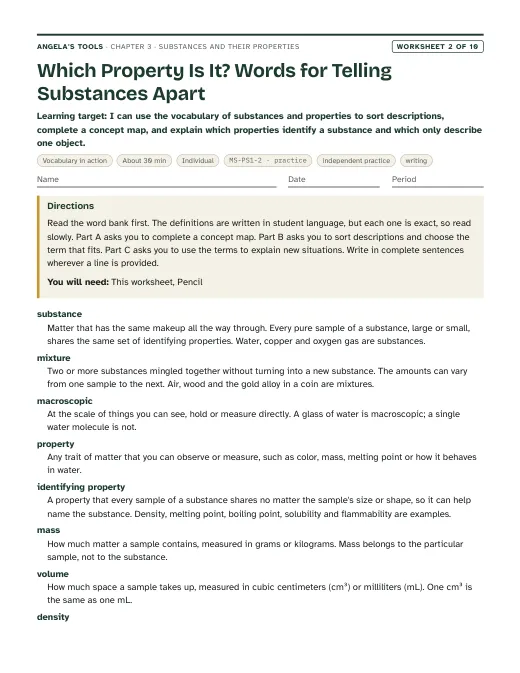
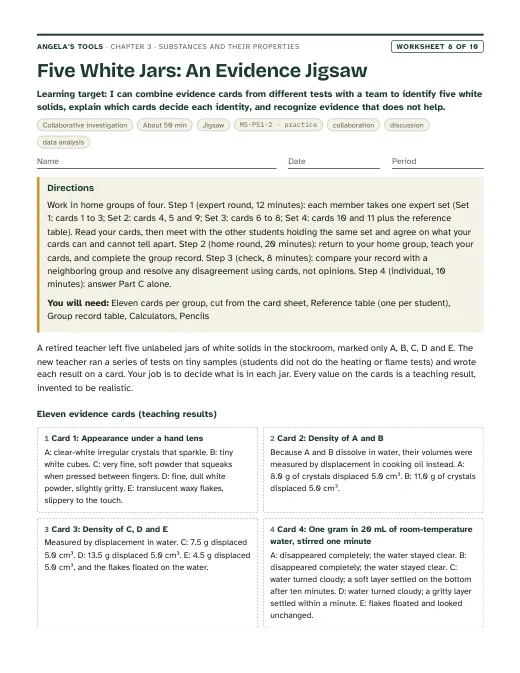
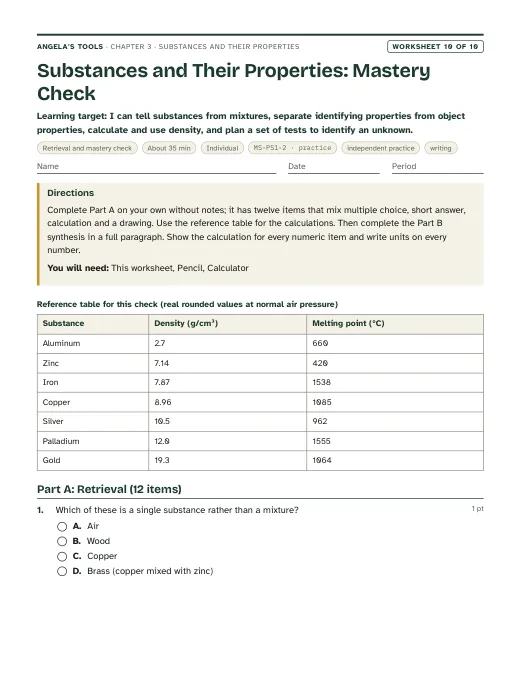
First page of Which Property Is It? Words for Telling Substances Apart
Worksheet 2 · Vocabulary in action

Which Property Is It? Words for Telling Substances Apart

I can use the vocabulary of substances and properties to sort descriptions, complete a concept map, and explain which properties identify a substance and which only describe one object.

30 minindividualBuilds understandingIndependent practiceWriting MS-PS1-2 · practice
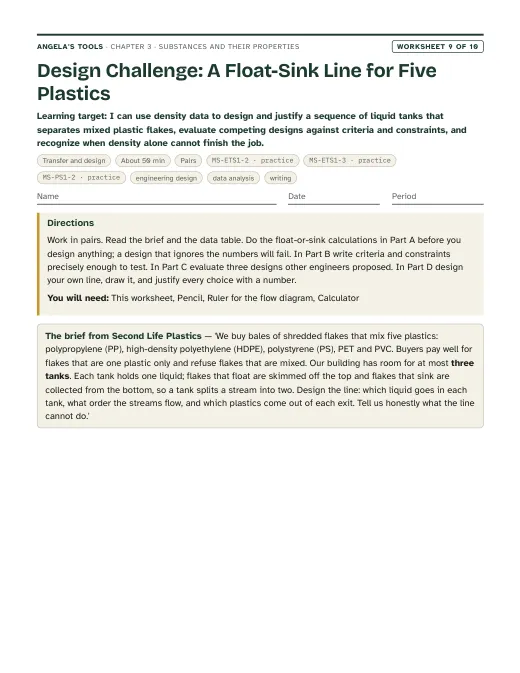
First page of Design Challenge: A Float-Sink Line for Five Plastics
Worksheet 9 · Transfer and design

Design Challenge: A Float-Sink Line for Five Plastics

I can use density data to design and justify a sequence of liquid tanks that separates mixed plastic flakes, evaluate competing designs against criteria and constraints, and recognize when density alone cannot finish the job.

50 minpairsExtensionEngineering designData analysisWriting MS-ETS1-2 · practiceMS-ETS1-3 · practiceMS-PS1-2 · practice

Collaborative labs 3 of 3

Three different investigation approaches. Each has a teacher guide (purpose, materials with quantities, estimated cost, prep, safety, procedure, expected observations, debrief, answer key, assessment criteria, accessibility adaptations, low-cost alternative) and a student recording sheet.

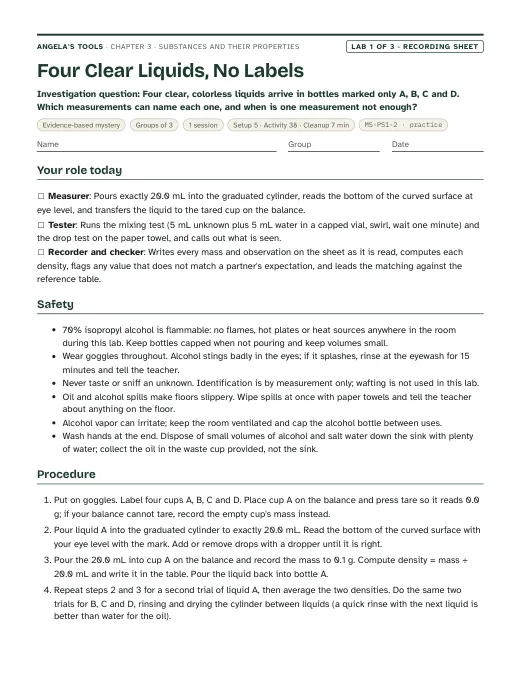
First page of the Four Clear Liquids, No Labels recording sheet
Lab 1 · Evidence-based mystery

Four Clear Liquids, No Labels

Four clear, colorless liquids arrive in bottles marked only A, B, C and D. Which measurements can name each one, and when is one measurement not enough?

Groups of 31 session38 min activityEst. 8 to 12 per classUnknown liquids A-D in capped, labeled bottles or cups, about 60 mL eachGraduated cylinder, 25 mL or 50 mLDigital balance reading to 0.1 g MS-PS1-2 · practice
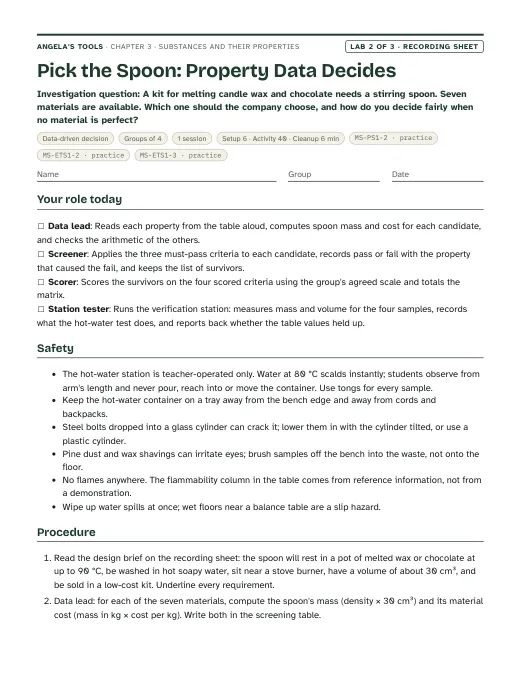
First page of the Pick the Spoon: Property Data Decides recording sheet
Lab 2 · Data-driven decision

Pick the Spoon: Property Data Decides

A kit for melting candle wax and chocolate needs a stirring spoon. Seven materials are available. Which one should the company choose, and how do you decide fairly when no material is perfect?

Groups of 41 session40 min activityEst. 6 to 10 per classProperty data table and recording sheetCalculatorSteel bolts or nuts, about 50 g total MS-PS1-2 · practiceMS-ETS1-2 · practiceMS-ETS1-3 · practice
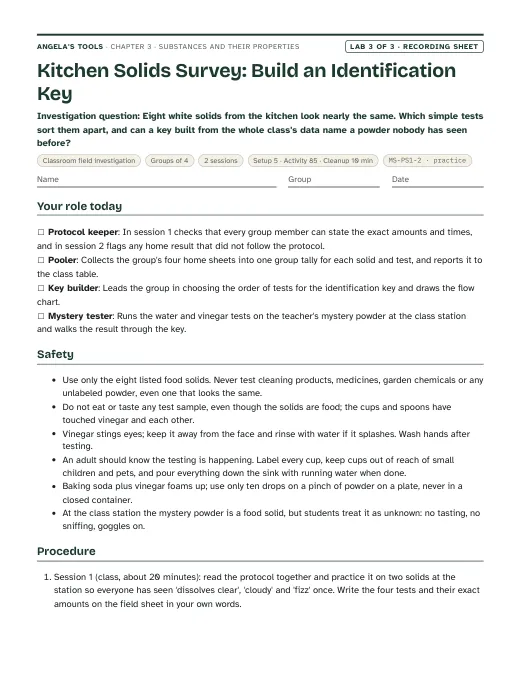
First page of the Kitchen Solids Survey: Build an Identification Key recording sheet
Lab 3 · Classroom field investigation

Kitchen Solids Survey: Build an Identification Key

Eight white solids from the kitchen look nearly the same. Which simple tests sort them apart, and can a key built from the whole class's data name a powder nobody has seen before?

Groups of 42 sessions85 min activityEst. 10 to 15 per classField sheet with the protocol and the data tableHome kit list: table salt, granulated sugar, baking soda, baking powder, flour, cornstarch, Epsom salt, powdered sugarWhite vinegar MS-PS1-2 · practice

Teacher guidance

Suggested sequence (6 steps)
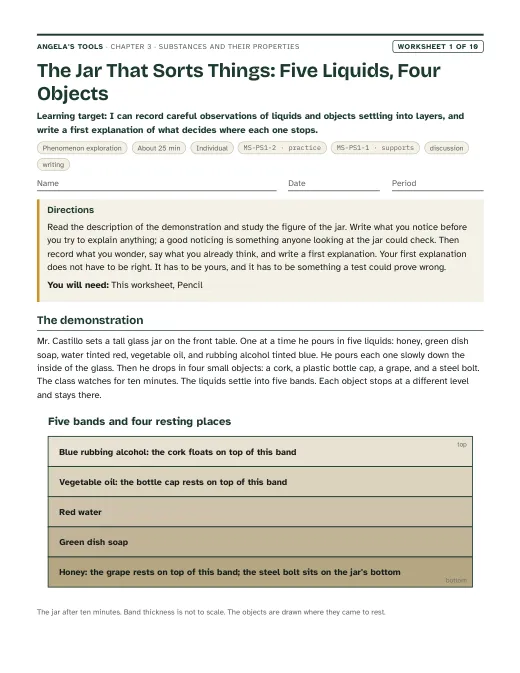
  1. Period 1: Presentation slides 1-7 (layered-jar phenomenon, targets, what a substance is, pure substance versus mixture). W1 phenomenon worksheet as the opener; W2 vocabulary relationships to close.
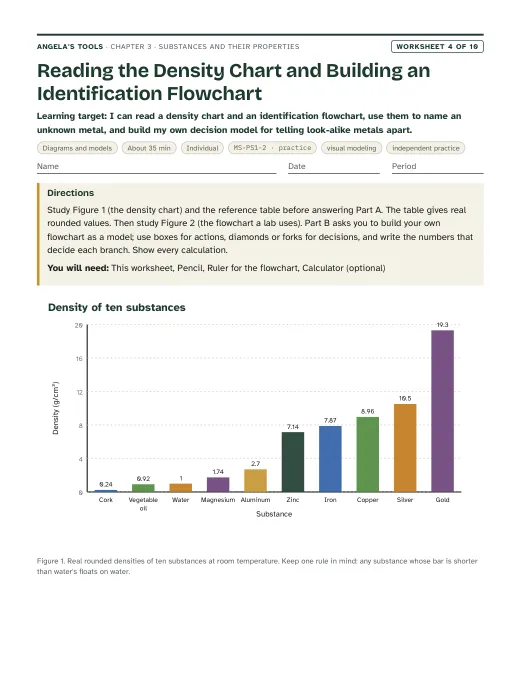
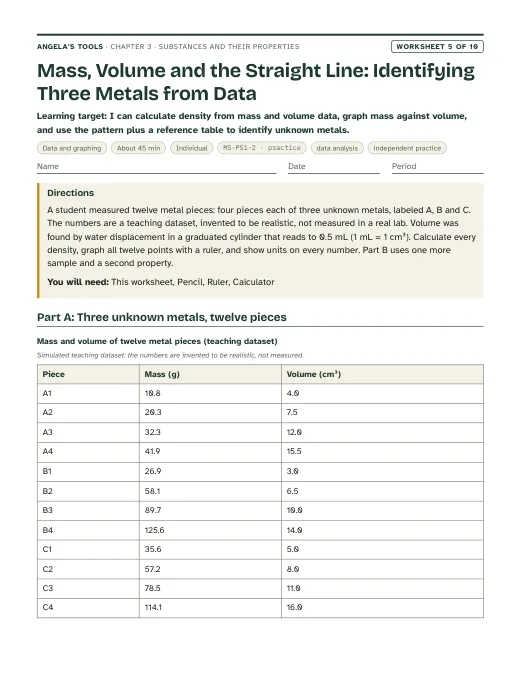
  2. Period 2: Slides 8-13 (object properties versus substance properties, the two gray rings discussion, density, the density bar chart, the density quick check). W4 diagram worksheet on density and equal volumes; W5 data worksheet on density calculations for homework.
  3. Period 3: Lab 1, four unknown liquids (one session). Students measure density, test mixing with water and watch what each drop leaves behind, then match to a reference table. Hand out the Lab 3 field sheet at the end and explain the home protocol.
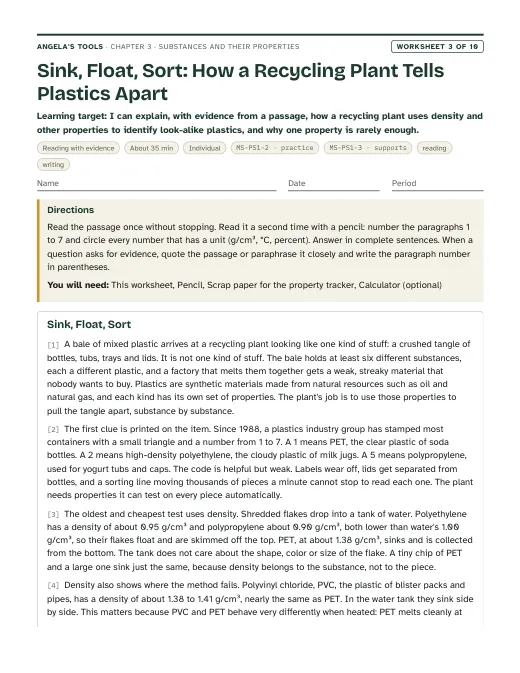
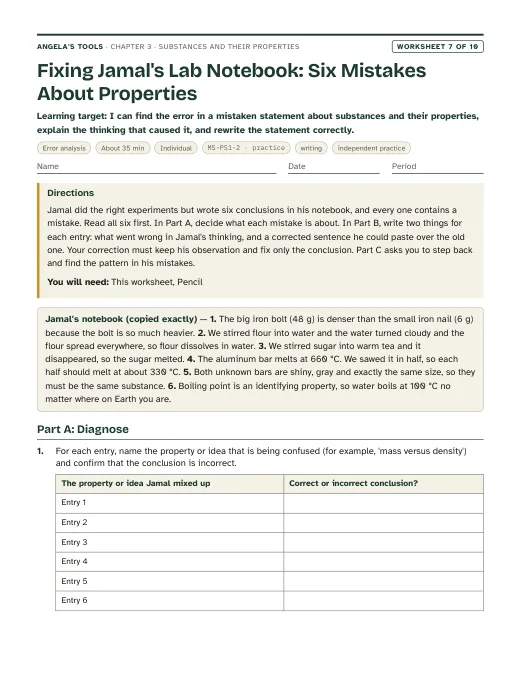
  4. Period 4: Slides 14-23 (melting and boiling point, solubility, the salt-pond connection, flammability, the identification flow and the mystery-metal task). W3 reading passage in class or for homework; W7 misconception repair on 'bigger means denser'.
  5. Period 5: Lab 2, choose the spoon material (one session with the verification station). W9 transfer task can replace the written recommendation if time is short. Students should have finished Lab 3 home data collection by this day.
  6. Period 6: Lab 3 pooling session (build the identification key, identify the unknown powder), then slides 24-28 (destructive tests discussion, mixtures, misconception, synthesis, exit). W8 collaborative evidence sort earlier in the period if Lab 3 pooling is quick; W6 CER as the written assessment and W10 mastery as the quiz, either here or in a seventh period.

Materials overview: No open flames anywhere in the chapter; flammability is taught from descriptions only. Lab 1 uses water, saturated salt water, 70% isopropyl alcohol and vegetable oil in small volumes, a 0.1 g balance, graduated cylinders, cups and paper towels. Lab 2 uses steel bolts, polypropylene bottle caps, a pine block, a candle-wax chunk, a graduated cylinder, a ruler, a balance and, for one teacher-run station, hot water from a kettle. Lab 3 uses food-grade kitchen solids, white vinegar, measuring spoons and cups, done mostly at home with a class pooling session. A three-liquid density jar (corn syrup, tinted water, vegetable oil) with a bolt, a grape, a milk-jug cap shaving and a cork makes the phenomenon a live demonstration.

Common misconceptions (6)
“A bigger or heavier piece of a substance has a higher density, higher melting point or different properties than a small piece.”
Why it happens: Students feel that a heavy object is 'denser' and watch large things take longer to melt, so they fold size into the property.
Correction: Mass and volume grow together when the sample gets bigger, so their ratio, density, stays fixed. A large block of silver takes longer to melt than a small one because it needs more energy, but both begin melting at about 962 °C. Identifying properties belong to the substance, not to the size of the sample.
“When sugar or salt dissolves, it disappears or stops existing.”
Why it happens: The crystals vanish from sight, and everyday speech says the sugar is 'gone'.
Correction: The particles spread out among the water particles and become too small and too separated to see. The mass of the solution equals the mass of the water plus the mass of the solid, the solution tastes of the solid, and evaporating the water brings the solid back unchanged.
“Color and shininess are enough to tell metals apart, and 'heavier' means 'denser'.”
Why it happens: Students have mostly met metals as colors (gold, silver, copper) and compare objects by lifting them.
Correction: Silver, platinum, palladium, aluminum and magnesium are all gray and shiny. To compare substances fairly you must compare equal volumes, which is what density does: a tiny platinum bead is less massive than a silver spoon, yet platinum is twice as dense.
“A metal that 'dissolves' in acid is dissolving the same way sugar dissolves in water.”
Why it happens: The textbook uses the word soluble for both cases, and both make the solid seem to vanish.
Correction: Sugar in water is a physical change: the sugar is still there and can be recovered by evaporation. A metal in acid reacts: bubbles of gas form and the metal becomes new substances that are not the metal any more. The lesson treats solubility as the physical case only.
“Anything called a 'chemical' is dangerous and unnatural, and water, salt and air are not chemicals.”
Why it happens: Advertising and warning labels use 'chemical' to mean 'hazardous additive'.
Correction: A chemical is simply a substance. Water, table salt and the oxygen in air are chemicals; some chemicals are hazardous and most are not. Whether something is safe depends on which substance it is and how much of it there is, not on the word.
“Melting point and boiling point never change for a substance under any conditions.”
Why it happens: The book stresses that these points do not depend on the amount of substance, and students generalize to 'never change at all'.
Correction: They do not depend on the amount, but boiling point does depend on air pressure. Water boils at 100 °C at sea level and at about 94 °C near Lake Tahoe, 1,900 m up. Reference tables give values at sea-level pressure, so compare measurements under the same conditions.
Differentiation suggestions (5)
  • Multilingual learners: Pre-teach substance, property, density, dissolve and mixture with a picture card set that shows the test for each; provide the reference tables with icons (a drop for 'mixes with water', a flame for 'burns'); pair students during Lab 1 so measurements are read aloud and recorded together; accept the Lab 3 home sheet in the home language with the test names in English.
  • Students who need more support: Give the density formula as a triangle card, provide the Lab 1 mass table with the volume column pre-filled at 20.0 mL, supply a sentence frame for identifications ('Liquid A is ___ because its density is ___ and it ___ with water'), and let the Lab 2 matrix start with the must-pass screen already applied to two of the seven candidates as a worked example.
  • Students ready for extension: Ask them to explain why the Lab 1 density of 70% isopropyl alcohol is not the average of alcohol and water densities, to find out why reference boiling points name a pressure, to design a two-material spoon in Lab 2 and estimate its mass, or to research how a jeweler tests gold purity without melting the piece.
  • Students who need movement or alternative output: Run the property sort as a wall-posting activity with cards students carry to the 'describes one object' or 'identifies the substance' side; let the Lab 3 identification key be built physically with string and index cards on the floor; accept a recorded spoken recommendation for Lab 2.
  • Students with low vision or limited fine-motor control: Provide a tactile density model (equal-volume cubes of wood, plastic and steel to hold), large-print reference tables, a digital balance with a large display, and the role of recorder or decision-matrix scorer in labs; a partner can pour while the student reads the balance and calls the values.
Accuracy notes: where the textbook simplifies (12)
  • Key Science Concept, Test 2 (p. 38): the book works out 135 g ÷ 50 cm³ = 2.7 g/cm³ and then says the sample is 'too dense' to be silver. Silver is about 10.5 g/cm³, so the sample is far less dense than silver. The arithmetic and the aluminum conclusion are right; only the direction word is wrong. Say 'much less dense than silver' when you use this example.
  • Metals 'soluble' in acids (pp. 36, 38): a metal that seems to dissolve in acid is reacting and turning into new substances (bubbles of hydrogen gas form); this is not the physical dissolving of sugar in water. This chapter treats solubility as physical dissolving only and never uses acid tests. The vinegar fizz in Lab 3 is deliberately presented as a reaction, not as dissolving.
  • Identifying properties 'never change' (pp. 33, 39): they do not depend on the amount of substance, but boiling point depends on air pressure (water boils near 94 °C at Lake Tahoe's elevation and near 90 °C at 3,100 m), and density changes slightly with temperature. Teach 'under the same conditions' and give reference values at sea-level pressure and room temperature.
  • Odor as an identifier (p. 33): many substances, including the book's own aluminum ingot, have no odor, and smelling unknown substances is not a safe general test. Waft only, and only for known-safe materials; this chapter does not use odor to identify anything.
  • Everyday objects called single substances (pp. 30, 33): building beams are steel, an alloy; window glass has several ingredients; modern U.S. pennies are mostly zinc with a thin copper coating, and the Statue of Liberty's green surface is copper that has reacted with air over decades. Use 'a pure copper statue and a pure copper bead' when you want a same-substance comparison.
  • Burning splint test (p. 37): a flammable gas pops only when it is mixed with enough air (hydrogen pops best at roughly 20 to 40 percent in air), and oxygen, which does not itself burn, makes a glowing splint burst back into flame. Say 'can ignite' rather than 'will always ignite', and do not treat 'puts out the splint' as proof of any one gas.
  • Octane and gasoline (p. 37): gasoline is a mixture of many petroleum liquids, and most U.S. gasoline also contains about 10 percent ethanol. Octane is one of its components; 'octane rating' is a separate measure. Treat gasoline as a flammable mixture, not a substance.
  • Physical versus chemical properties: the lesson never defines the two, though the p. 37 caption calls flammability a chemical property. Teach that density, melting point, boiling point and solubility can be measured while the substance stays the same (physical properties), while flammability shows up only as the substance changes into new substances (chemical property). Magnesium burning in air forms magnesium oxide.
  • 'Billions of trillions' (p. 32): a 250 mL cup of water holds roughly 8 × 10²⁴ molecules, which is trillions of trillions, not billions of trillions. The next sentence of the book has the right scale. Say 'trillions of trillions'.
  • Magnesium melting point: magnesium melts at about 650 °C, but in air it burns before it melts cleanly, as the book's own story on p. 37 shows. If you quote its melting point, add 'measured with the air kept away, for example under argon'.
  • Reference values used in this chapter (rounded from PubChem and the CRC Handbook): densities in g/cm³ of magnesium 1.74, aluminum 2.70, zinc 7.14, iron 7.87, copper 8.96, molybdenum 10.2, silver 10.5, lead 11.3, palladium 12.0, gold 19.3, platinum 21.5; melting points of zinc 420 °C, aluminum 660 °C, magnesium 650 °C, silver 962 °C, gold 1064 °C, copper 1085 °C, palladium 1555 °C, platinum 1768 °C, molybdenum 2623 °C. Liquid densities at room temperature: 70% isopropyl alcohol about 0.88, vegetable oil about 0.92, water 1.00, saturated salt water about 1.20, glycerin 1.26, corn syrup about 1.38. Say 'about' with every value.
  • Density of 'water' in Lab 1: tap water contains dissolved minerals, but far too little to change its density at the 0.1 g level; distilled water is not required.

Review status: reviewed · 2026-10-18 · Re-solved every numeric and multiple-choice item in W1-W10 and Labs 1-3 against the keys; densities, melting points, boiling points and solubilities checked against reference values. Originality: the solubility definition in chapter.json, slide 18 and W2 (term and q14 key) echoed the book's wording and was rewritten; the air-as-mixture bullet on slide 25 was rephrased. Lab 1 q3 asked for 'two' reference liquids within 0.05 g/mL when three qualify (0.85, 0.88, 0.92); question and key corrected. Lab 1 debrief and slide 2 predicted that a drop of alcohol would join the water layer, which is unreliable because 70% alcohol is less dense than the oil; replaced with a food-coloring drop. Lab 2 criterion 2 would have eliminated nylon ('soaks up a little') although the lab treats nylon as a survivor; the criterion now states the threshold. W3's extension duplicated W9's core design task (a two-tank float-sink line); replaced with a black-plastic extension so the two sheets stay distinct. W1 teacher note gave the density of pure isopropyl alcohol (0.79) for store rubbing alcohol; corrected to the 70-91% range. W4 Figure 1 caption, W4 q4 key wording, W4 flowchart node 1 (odor of unknowns), W6 teacher note on the ethanol fifth test, and a garbled misconceptionWatch on the density slide were clarified. Added MS-ETS1-3 (practice) to the chapter standards because Lab 2 and W9 already cite it. Labs remain untested physically; see each lab's modelLimitations.

Source references

Verified against the student edition of Bring Science Alive! 7th Grade Integrated (Student Edition). Printed page numbers appear in the book; PDF pages are the physical pages of the 524-page scan (printed + 36). The textbook is not reproduced on this site.

SectionPrinted pagesPDF pagesUsed for
Introduction: iron and glass, 'chemicals' you drink and eat, the lesson question30, 3166, 67Essential question, the 'chemical means substance' misconception, vocabulary list, the publisher's standards box (MS-PS1-2, PS1.A, PS1.B, Patterns).
1. Substances: macroscopic amounts of molecules, invisible gases as substances3268Substance and macroscopic definitions, the scale correction in accuracyNotes, slides 4-5.
2. Properties: the treasure-box scenario, mass, volume, shape and odor3369The object-properties versus substance-properties distinction (slides 8-9, W2, W4), the copper-statue caution.
3. Density: silver versus platinum, density = mass ÷ volume3470Density definition, the equal-volume comparison, the bar chart of lookalike metals, Lab 1 and Lab 2 density measurements, W5.
4. Melting and Boiling Point: silver versus palladium3571Melting-point slides and the simulated heating-curve diagram, the pressure correction for boiling point.
5. Solubility: sugar versus flour, marker inks, metals in acids3672Solubility as a pair, Lab 1 mixing test, Lab 3 kitchen-solids survey, the acid-dissolving accuracy note.
6. Flammability: magnesium wire, the burning splint, combining tests3773Flammability as a chemical property, the 'several tests' idea on the identification flow slide, splint-test accuracy note.
Key Science Concept: Using Tests to Identify a Substance3874The test-then-compare structure of the identification flow diagram and the mystery-metal task; the 'too dense' correction.
7. Mixtures and Lesson Summary: gold alloys, wood, air3975Mixtures slide, alloy vocabulary, the pure-substance-versus-mixture compare diagram, synthesis.

External references used for accuracy checks

Related chapters