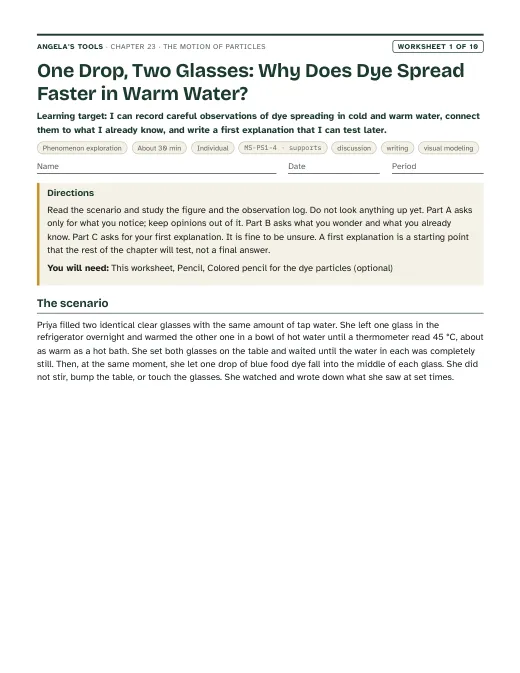
One Drop, Two Glasses: Why Does Dye Spread Faster in Warm Water?
I can record careful observations of dye spreading in cold and warm water, connect them to what I already know, and write a first explanation that I can test later.
Chapter 23 · Unit 8: States of Matter · Segment 3
How does the motion of particles explain what a solid, a liquid and a gas can do, and what happens to that motion when thermal energy is added or removed?
Students figure out that the particles of every substance are always moving, and that how they move, vibrating in place, sliding past each other, or flying freely, is what makes a sample a solid, a liquid or a gas. They connect temperature to the average motion of those particles, use that link to explain why a drop of dye spreads faster in warm water, and build a model that predicts what happens to particle motion, temperature and state when thermal energy is added or removed. They then add pressure to the model, read a state diagram, and see why scientists report the conditions of every measurement. This chapter is the particle foundation for thermal energy and heat transfer in the lessons that follow.
Estimated class time: presentation about 129 minutes · worksheets about 420 minutes in total · labs 3 sessions. Seven 50-minute periods: two for the dye phenomenon, the three states and the temperature-motion link; two for the energy-in, energy-out model of changes of state; two for pressure, state diagrams and standard conditions; one for synthesis and mastery. Labs 1 and 2 each fit one period; Lab 3 fits one period with the cooling run as an optional second session.
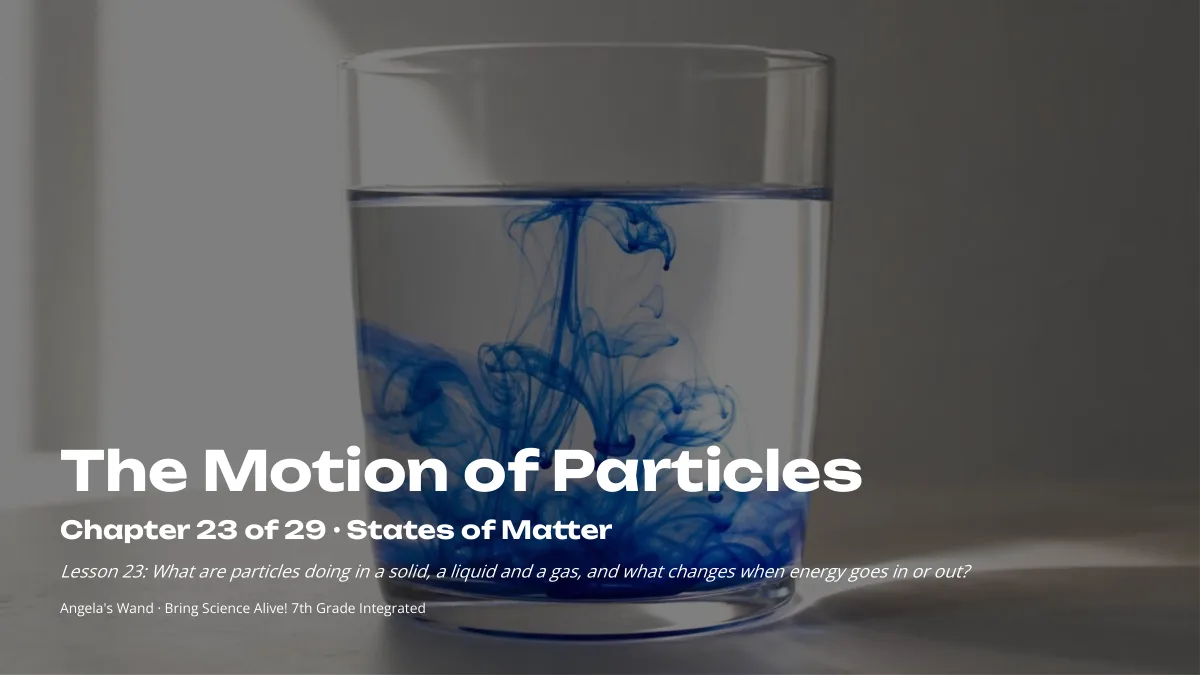
Two clear cups sit on a desk. One holds water chilled in a refrigerator; the other holds water warmed to about the temperature of a hot bath. A student lets one drop of blue food coloring fall into each cup at the same moment and then does not touch either cup. In the warm cup the blue threads curl outward and the whole cup is evenly tinted in about two minutes. In the cold cup a dark blob sits near the bottom and is still streaky ten minutes later. No spoon, no shaking, no fan. What inside the water is moving the dye, and why does temperature change how fast it moves?
Notice and wonder prompts
California NGSS, Grade 7 Preferred Integrated Course Model. Each entry says whether this chapter's work assesses the performance expectation, gives practice toward it, or supports it as background; the resource lists below repeat this for every worksheet and lab.
Develop a model that predicts and describes changes in particle motion, temperature, and state of a pure substance when thermal energy is added or removed.
Every strand of this chapter builds or uses a particle model of solids, liquids and gases. Lab 2 and Lab 3 have students run a model in which adding or removing energy changes particle motion and then the state, and record the result as data; W4, W6 and W9 ask for drawn and written models that predict what happens when a pure substance is heated or cooled. No task asks for a calculation of energy or heat.
Plan an investigation to determine the relationships among the energy transferred, the type of matter, the mass, and the change in the average kinetic energy of the particles as measured by the temperature of the sample.
This is a Grade 6 PE in the California integrated sequence, taught before this lesson. The chapter leans on its core idea, that a thermometer reports the average motion of particles, to explain why warm water spreads dye faster (Lab 1), but no activity here plans the mass-and-energy investigation the PE describes.
Assessment boundary: Assessment does not include calculating the total amount of thermal energy transferred.
The Motion of Particles: how particles move, and what changes when energy goes in or out. Original, editable slides with speaker notes: a phenomenon opener, learning targets, the chapter's concepts with diagrams, vocabulary in context, 3 checks for understanding, 2 discussion prompts, an application task, a misconception check, a synthesis and an exit ticket.

Ten different tasks, one per instructional blueprint. Each has a student PDF (low ink, US Letter), an editable DOCX, an HTML preview, and a separate teacher answer key with reasoning.
I can record careful observations of dye spreading in cold and warm water, connect them to what I already know, and write a first explanation that I can test later.
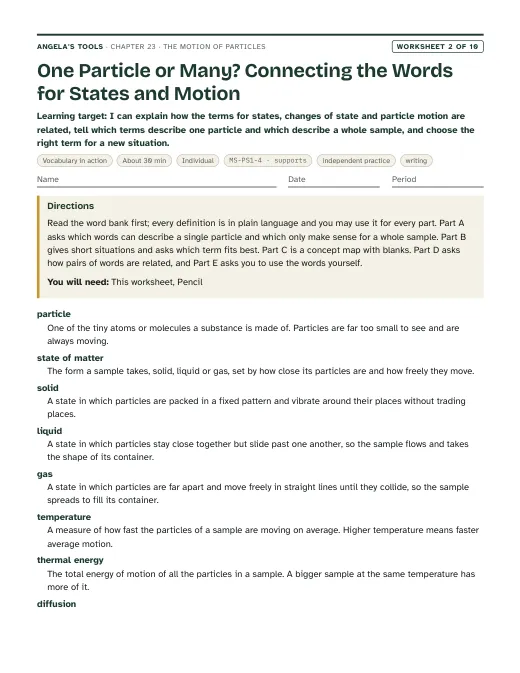
I can explain how the terms for states, changes of state and particle motion are related, tell which terms describe one particle and which describe a whole sample, and choose the right term for a new situation.
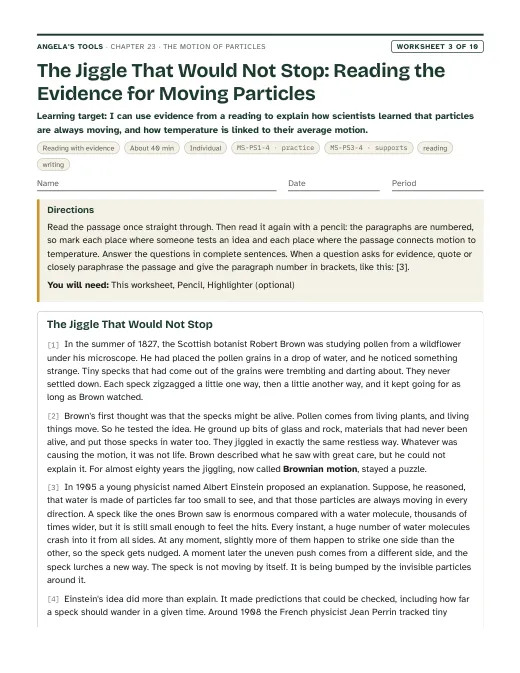
I can use evidence from a reading to explain how scientists learned that particles are always moving, and how temperature is linked to their average motion.
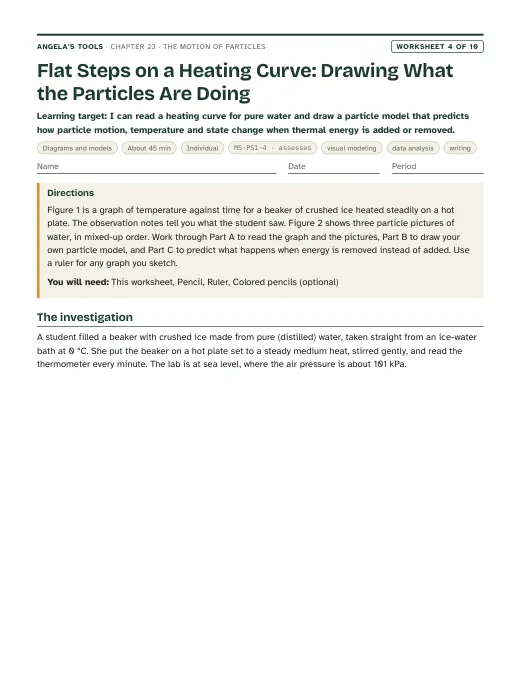
I can read a heating curve for pure water and draw a particle model that predicts how particle motion, temperature and state change when thermal energy is added or removed.
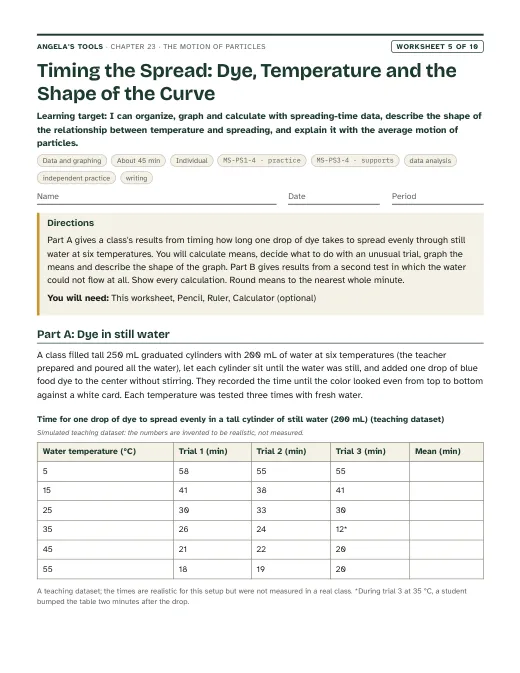
I can organize, graph and calculate with spreading-time data, describe the shape of the relationship between temperature and spreading, and explain it with the average motion of particles.
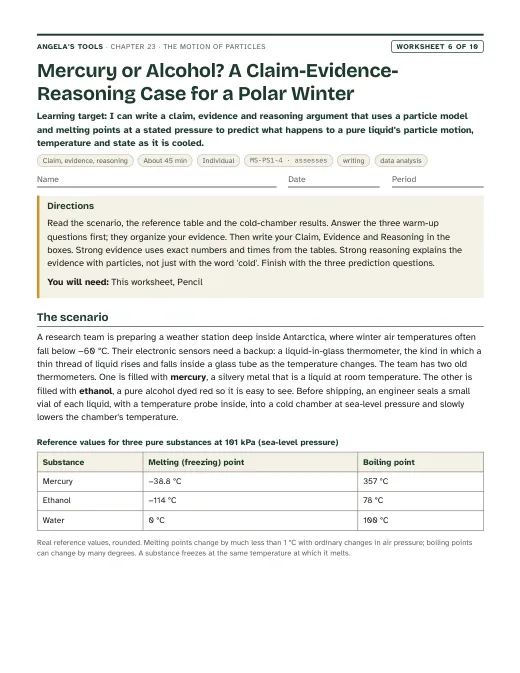
I can write a claim, evidence and reasoning argument that uses a particle model and melting points at a stated pressure to predict what happens to a pure liquid's particle motion, temperature and state as it is cooled.
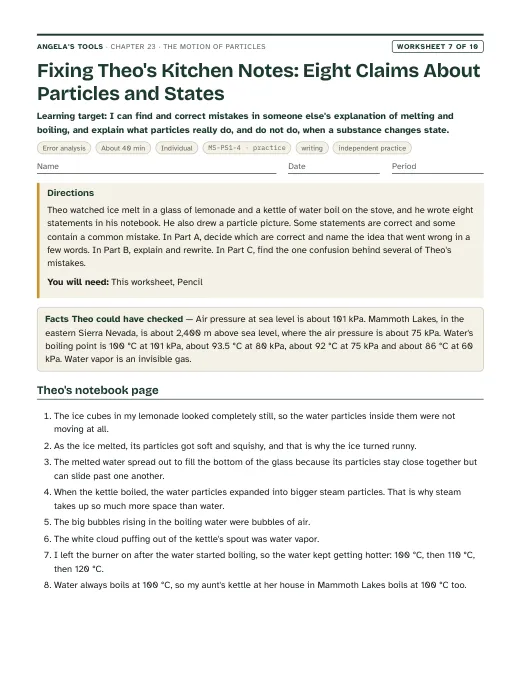
I can find and correct mistakes in someone else's explanation of melting and boiling, and explain what particles really do, and do not do, when a substance changes state.
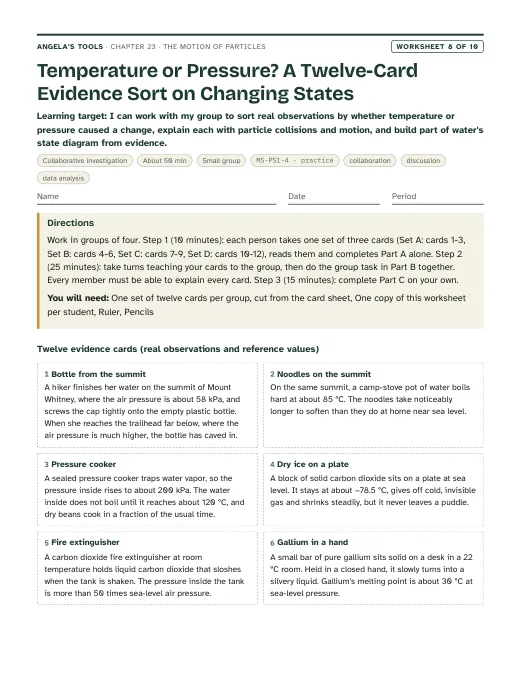
I can work with my group to sort real observations by whether temperature or pressure caused a change, explain each with particle collisions and motion, and build part of water's state diagram from evidence.
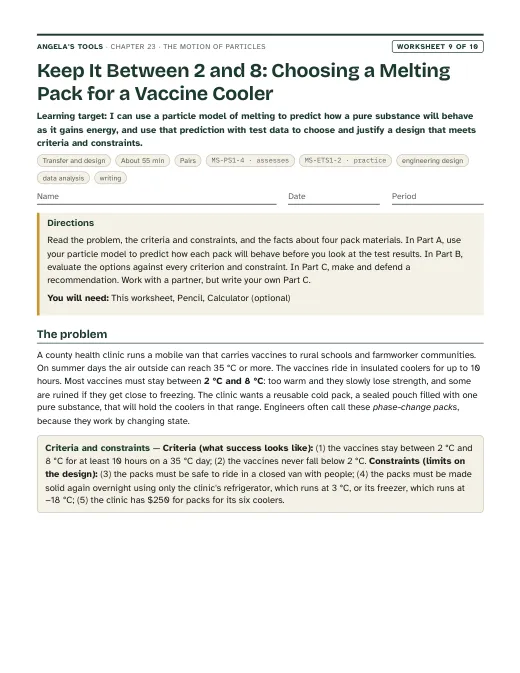
I can use a particle model of melting to predict how a pure substance will behave as it gains energy, and use that prediction with test data to choose and justify a design that meets criteria and constraints.
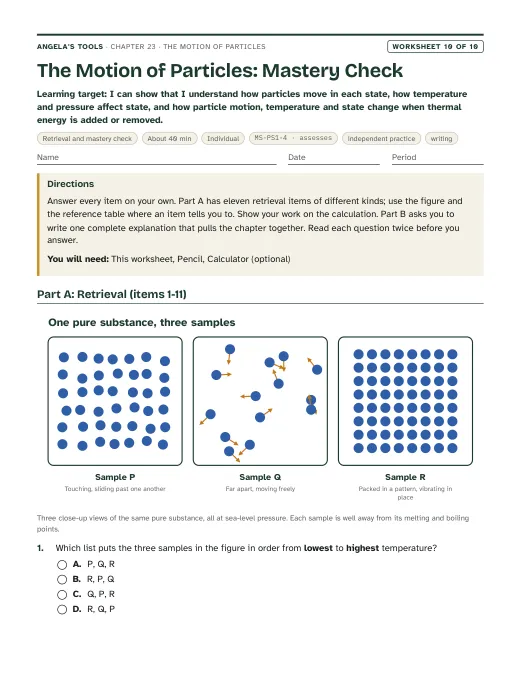
I can show that I understand how particles move in each state, how temperature and pressure affect state, and how particle motion, temperature and state change when thermal energy is added or removed.
Three different investigation approaches. Each has a teacher guide (purpose, materials with quantities, estimated cost, prep, safety, procedure, expected observations, debrief, answer key, assessment criteria, accessibility adaptations, low-cost alternative) and a student recording sheet.
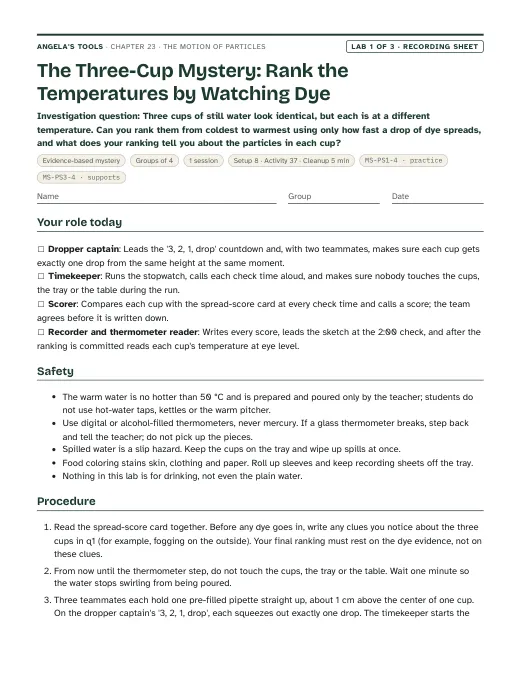
Three cups of still water look identical, but each is at a different temperature. Can you rank them from coldest to warmest using only how fast a drop of dye spreads, and what does your ranking tell you about the particles in each cup?
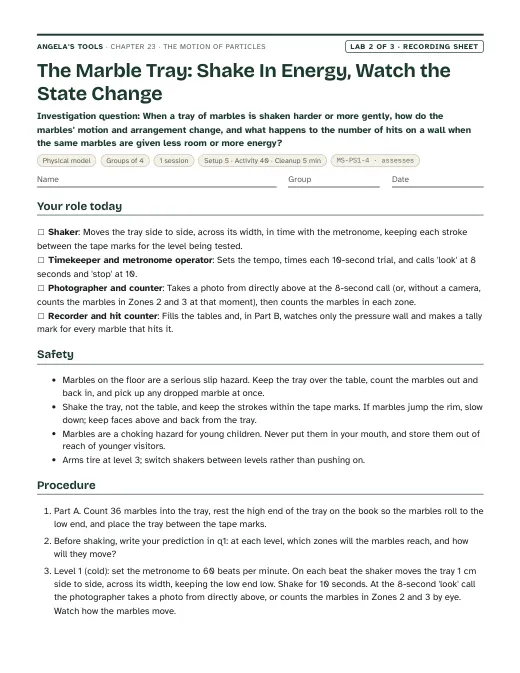
When a tray of marbles is shaken harder or more gently, how do the marbles' motion and arrangement change, and what happens to the number of hits on a wall when the same marbles are given less room or more energy?
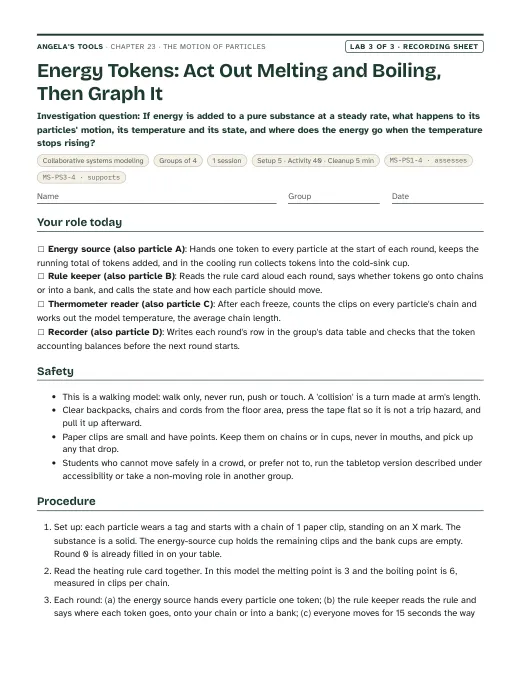
If energy is added to a pure substance at a steady rate, what happens to its particles' motion, its temperature and its state, and where does the energy go when the temperature stops rising?
Materials overview: No open flames, and no water above 50 °C in any hands-on activity; the teacher prepares and pours the warm water. Lab 1 uses clear cups, plastic pipettes, food coloring, a thermometer, refrigerator water and warm tap water. Lab 2 uses 36 matching marbles (or dried lima beans), a rimmed tray tilted on a book, masking tape, a cardboard divider and a metronome app. Lab 3 uses masking tape on the floor, four paper cups and about fifty paper clips per group as energy tokens. The dye demonstration for the phenomenon needs two clear cups, one cold and one warm, and a white sheet of paper behind them.
Review status: reviewed · 2026-10-19 · Re-solved every numeric, multiple-choice, true/false, fill and table item in W1-W10 and Labs 1-3, including the Lab 3 heating, uneven-round and cooling runs round by round, the slide-16 and W4 heating-curve proportions (they match water's real specific and latent heats) and the slide 23 and W10 state tables; keys agree except where changed below. Diffusion example in the vocabulary replaced: air currents, not diffusion, carry a smell across a room, so the inContext sentence now uses dye spreading in set gelatin; slide 14's diffusion example and its model sentence were corrected the same way. Dye-spread data made consistent. W1's warm glass lowered from 60 °C to 45 °C (the chapter's hands-on ceiling and the Lab 1 and slide 12 temperature), with its log, figure and q1, q2, q3 and q8 keys rewritten so the warm glass is even within minutes, as on slide 12 and in Lab 1; W5's identical-sounding '200 mL cups' that took 19-56 minutes are now tall graduated cylinders, with a teacher note on comparing patterns rather than minutes. Slide links and chapter claims checked against the sheets as written: links on slides 16, 18, 20, 22 and 25 match (W4 heating curve, W8 summit and pressure cards, Lab 2 Part B, W6 reference table); the threeDimensions claim that W4 and W10 use a state diagram was corrected (W4 reads a heating curve; W10 uses a reference table; W8 builds the boiling line); W10's two lists of PE-evidence items were made to agree. History and reference values verified: Brown 1827, Einstein 1905, Perrin about 1908-1909 and his 1926 Nobel Prize (W3); mercury −38.8 °C and ethanol −114 °C (W6); Mount Whitney 4,421 m, about 58 kPa and about 85 °C, Badwater −86 m and just above 100 °C, about 135 km apart (slide 18); Mammoth Lakes about 75 kPa and 92 °C (W7); NIST boiling-line values on slide 22. Gallium's boiling point on slide 23 changed from 'about 2,400 °C' to 'above 2,000 °C', which every reference supports and which matches W10. Boundary margins checked: every state prediction is at least 10 °C from a boundary except W9's tetradecane pack, which by design melts inside the 2-8 °C range and re-solidifies only about 3 °C below its melting point; the accuracy note and W9 key and teacher notes now say so. W10 item 6g moved from 15 °C to 10 °C so its stated '15 °C from every boundary' holds against gallium's 29.76 °C. Smaller fixes: slide 1 subtitle reworded (it echoed the lesson's opening question), the kilopascal accuracy note restated in symbols, the pressure inContext sentence made dimensionally sensible, the fog correction now says the droplets condense from water vapor, slide 20's notes say condensation begins when the pressure reaches 101 kPa, slide 24's second clue no longer says air 'gives off' vapor, W3 says 'Brown's specks' instead of 'pollen specks', W9 states the alkanes' real hazard, criteria added to W1 q2 and q8, and the 'no water above 50 °C' claims limited to hands-on work. Originality sweep against the lesson text (column-aware, 5- and 6-word runs) found no copied sentences after the subtitle change; remaining shared runs are short technical phrases or attributed quotations in accuracy notes. Not changed: the lesson has no engineering strand, so MS-ETS1-2 appears only on W9, not in chapter.json; labs are not physically tested, and the Lab 1 room-temperature cup may mix nearly as slowly as the cold cup because neither has strong currents, which the debrief already anticipates (those two cups are the pair most often confused).
Verified against the student edition of Bring Science Alive! 7th Grade Integrated (Student Edition). Printed page numbers appear in the book; PDF pages are the physical pages of the 524-page scan (printed + 36). The textbook is not reproduced on this site.
| Section | Printed pages | PDF pages | Used for |
|---|---|---|---|
| Introduction: the dry-ice puzzle and the vocabulary list | 296, 297 | 332, 333 | Lesson question, the sinking-fog phenomenon reworked as the dry-ice discussion slide, the publisher's standards box. |
| 1. Molecular Motion in Solids | 297, 298 | 333, 334 | Vibration-in-place model of solids, fixed shape and nearly fixed volume, the expansion accuracy note. |
| 2. Molecular Motion in Liquids | 299 | 335 | Sliding-particle model of liquids, flow and container shape, Lab 2's medium-shake state. |
| 3. Molecular Motion in Gases | 300 | 336 | Free, straight-line motion with collisions, gases fill their container, the invisibility of water vapor. |
| 4. Temperature Affects the State of Matter | 301 | 337 | Melting and boiling points as properties, the heating-curve slide and Lab 3 thresholds. |
| 5. Pressure Affects the State of Matter | 302, 303 | 338, 339 | Pressure from collisions, the crumpling bottle, the piston idea, boiling point dropping with pressure, Lab 2's divider test. |
| 6. Predicting States of Matter and the Key Science Concept | 304, 305, 306 | 340, 341, 342 | State diagram reading, water, carbon dioxide and gallium comparisons, the prediction task. |
| 7. Standard Temperature and Pressure, and the lesson summary | 307 | 343 | Why scientists state conditions, the STP slide and its accuracy note. |