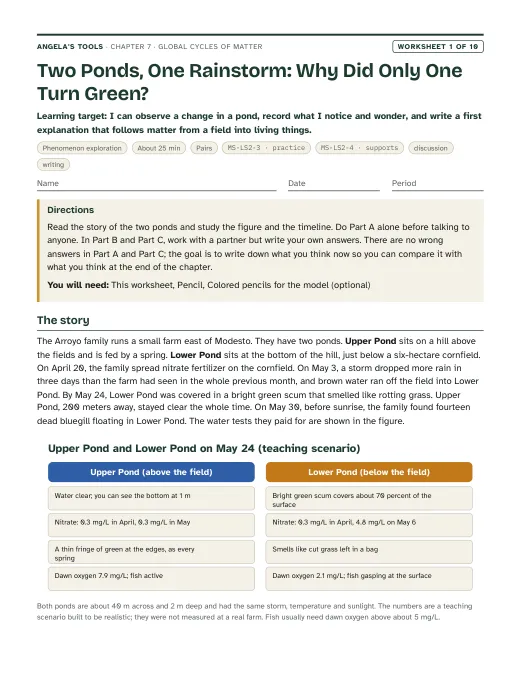
Two Ponds, One Rainstorm: Why Did Only One Turn Green?
I can observe a change in a pond, record what I notice and wonder, and write a first explanation that follows matter from a field into living things.
Chapter 07 · Unit 2: Energy and Matter in Ecosystems · Segment 1
How does the same matter keep moving through Earth's living and nonliving parts, and what happens to the cycles when people change them?
Students figure out that the atoms in a pond's green scum, a farmer's fertilizer bag, a breath of air and a lump of coal are the same kinds of atoms taking turns in different places, and that Earth keeps reusing them because almost no matter arrives or leaves the planet. They build and use models of three cycles, water, carbon and nitrogen, by tracing single atoms through reservoirs such as the air, soil, water and living bodies, and they test the closed-system idea with a sealed jar that changes inside while its mass stays put. The chapter ends with two human decisions that only make sense once the cycles are understood: how much fertilizer a field can take before the pond downhill pays for it, and where to plant trees so that photosynthesis pulls the most carbon out of the air for the least cost.
Estimated class time: presentation about 150 minutes · worksheets about 400 minutes in total · labs 5 sessions. Seven 50-minute periods, with Lab 2 (the sealed jar) started on day 2 so its three short sessions spread across the chapter. One period can be saved by running the presentation task in place of Lab 3, or by assigning W3 as homework.
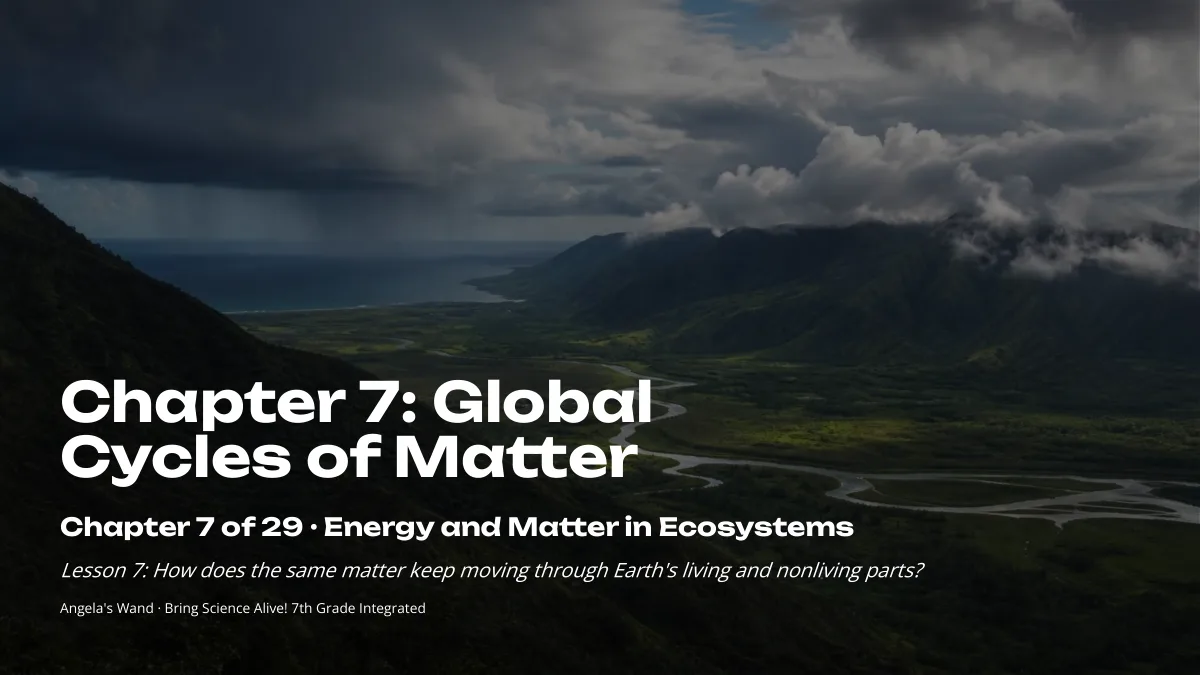
A small pond sits at the bottom of a sloping field. In early spring the field is spread with fertilizer and the pond is clear enough to see the bottom. Two weeks later a heavy storm washes across the field. Within ten days the pond is covered with a thick green scum, it smells of rot along the edges, and a neighbor finds a few dead fish in the shallows. Nobody poured anything into the pond, and the field looks healthier than ever. Where did the material in all that green scum come from, and why did the fish suffer when the plants in the field did so well?
Notice and wonder prompts
California NGSS, Grade 7 Preferred Integrated Course Model. Each entry says whether this chapter's work assesses the performance expectation, gives practice toward it, or supports it as background; the resource lists below repeat this for every worksheet and lab.
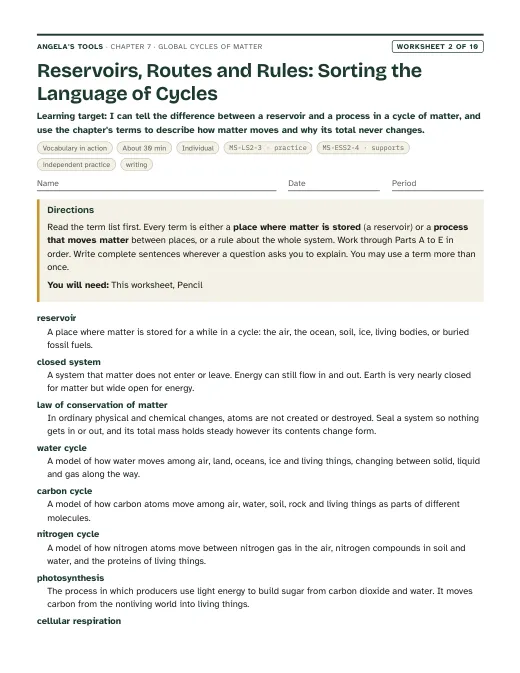
Develop a model to describe the cycling of matter and flow of energy among living and nonliving parts of an ecosystem.
The chapter's core product is a student-built model of how matter cycles among living and nonliving parts of an ecosystem, with the boundary of the system stated. Lab 1 (atom passports), Lab 2 (sealed jar), W4 and the presentation task produce that evidence directly. The assessment boundary is respected: no task asks students to use chemical equations; atoms are traced by name and process.
Assessment boundary: Assessment does not include the use of chemical reactions to describe the processes.
Evaluate competing design solutions using a systematic process to determine how well they meet the criteria and constraints of the problem.
The lesson's engineering spread evaluates reforestation sites against criteria and constraints. Lab 3 requires students to score five competing fertilizer plans in a decision matrix against stated criteria and constraints, and the presentation task does the same for four reforestation sites, which is direct evidence toward this PE.
Construct a scientific explanation based on evidence for the role of photosynthesis in the cycling of matter and flow of energy into and out of organisms.
Photosynthesis is treated here only as the process that moves carbon and water into producers, which is background from Lesson 4; students are not asked to construct the full explanation of photosynthesis in this chapter.
Assessment boundary: Assessment does not include the biochemical mechanisms of photosynthesis.
Develop a model to describe the cycling of water through Earth’s systems driven by energy from the sun and the force of gravity.
The water cycle in this lesson is a Grade 6 performance expectation in the California integrated sequence (MS-ESS2-4), where it is taught in full with energy from the sun and the force of gravity. Here it is reviewed as one of three matter cycles and used as the easiest example of a reservoir-and-process model; it is not assessed.
Assessment boundary: A quantitative understanding of the latent heats of vaporization and fusion is not assessed.
Global Cycles of Matter: the same atoms, again and again. Original, editable slides with speaker notes: a phenomenon opener, learning targets, the chapter's concepts with diagrams, vocabulary in context, 4 checks for understanding, 2 discussion prompts, an application task, a misconception check, a synthesis and an exit ticket.

Ten different tasks, one per instructional blueprint. Each has a student PDF (low ink, US Letter), an editable DOCX, an HTML preview, and a separate teacher answer key with reasoning.
I can observe a change in a pond, record what I notice and wonder, and write a first explanation that follows matter from a field into living things.
I can tell the difference between a reservoir and a process in a cycle of matter, and use the chapter's terms to describe how matter moves and why its total never changes.
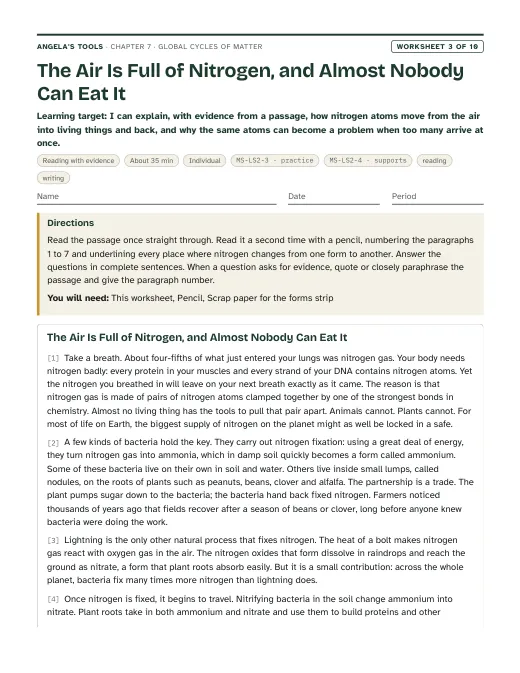
I can explain, with evidence from a passage, how nitrogen atoms move from the air into living things and back, and why the same atoms can become a problem when too many arrive at once.
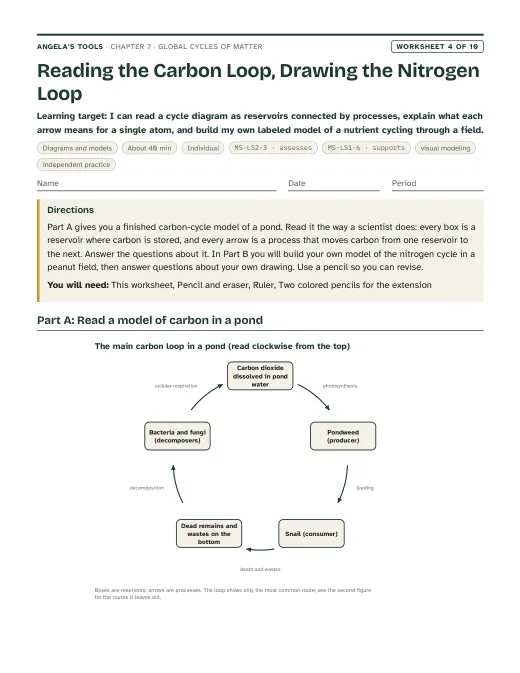
I can read a cycle diagram as reservoirs connected by processes, explain what each arrow means for a single atom, and build my own labeled model of a nutrient cycling through a field.
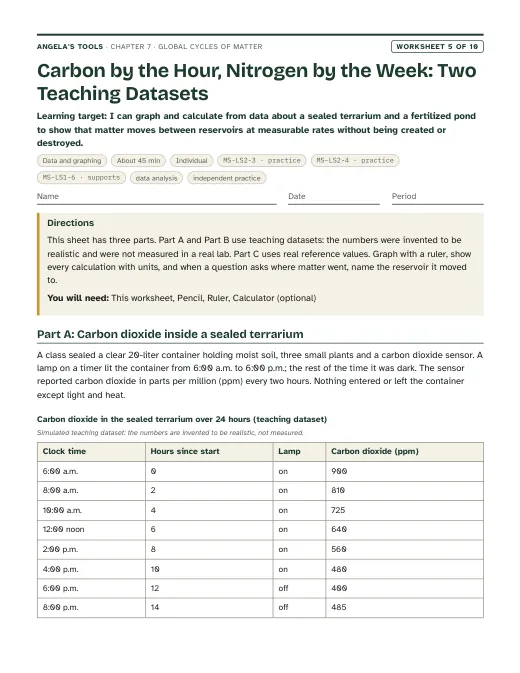
I can graph and calculate from data about a sealed terrarium and a fertilized pond to show that matter moves between reservoirs at measurable rates without being created or destroyed.
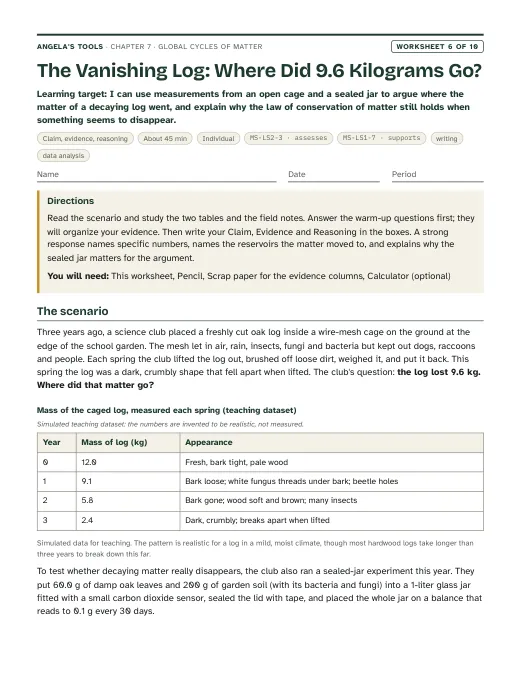
I can use measurements from an open cage and a sealed jar to argue where the matter of a decaying log went, and explain why the law of conservation of matter still holds when something seems to disappear.
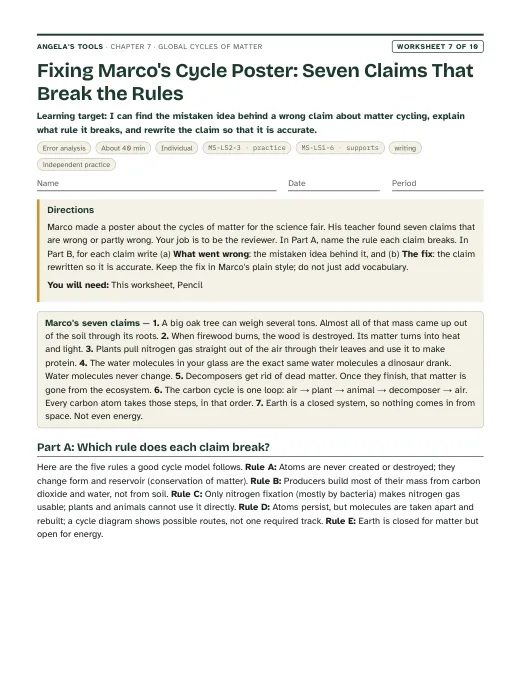
I can find the mistaken idea behind a wrong claim about matter cycling, explain what rule it breaks, and rewrite the claim so that it is accurate.
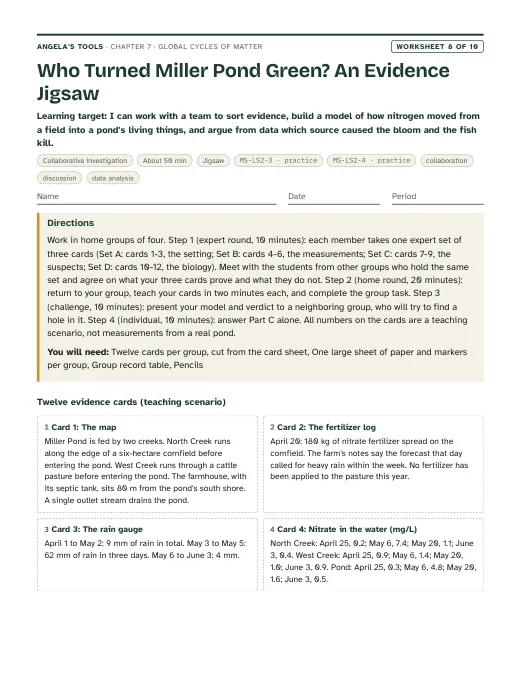
I can work with a team to sort evidence, build a model of how nitrogen moved from a field into a pond's living things, and argue from data which source caused the bloom and the fish kill.
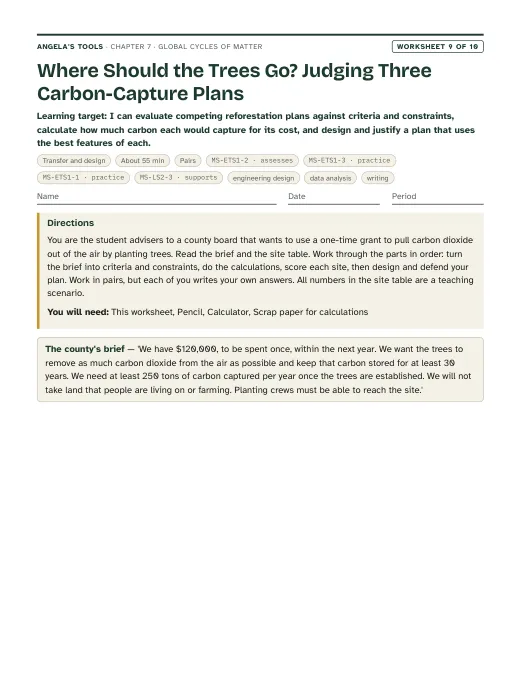
I can evaluate competing reforestation plans against criteria and constraints, calculate how much carbon each would capture for its cost, and design and justify a plan that uses the best features of each.
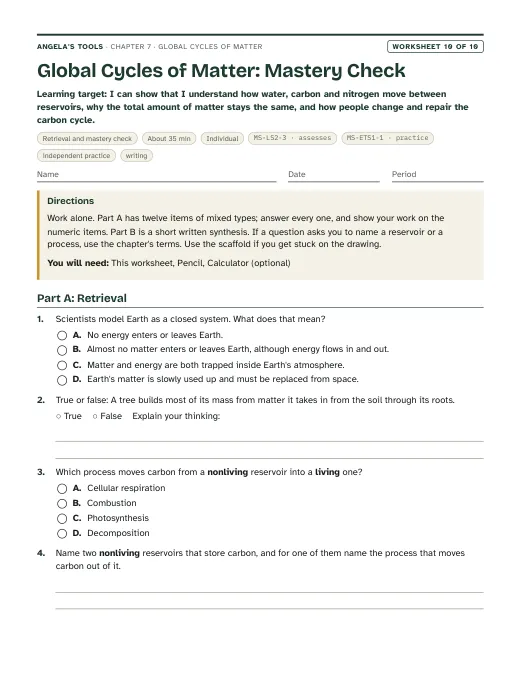
I can show that I understand how water, carbon and nitrogen move between reservoirs, why the total amount of matter stays the same, and how people change and repair the carbon cycle.
Three different investigation approaches. Each has a teacher guide (purpose, materials with quantities, estimated cost, prep, safety, procedure, expected observations, debrief, answer key, assessment criteria, accessibility adaptations, low-cost alternative) and a student recording sheet.
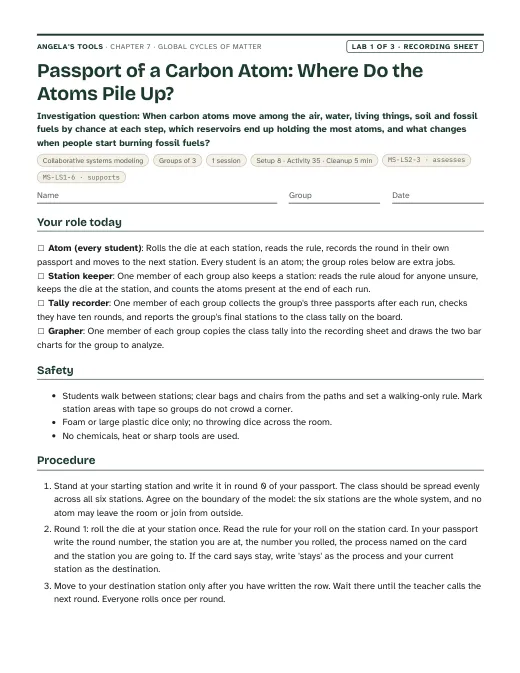
When carbon atoms move among the air, water, living things, soil and fossil fuels by chance at each step, which reservoirs end up holding the most atoms, and what changes when people start burning fossil fuels?
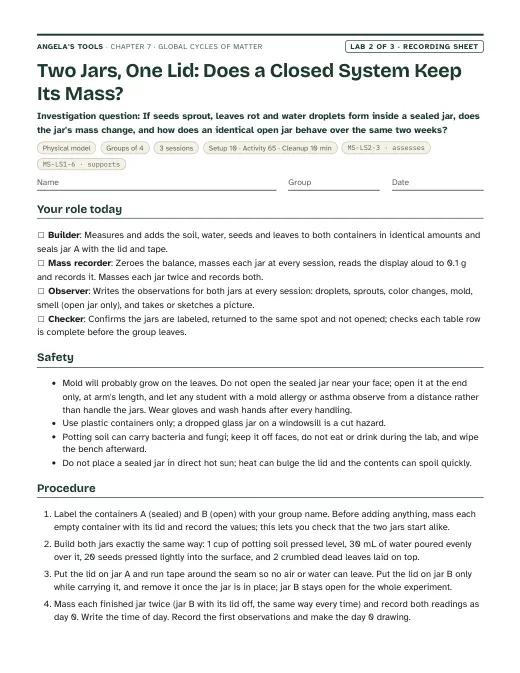
If seeds sprout, leaves rot and water droplets form inside a sealed jar, does the jar's mass change, and how does an identical open jar behave over the same two weeks?
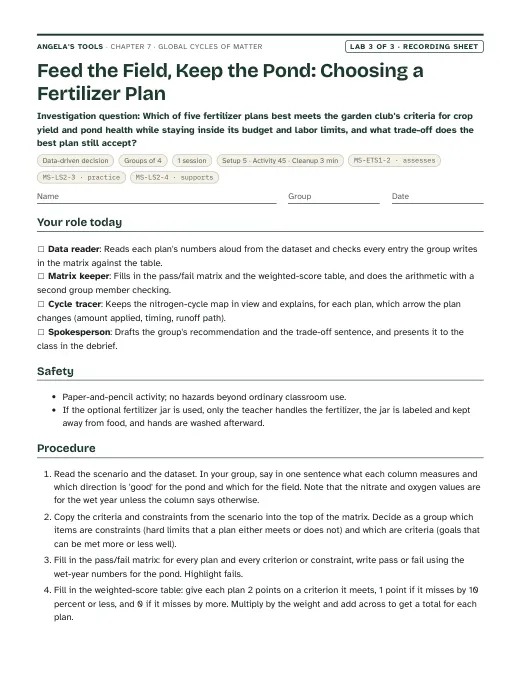
Which of five fertilizer plans best meets the garden club's criteria for crop yield and pond health while staying inside its budget and labor limits, and what trade-off does the best plan still accept?
Materials overview: No open flames and no chemicals beyond potting soil and household fertilizer (handled only by the teacher, if used at all). Lab 1 needs six dice, printed station cards and passports. Lab 2 needs clear plastic deli containers with lids, potting soil, grass or radish seeds, a few dead leaves, tape and a balance reading to 0.1 g. Lab 3 is paper only. A clear jar of pond or aquarium water left in sunlight for a week makes a vivid live version of the phenomenon.
Review status: reviewed · 2026-10-19 · Re-solved every numeric and multiple-choice item in W1-W10 and Labs 1-3 (including the Lab 3 weighted matrix and W9 site arithmetic); all keys matched. Fixed one self-contradictory Lab 3 key (q2: oxygen weight 3 gives a C-E tie, not E above C). Rewrote the law-of-conservation definition in chapter.json, the presentation vocab slide and W2, which had reproduced the textbook's wording. Fixed cross-references: W6 is the decaying-log CER, not a pond CER (chapter SEP, evidenceOfLearning, sequence, three presentation links); W8 is the pond evidence task. Trimmed relatedChapters to four. Slide 13 example changed from gasoline to coal (much petroleum formed during the age of dinosaurs, so 'long before dinosaurs' was wrong for gasoline). Renderability: shortened slide 20 flow nodes and the cycle edge labels on slides 9, 12 and 17 (they overflowed their boxes); moved W1's compare bothItems into the caption (the compare renderer ignores bothItems); shortened W1 timeline descriptions. W1 key no longer cites a fertilizer mass that appears only in W8. W6 jar dataset: leaf descriptions softened and a teacher note added, because a sealed 1 L jar lacks the oxygen to decompose 60 g of leaves to crumbs; log caption now says the three-year loss is fast for oak. Lab 1 graph ticks extended to 20; Lab 2 jar mass estimate corrected; W8 teacher note no longer calls W5 'the same pond'. Standards confirmed against standards.json; MS-ESS2-1 (rock cycle) correctly left out; MS-ESS2-4 flagged as Grade 6. Labs remain physically untested.
Verified against the student edition of Bring Science Alive! 7th Grade Integrated (Student Edition). Printed page numbers appear in the book; PDF pages are the physical pages of the 524-page scan (printed + 36). The textbook is not reproduced on this site.
| Section | Printed pages | PDF pages | Used for |
|---|---|---|---|
| Introduction: aspen forest, squirrel and decomposers; vocabulary; publisher's standards list | 76, 77 | 112, 113 | Lesson question, the Spaceship Earth framing, the list of vocabulary terms, the publisher's MS-LS2-3 and MS-ETS1-2 claims. |
| 1. Earth is a Closed System | 78 | 114 | Conservation of matter, the closed-system model and its exceptions; Lab 2 and the matter-versus-energy compare diagram. |
| 2. The Water Cycle | 79 | 115 | The water cycle as the first reservoir map; the atoms-versus-molecules accuracy note; the sublimation note. |
| 3. The Carbon Cycle | 80, 81 | 116, 117 | Photosynthesis in, cellular respiration out; decomposers, soil storage, fossil fuels and combustion; Lab 1 station rules. |
| 4. The Nitrogen Cycle | 82, 83 | 118, 119 | Fixation by bacteria and lightning, nitrification, consumers, decomposers, denitrification; fertilizer as the link to the pond phenomenon and Lab 3. |
| Key Science Concept: Global Cycles of Matter and You | 84, 85 | 120, 121 | How one person sits in all three cycles at once; the synthesis slide and the human-body check questions. |
| 5. Designing Carbon Capture Solutions (Engineering Design) | 86, 87 | 122, 123 | Criteria and constraints for reforestation, forest growth rates and cost; the presentation task and the decision-matrix method used in Lab 3. |
| Lesson Summary | 87 | 123 | Check that every section's main idea is covered by a learning target. |