Worksheet 1 · Phenomenon exploration
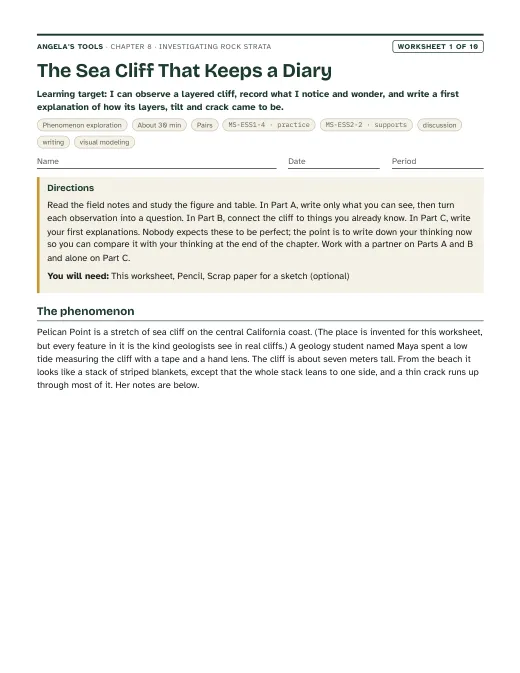
The Sea Cliff That Keeps a Diary
I can observe a layered cliff, record what I notice and wonder, and write a first explanation of how its layers, tilt and crack came to be.
Teacher only
 Angela's Wand
Chapter 08 · Unit 3: Earth Processes Through Geologic Time · Segment 1
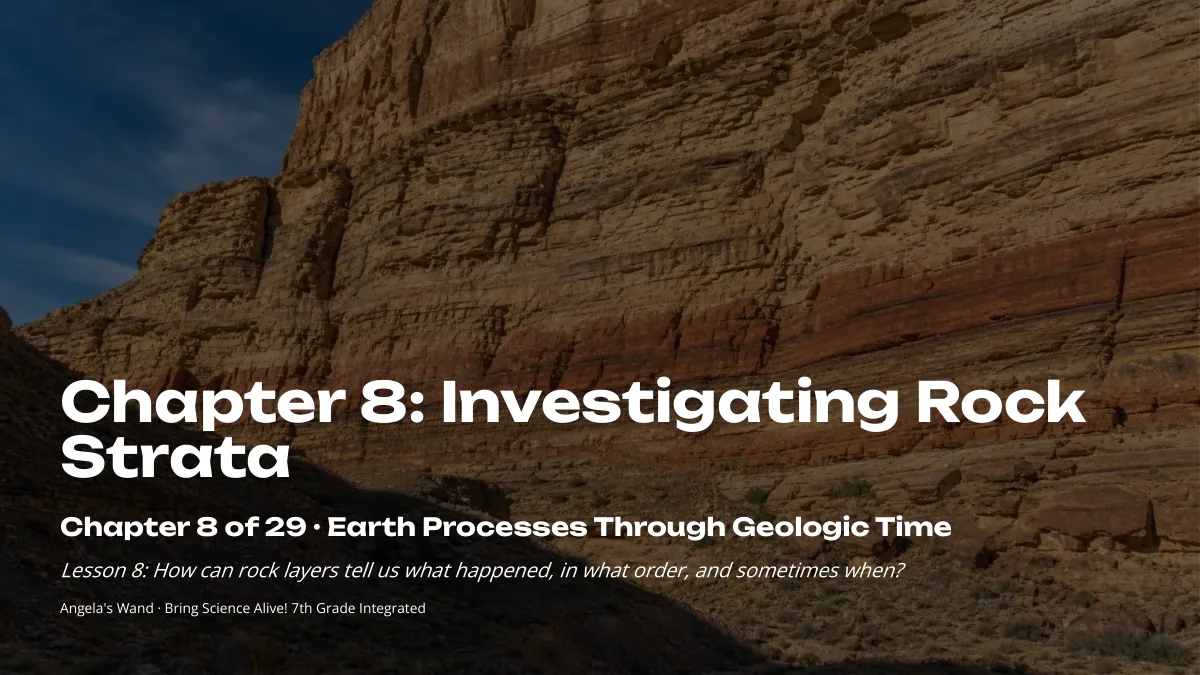
How can rock layers tell us the order of events in Earth's past, and when can they tell us how long ago those events happened?
Students figure out how geologists read a stack of rock layers as a record of events that nobody watched happen. They use a small set of rules, superposition, original horizontality, lateral continuity, cross-cutting relationships and fossil succession, to put layers, folds, faults, intrusions and erosion surfaces in order, and they learn why that order is only relative. Then they see how radioactive atoms trapped in igneous crystals act as clocks, how half-life turns a measurement into an age in years, and how dated volcanic layers put numbers on the sedimentary layers between them. The chapter builds the evidence-reading skills that Lesson 9 uses to assemble Earth's history, and it reuses the weathering, erosion and deposition ideas from the rock cycle.
Estimated class time: presentation about 130 minutes · worksheets about 405 minutes in total · labs 3 sessions. Six 50-minute periods, seven if Lab 3 runs outdoors: two for the phenomenon, deposition and the three stacking rules (with Lab 1); one for folding, faults, intrusions and the cross-section task; one for the Lab 2 quarry mystery; one for fossils and radiometric dating; one for deposition and erosion in the tray (Lab 3), synthesis and mastery.
A highway crew blasts through a hillside and leaves a fresh rock wall beside the road. The wall shows a stack of striped layers, tan sandstone, gray shale and a pale limestone band, all leaning at about twenty degrees. A dark band of rock about a meter wide runs diagonally up through every layer like a stripe painted on later. Partway along, the layers on the left sit a meter higher than the same layers on the right, as if someone had sliced the wall and shifted one side. Across the top, a flat bed of loose river gravel lies on everything, and nothing cuts it. A geologist walks up, looks for a minute and says she can list the events that made this wall in order. How?
Notice and wonder prompts
California NGSS, Grade 7 Preferred Integrated Course Model. Each entry says whether this chapter's work assesses the performance expectation, gives practice toward it, or supports it as background; the resource lists below repeat this for every worksheet and lab.
Construct a scientific explanation based on evidence from rock strata for how the geologic time scale is used to organize Earth’s 4.6-billion-year-old history.
In California's Preferred Integrated model this PE belongs to Grade 8, so a seventh-grade class using this textbook is meeting it early; label it as a Grade 8 standard on any report. The lesson teaches the relative-dating rules and fossil succession that the PE's clarification names as the evidence base, and Lab 2 and W6 have students construct an explanation of event order from strata evidence, which is the first half of the PE. The organizing role of the geologic time scale itself is built in Lesson 9, and the assessment boundary (no recall of period or epoch names) is respected throughout.
Assessment boundary: Assessment does not include recalling the names of specific periods or epochs and events within them.
Construct an explanation based on evidence for how geoscience processes have changed Earth’s surface at varying time and spatial scales.
Every rule in this lesson is a cause-and-effect statement about a geoscience process: sediment settling, rivers cutting canyons, plates folding and faulting rock, magma intruding. Lab 3 has students produce and explain deposition and erosion in a tray at a small scale and connect it to the Grand Canyon scale, and the slides compare a fault you can step across with the San Andreas, which builds toward explanations at varying time and spatial scales.
Analyze and interpret data for patterns in the fossil record that document the existence, diversity, extinction, and change of life forms throughout the history of life on Earth under the assumption that natural laws operate today as in the past.
A Grade 8 PE in California's sequence. The fossil-succession section gives students the idea that fossils appear in one chronological order in the rock record and that this order is the same everywhere, which is background for analyzing patterns in the fossil record later. This chapter does not ask students to analyze fossil-record data on diversity or extinction, so the role is supports.
Assessment boundary: Assessment does not include the names of individual species or geological eras in the fossil record.
Investigating Rock Strata: reading the order of events in rock. Original, editable slides with speaker notes: a phenomenon opener, learning targets, the chapter's concepts with diagrams, vocabulary in context, 4 checks for understanding, 2 discussion prompts, an application task, a misconception check, a synthesis and an exit ticket.
Ten different tasks, one per instructional blueprint. Each has a student PDF (low ink, US Letter), an editable DOCX, an HTML preview, and a separate teacher answer key with reasoning.
I can observe a layered cliff, record what I notice and wonder, and write a first explanation of how its layers, tilt and crack came to be.
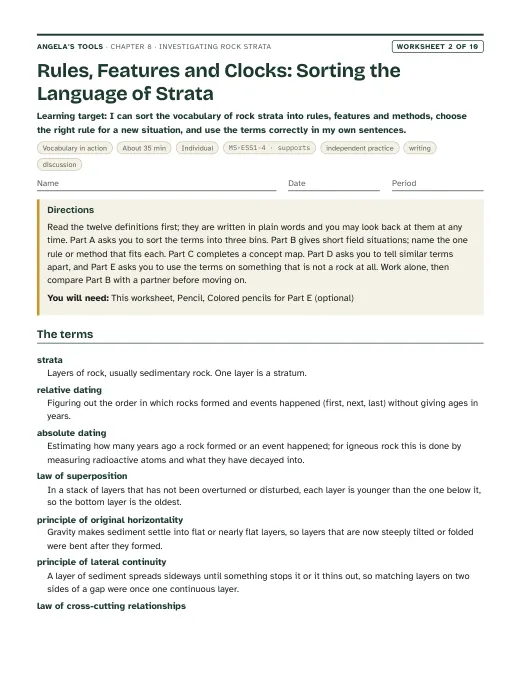
I can sort the vocabulary of rock strata into rules, features and methods, choose the right rule for a new situation, and use the terms correctly in my own sentences.
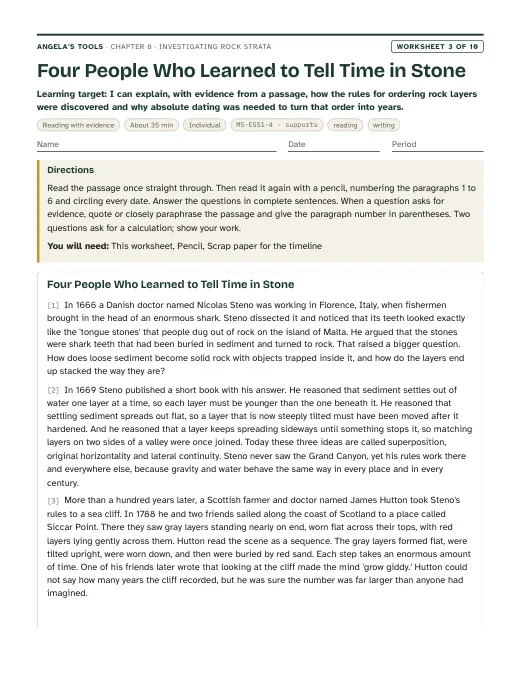
I can explain, with evidence from a passage, how the rules for ordering rock layers were discovered and why absolute dating was needed to turn that order into years.
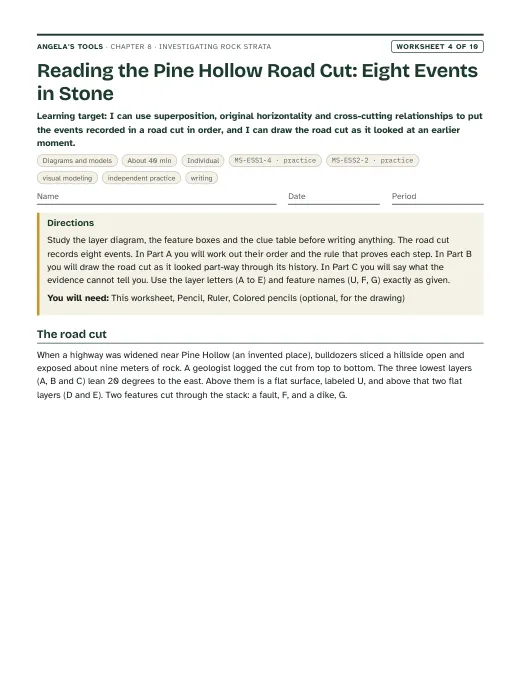
I can use superposition, original horizontality and cross-cutting relationships to put the events recorded in a road cut in order, and I can draw the road cut as it looked at an earlier moment.
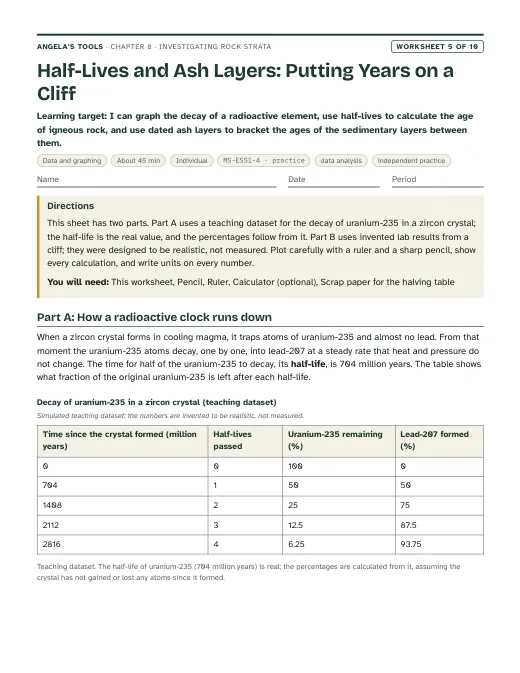
I can graph the decay of a radioactive element, use half-lives to calculate the age of igneous rock, and use dated ash layers to bracket the ages of the sedimentary layers between them.
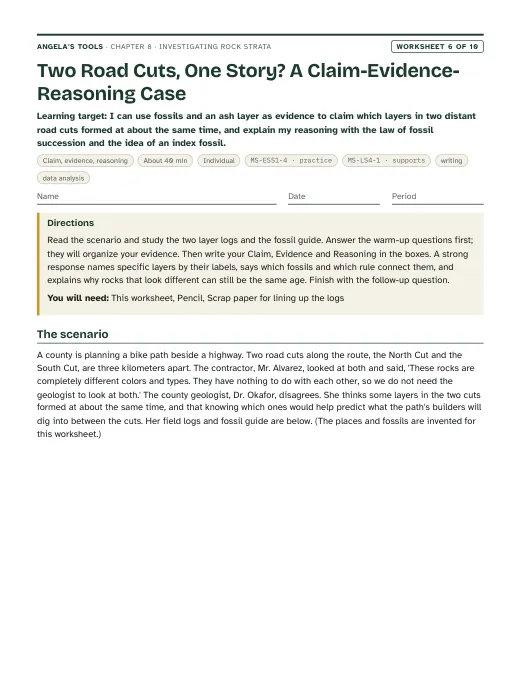
I can use fossils and an ash layer as evidence to claim which layers in two distant road cuts formed at about the same time, and explain my reasoning with the law of fossil succession and the idea of an index fossil.
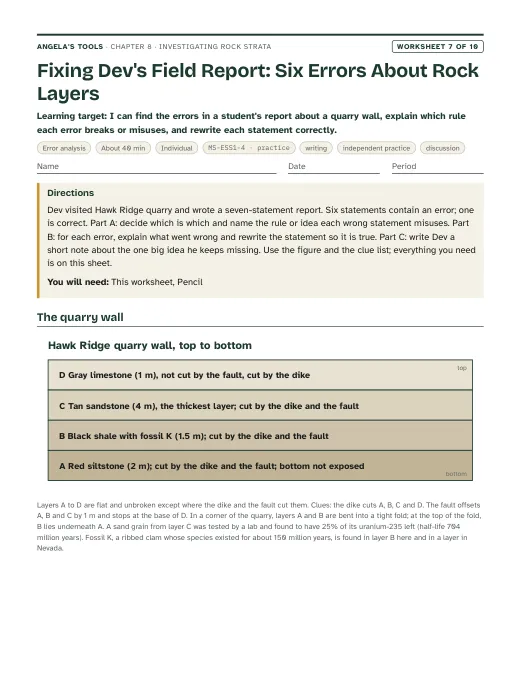
I can find the errors in a student's report about a quarry wall, explain which rule each error breaks or misuses, and rewrite each statement correctly.
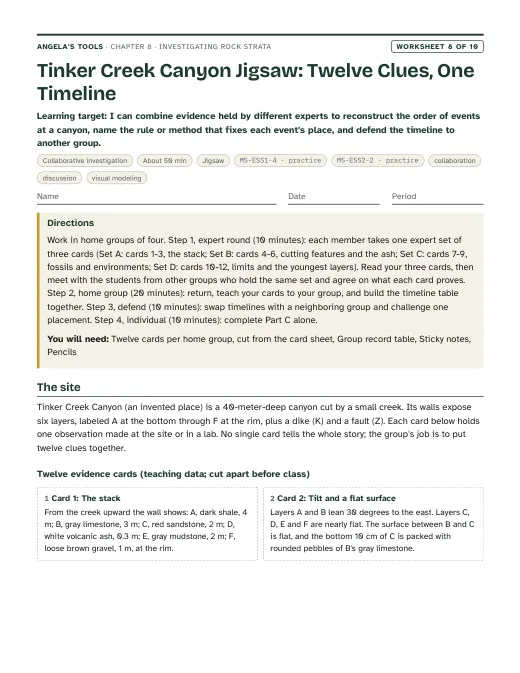
I can combine evidence held by different experts to reconstruct the order of events at a canyon, name the rule or method that fixes each event's place, and defend the timeline to another group.
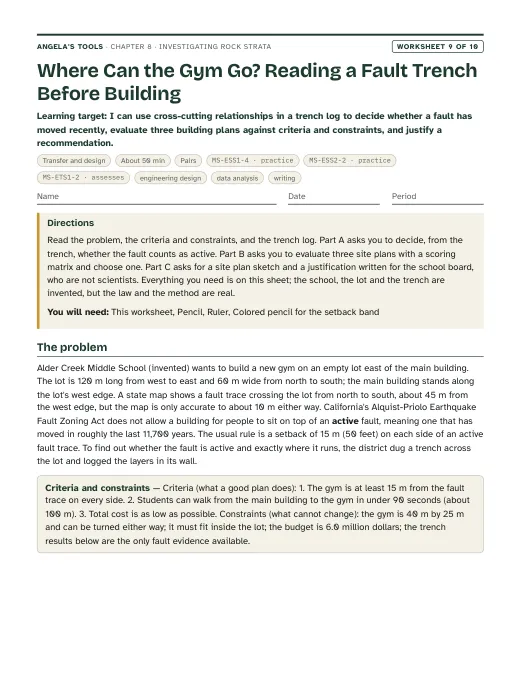
I can use cross-cutting relationships in a trench log to decide whether a fault has moved recently, evaluate three building plans against criteria and constraints, and justify a recommendation.
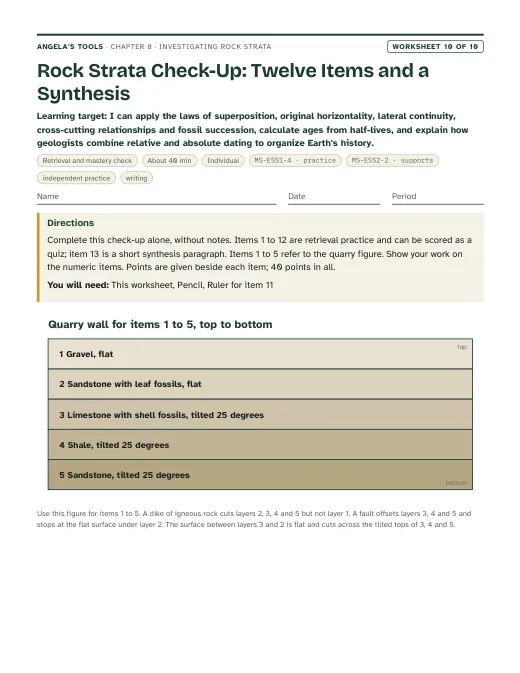
I can apply the laws of superposition, original horizontality, lateral continuity, cross-cutting relationships and fossil succession, calculate ages from half-lives, and explain how geologists combine relative and absolute dating to organize Earth's history.
Three different investigation approaches. Each has a teacher guide (purpose, materials with quantities, estimated cost, prep, safety, procedure, expected observations, debrief, answer key, assessment criteria, accessibility adaptations, low-cost alternative) and a student recording sheet.
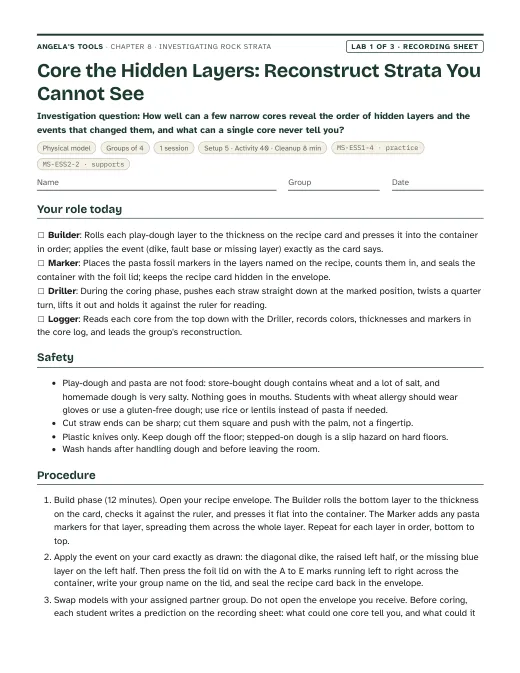
How well can a few narrow cores reveal the order of hidden layers and the events that changed them, and what can a single core never tell you?
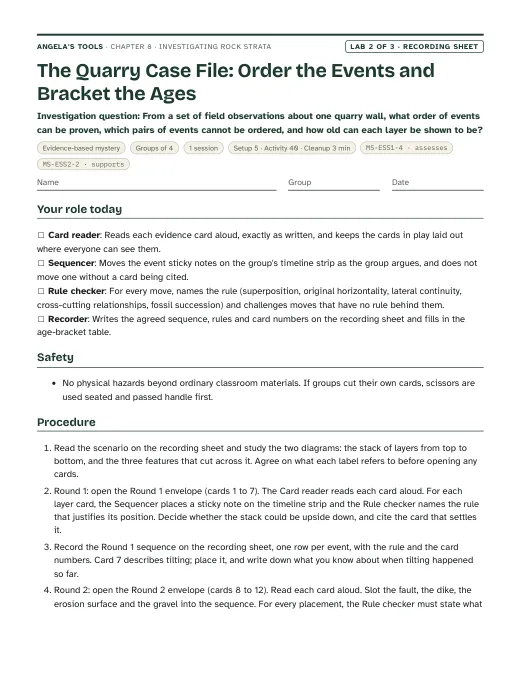
From a set of field observations about one quarry wall, what order of events can be proven, which pairs of events cannot be ordered, and how old can each layer be shown to be?
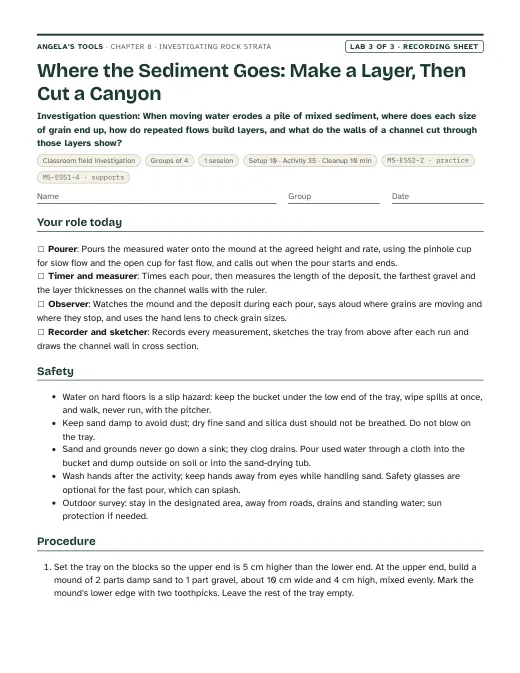
When moving water erodes a pile of mixed sediment, where does each size of grain end up, how do repeated flows build layers, and what do the walls of a channel cut through those layers show?
Materials overview: No chemicals, flames or sharp blades beyond plastic knives. Lab 1 uses play-dough (store-bought or homemade), opaque containers, foil, clear wide straws and small pasta shapes. Lab 2 is paper only: printed evidence cards, the cross-section figure and the recording sheet. Lab 3 uses a shallow tray, damp play sand, aquarium gravel, coffee grounds, a cup with a pinhole, a bucket and towels; it can move outdoors to a bare slope with a watering can. A set of rock samples (sandstone, shale, limestone, a dark igneous rock) helps but is optional.
Review status: reviewed · 2026-10-19 · Re-solved every numeric and multiple-choice item in W1-W10 and Labs 1-3 (half-life chains, brackets, offsets, ratios, dates); all keys confirmed. W5 Part B: removed shell fossils from a shale bracketed at 704-1,408 million years (shelled animals appear about 540 million years ago). W1 q7 key: the cliff does fix the tilt after the crack (layers 1 and 2 are unbroken across the crack and lean with the stack); key corrected. Lab 2 layers diagram had 8 entries; the renderer draws at most 7 and would have dropped the lowest layer. Surface E folded into the gravel entry and captions. Vocabulary definitions for absolute dating, cross-cutting relationships and half-life reworded in chapter, slide 14 and W2 to remove six-word runs shared with the textbook; slide 19 bullet reworded. W3 q8 key quote made exact; W4 q8 and W6 CER key wording tightened; caGrade added to all lab standards. Added two accuracyNotes: the inclusion and way-up clues used in W4, W8 and Lab 2, and the radiocarbon ages assumed in W9. Labs have not been physically tested; see each lab's modelLimitations.
Verified against the student edition of Bring Science Alive! 7th Grade Integrated (Student Edition). Printed page numbers appear in the book; PDF pages are the physical pages of the 524-page scan (printed + 36). The textbook is not reproduced on this site.
| Section | Printed pages | PDF pages | Used for |
|---|---|---|---|
| Introduction: the New Zealand cliff and the lesson question | 90, 91 | 126, 127 | Lesson question, vocabulary list, publisher's standards box; the idea of a cliff that mixes sedimentary and volcanic layers behind the phenomenon. |
| 1. Finding the Ages of Rock Layers: relative versus absolute dating | 92 | 128 | The two-kinds-of-dating distinction on slides 4 and 7 and in the vocabulary. |
| 2. Reading Strata from the Bottom Up: deposition and superposition | 93 | 129 | Flow diagram of how a stratum forms, superposition slide, Lab 1 build-and-core model, Lab 3 deposition runs. |
| 3. Finding Continuity in Rock Strata: lateral continuity and erosion | 94 | 130 | Lateral continuity slide, canyon discussion, Lab 1 core correlation, Lab 3 channel step. |
| 4. Reading Folded and Tilted Strata: original horizontality | 95 | 131 | Folding and tilting slides, the overturned-fold misconception, the tilted layers in the Lab 2 quarry. |
| 5. Reading Features That Cut Across Strata: intrusions and faults | 96, 97 | 132, 133 | Cross-cutting diagram, fault rules, San Andreas connection, the slide task and Lab 2 dike and fault. |
| 6. Using Fossils to Determine the Age of Strata: fossil succession and index fossils | 98, 99 | 134, 135 | Fossil succession and index fossil slides, the two-quarries discussion, Lab 1 fossil markers, Lab 2 fossil cards. |
| Key Science Concept: Evidence from Relative Dating Methods | 100, 101 | 136, 137 | The idea of reading a whole landscape; the backward cross-cutting callout is the source of the W7 error and an accuracy note. |
| 7. Finding the Absolute Age of Rock: radiometric dating, half-life, zircon | 102, 103 | 138, 139 | Radiometric clock slides, half-life line diagram and check, bracketing slide, Lab 2 ash-bed dates. |