Chapter 07 · Unit 2: Energy and Matter in Ecosystems · Segment 1

Global Cycles of Matter

How does the same matter keep moving through Earth's living and nonliving parts, and what happens to the cycles when people change them?

MS-LS2-3 · assessesMS-ETS1-2 · assessesMS-LS1-6 · supportsMS-ESS2-4 · supports Textbook pp. 76–87 1 presentation · 10 worksheets · 3 labs

Overview

Students figure out that the atoms in a pond's green scum, a farmer's fertilizer bag, a breath of air and a lump of coal are the same kinds of atoms taking turns in different places, and that Earth keeps reusing them because almost no matter arrives or leaves the planet. They build and use models of three cycles, water, carbon and nitrogen, by tracing single atoms through reservoirs such as the air, soil, water and living bodies, and they test the closed-system idea with a sealed jar that changes inside while its mass stays put. The chapter ends with two human decisions that only make sense once the cycles are understood: how much fertilizer a field can take before the pond downhill pays for it, and where to plant trees so that photosynthesis pulls the most carbon out of the air for the least cost.

Estimated class time: presentation about 150 minutes · worksheets about 400 minutes in total · labs 5 sessions. Seven 50-minute periods, with Lab 2 (the sealed jar) started on day 2 so its three short sessions spread across the chapter. One period can be saved by running the presentation task in place of Lab 3, or by assigning W3 as homework.

Phenomenon

The pond that turned green after the rain

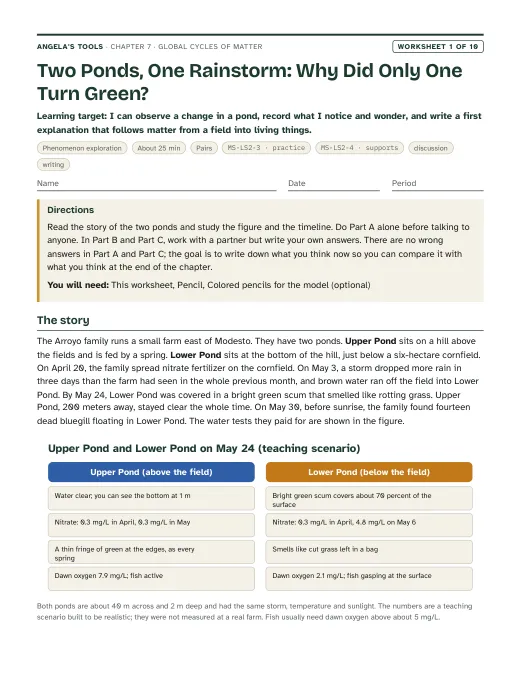
A small pond sits at the bottom of a sloping field. In early spring the field is spread with fertilizer and the pond is clear enough to see the bottom. Two weeks later a heavy storm washes across the field. Within ten days the pond is covered with a thick green scum, it smells of rot along the edges, and a neighbor finds a few dead fish in the shallows. Nobody poured anything into the pond, and the field looks healthier than ever. Where did the material in all that green scum come from, and why did the fish suffer when the plants in the field did so well?

Notice and wonder prompts

  • What has to be true about the storm, the field and the pond for the scum to appear only after the rain?
  • Green scum is made of living things. Living things are made of matter. Where did that matter come from in only ten days?
  • Why would more green growth in the pond be bad for the fish, when more green growth in the field is good for the farmer?
  • If the fertilizer had stayed in the field, where would its atoms have ended up instead?

Learning targets

  • I can explain why Earth can be modeled as a closed system for matter while energy flows in and out, and describe the exceptions.
  • I can trace a single atom of carbon, nitrogen or an atom in a water molecule through living and nonliving reservoirs and name the process that moves it at each step.
  • I can develop a model of a matter cycle that shows reservoirs, the processes connecting them and the boundary of the system, and use it to explain conservation of matter.
  • I can use a cycle model to predict what changes when people burn fossil fuels or add fertilizer, and explain the pond phenomenon.
  • I can evaluate competing solutions, such as fertilizer plans or reforestation sites, using criteria and constraints in a systematic way.

What shows the learning happened

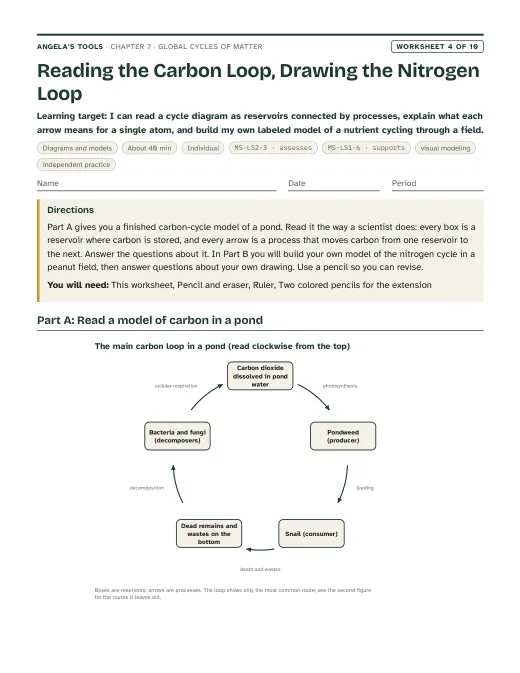
  • A labeled carbon-cycle model (W4 or Lab 1 debrief) with at least five reservoirs, the process named on every arrow, the system boundary drawn and a sentence stating that no atoms are created or destroyed.
  • A completed atom passport (Lab 1) plus a class bar chart comparing reservoir counts under natural rules and fossil-fuel-burning rules, with a written explanation of why the atmosphere count rose.
  • A two-week mass record for a sealed and an open jar (Lab 2) with a written conclusion that uses the data to argue that the sealed jar is a closed system for matter but not for energy.
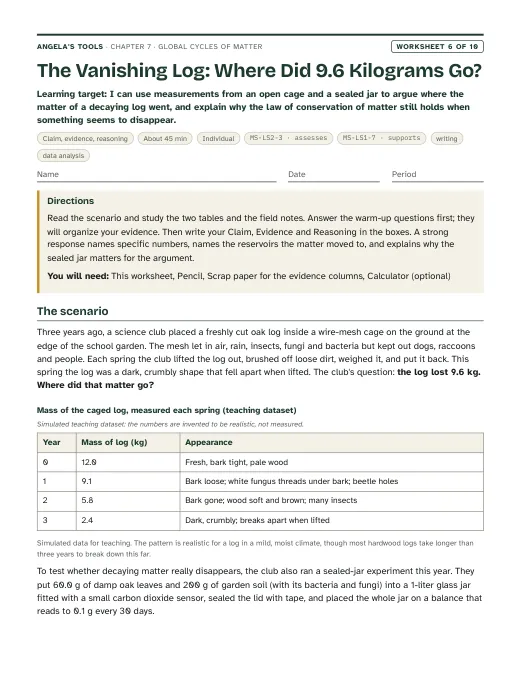
  • A Claim-Evidence-Reasoning paragraph (W6) that uses an open cage and a sealed jar to argue that a decaying log's 9.6 kg moved to the air and soil rather than disappearing.
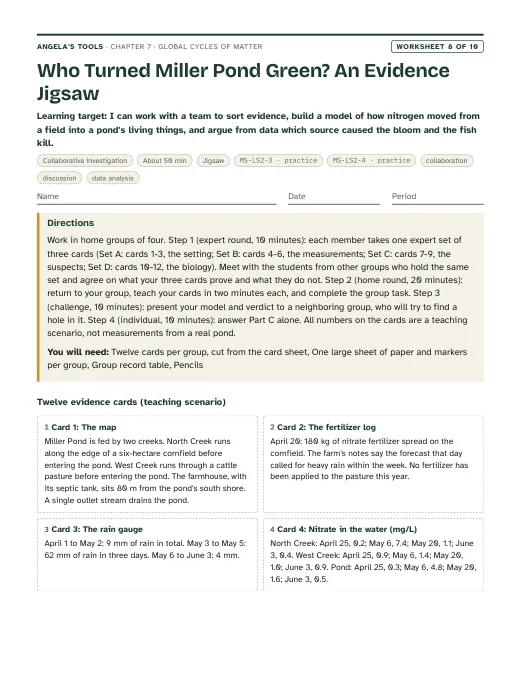
  • A group flow model and individual written answers (W8) explaining the green pond as nitrogen and other nutrients moving from field to water to algae to decomposers, with each arrow tied to an evidence card.
  • A decision matrix (Lab 3 or the presentation task) that scores every competing plan against every criterion and constraint, followed by a justified recommendation that names the trade-off accepted.
  • A short answer that correctly distinguishes what persists in a cycle (atoms) from what is rebuilt (molecules), using water or carbon dioxide as the example.

Key vocabulary 12 terms

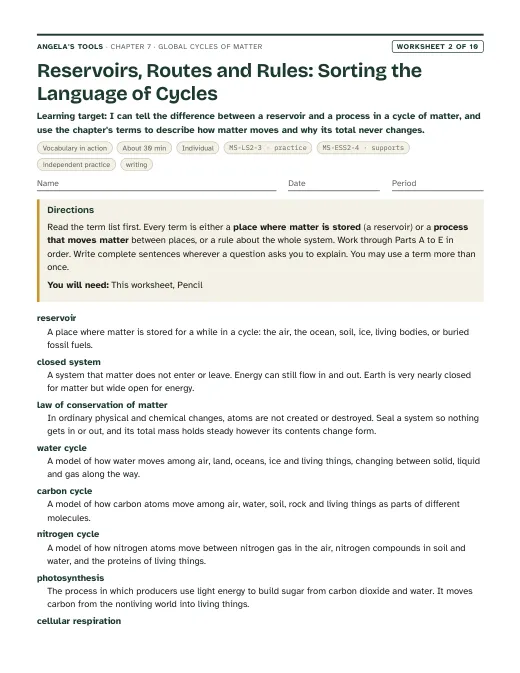
law of conservation of matterOrdinary physical and chemical changes never create or destroy atoms. Seal a system so nothing gets in or out, and its total mass holds steady no matter how its contents change form.By the law of conservation of matter, the mass of a sealed jar cannot change when the seeds inside sprout; the atoms only move from the air and water into the plant.
closed systemA system that matter does not enter or leave. Energy can still cross the boundary. Earth is very nearly a closed system for matter.The sealed jar is a closed system for matter, which is why its mass stayed within 0.1 g of the starting value for two weeks.
reservoirA place where matter is stored for a time within a cycle, such as the atmosphere, the ocean, soil, living bodies, ice or fossil fuel deposits.Fossil fuels are a carbon reservoir that holds atoms for millions of years, while a leaf is a reservoir that may hold them for a single season.
water cycleA model of how water moves among the air, land, oceans, ice and living things, changing among solid, liquid and gas along the way.The droplets on the inside of the jar lid are the water cycle running in miniature: evaporation from the soil, then condensation on the cooler lid.
carbon cycleA model of how carbon atoms move among the air, water, soil, rocks and living things as parts of different molecules such as carbon dioxide, sugars and proteins.In the carbon cycle, photosynthesis is the main road into living things and cellular respiration is the main road back out.
cellular respirationThe process in the cells of plants, animals, fungi and bacteria that breaks down sugar with oxygen to release usable energy, giving off carbon dioxide and water.The carbon atoms a squirrel exhales left its body through cellular respiration, not through digestion.
combustionBurning: a fast chemical reaction between a fuel and oxygen that releases energy and sends the fuel's carbon into the air as carbon dioxide.Combustion of a log moves most of its carbon into the air within an hour; the ash left behind is only a small part of the original mass.
fossil fuelCoal, oil or natural gas: a fuel formed over millions of years from the remains of ancient organisms buried under sediment and rock and changed by heat and pressure.Burning a fossil fuel releases carbon that photosynthesis removed from the air hundreds of millions of years ago.
nitrogen cycleA model of how nitrogen atoms move between nitrogen gas in the air, nitrogen compounds in soil and water, and the proteins and other molecules of living things.In the nitrogen cycle, bacteria do most of the work: they fix nitrogen gas, convert ammonium to nitrate, and return nitrogen gas to the air.
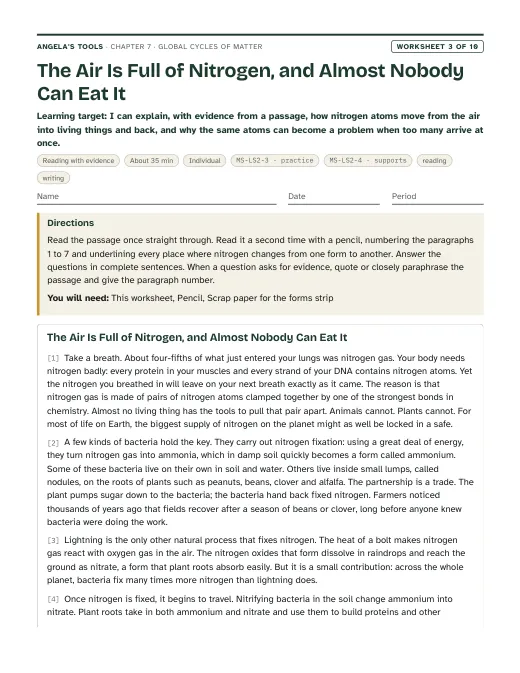
nitrogen fixationChanging nitrogen gas, which most living things cannot use, into nitrogen compounds such as ammonia that living things can use. Soil and root bacteria do most of it; lightning and fertilizer factories also fix nitrogen.Farmers rotate in peanuts or beans because the nitrogen fixation by bacteria in their roots leaves the soil richer for the next crop.
reforestationGrowing a new forest on land that was cleared or burned. As the trees grow, photosynthesis moves carbon from the air into wood.A reforestation project captures carbon fastest where sunlight, water and a long growing season let trees add wood quickly.
criteria and constraintsCriteria are the goals a solution must meet to count as a success. Constraints are the limits it must work within, such as cost, land, labor or laws.Keeping pond nitrate under 10 mg/L was a criterion for the fertilizer plan; the club's $80 budget was a constraint.

Standards alignment

California NGSS, Grade 7 Preferred Integrated Course Model. Each entry says whether this chapter's work assesses the performance expectation, gives practice toward it, or supports it as background; the resource lists below repeat this for every worksheet and lab.

MS-LS2-3Assesses: the cycling-of-matter half, with the system boundary definedCA Grade 7

Develop a model to describe the cycling of matter and flow of energy among living and nonliving parts of an ecosystem.

The chapter's core product is a student-built model of how matter cycles among living and nonliving parts of an ecosystem, with the boundary of the system stated. Lab 1 (atom passports), Lab 2 (sealed jar), W4 and the presentation task produce that evidence directly. The assessment boundary is respected: no task asks students to use chemical equations; atoms are traced by name and process.

Assessment boundary: Assessment does not include the use of chemical reactions to describe the processes.

MS-ETS1-2Assesses: evaluating competing solutions with a systematic processCA Grade 6-8

Evaluate competing design solutions using a systematic process to determine how well they meet the criteria and constraints of the problem.

The lesson's engineering spread evaluates reforestation sites against criteria and constraints. Lab 3 requires students to score five competing fertilizer plans in a decision matrix against stated criteria and constraints, and the presentation task does the same for four reforestation sites, which is direct evidence toward this PE.

MS-LS1-6Supports: photosynthesis as the entry point for carbon into living thingsCA Grade 7

Construct a scientific explanation based on evidence for the role of photosynthesis in the cycling of matter and flow of energy into and out of organisms.

Photosynthesis is treated here only as the process that moves carbon and water into producers, which is background from Lesson 4; students are not asked to construct the full explanation of photosynthesis in this chapter.

Assessment boundary: Assessment does not include the biochemical mechanisms of photosynthesis.

MS-ESS2-4Supports: the water cycle driven by the sun and gravityCA Grade 6

Develop a model to describe the cycling of water through Earth’s systems driven by energy from the sun and the force of gravity.

The water cycle in this lesson is a Grade 6 performance expectation in the California integrated sequence (MS-ESS2-4), where it is taught in full with energy from the sun and the force of gravity. Here it is reviewed as one of three matter cycles and used as the easiest example of a reservoir-and-process model; it is not assessed.

Assessment boundary: A quantitative understanding of the latent heats of vaporization and fusion is not assessed.

Science and engineering practices

  • Developing and Using Models. Students build reservoir-and-process models of the carbon and nitrogen cycles (W4, presentation diagrams), run a dice-driven simulation of carbon atoms moving among reservoirs (Lab 1), and use a sealed jar as a physical model of a closed system (Lab 2).
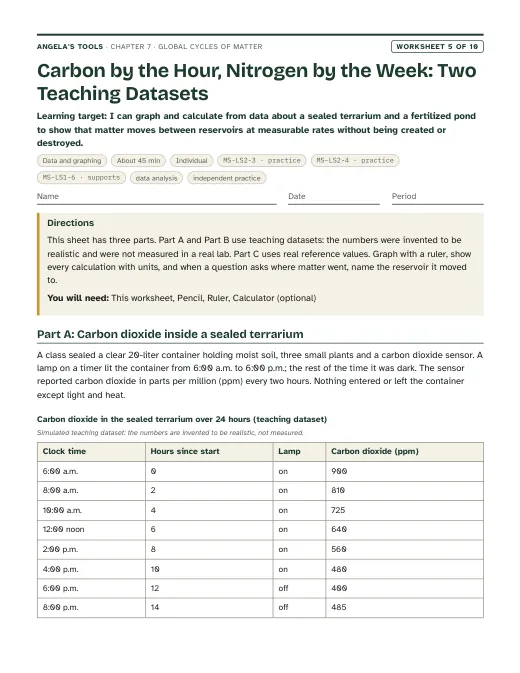
  • Analyzing and Interpreting Data. Students pool class data from the atom-passport simulation into bar charts, track jar masses over two weeks, and read simulated field and pond data to compare fertilizer plans (Lab 3, W5).
  • Constructing Explanations and Designing Solutions. Students argue from mass data where a decaying log's matter went (W6 CER), explain the green pond with a nitrogen-flow model backed by evidence cards (W8), and evaluate competing fertilizer plans and reforestation sites against criteria and constraints (Lab 3, presentation task, W9).

Disciplinary core ideas

  • LS2.B Cycles of Matter and Energy Transfer in Ecosystems. Matter moves among producers, consumers, decomposers and the nonliving environment; decomposers return nutrients to soil and water; atoms are cycled again and again because matter is conserved.
  • LS1.C Organization for Matter and Energy Flow in Organisms. Photosynthesis moves carbon from carbon dioxide into sugars; cellular respiration releases carbon dioxide and water; animals rebuild their proteins from the proteins they eat.
  • ETS1.B Developing Possible Solutions. A systematic process, a decision matrix with weighted criteria, is used to compare fertilizer plans and reforestation sites and to see which solution best meets the criteria within the constraints.

Crosscutting concepts

  • Energy and Matter. Atoms are conserved as they move through physical and chemical changes; Earth is nearly closed to matter but open to energy, and the sealed jar makes both halves of that statement testable.
  • Systems and System Models. Students define the boundary of each system they model (a jar, a pond and its field, the planet), name its reservoirs and the processes connecting them, and say what the model leaves out.
  • Stability and Change. A cycle that has run steadily for a long time can shift when one flow speeds up, as when fossil-fuel burning or fertilizer runoff adds matter to a reservoir faster than it leaves.

Presentation 27 slides

Global Cycles of Matter: the same atoms, again and again. Original, editable slides with speaker notes: a phenomenon opener, learning targets, the chapter's concepts with diagrams, vocabulary in context, 4 checks for understanding, 2 discussion prompts, an application task, a misconception check, a synthesis and an exit ticket.

Worksheets 10 of 10

Ten different tasks, one per instructional blueprint. Each has a student PDF (low ink, US Letter), an editable DOCX, an HTML preview, and a separate teacher answer key with reasoning.

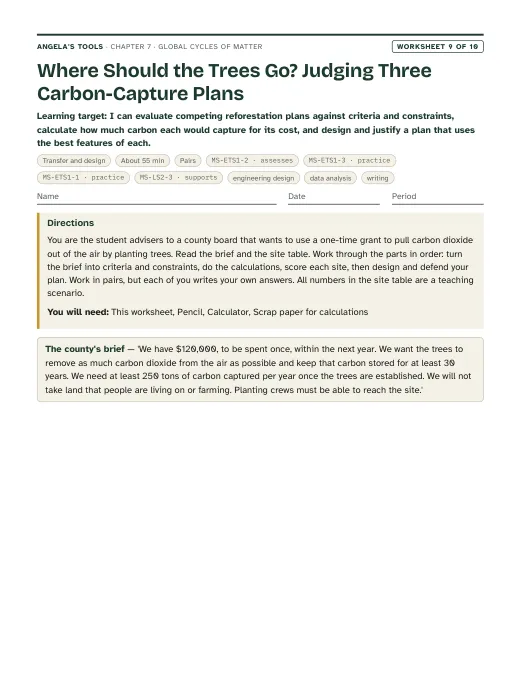
First page of Where Should the Trees Go? Judging Three Carbon-Capture Plans
Worksheet 9 · Transfer and design

Where Should the Trees Go? Judging Three Carbon-Capture Plans

I can evaluate competing reforestation plans against criteria and constraints, calculate how much carbon each would capture for its cost, and design and justify a plan that uses the best features of each.

55 minpairsExtensionEngineering designData analysisWriting MS-ETS1-2 · assessesMS-ETS1-3 · practiceMS-ETS1-1 · practiceMS-LS2-3 · supports

Collaborative labs 3 of 3

Three different investigation approaches. Each has a teacher guide (purpose, materials with quantities, estimated cost, prep, safety, procedure, expected observations, debrief, answer key, assessment criteria, accessibility adaptations, low-cost alternative) and a student recording sheet.

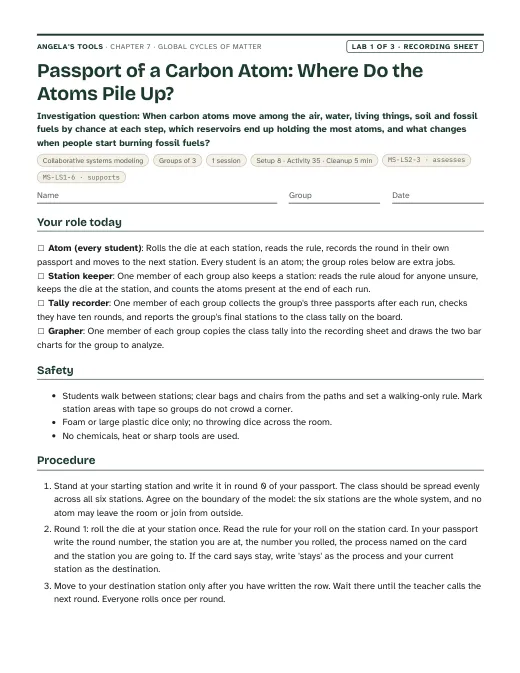
First page of the Passport of a Carbon Atom: Where Do the Atoms Pile Up? recording sheet
Lab 1 · Collaborative systems modeling

Passport of a Carbon Atom: Where Do the Atoms Pile Up?

When carbon atoms move among the air, water, living things, soil and fossil fuels by chance at each step, which reservoirs end up holding the most atoms, and what changes when people start burning fossil fuels?

Groups of 31 session35 min activityEst. 6 to 10 per class, reusableSix-sided diceStation cards printed from the rules table, one per reservoirPassport recording sheet MS-LS2-3 · assessesMS-LS1-6 · supports
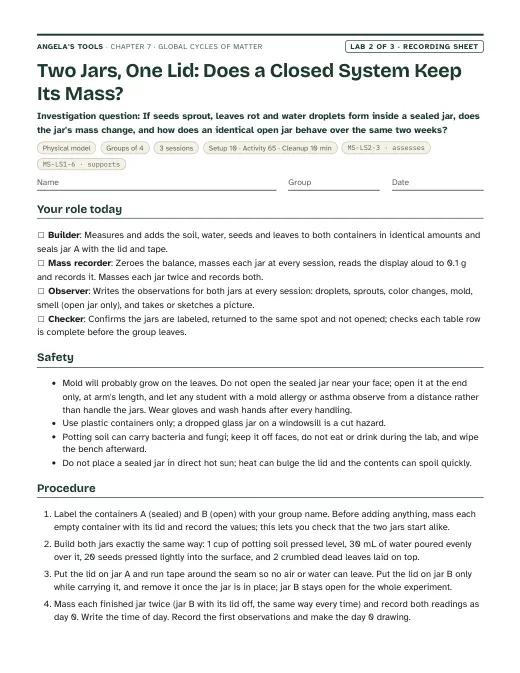
First page of the Two Jars, One Lid: Does a Closed System Keep Its Mass? recording sheet
Lab 2 · Physical model

Two Jars, One Lid: Does a Closed System Keep Its Mass?

If seeds sprout, leaves rot and water droplets form inside a sealed jar, does the jar's mass change, and how does an identical open jar behave over the same two weeks?

Groups of 43 sessions65 min activityEst. 15 to 25 per class, mostly reusableClear plastic deli containers with tight lids, about 500 mL to 1 LPotting soil (not garden soil)Grass seed or radish seed MS-LS2-3 · assessesMS-LS1-6 · supports
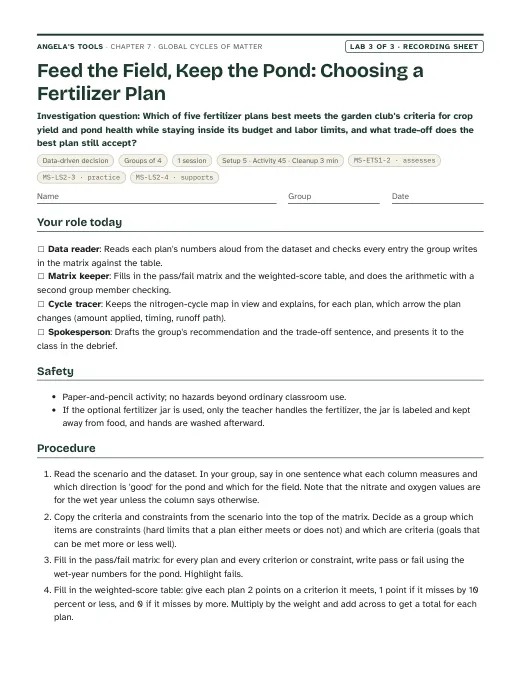
First page of the Feed the Field, Keep the Pond: Choosing a Fertilizer Plan recording sheet
Lab 3 · Data-driven decision

Feed the Field, Keep the Pond: Choosing a Fertilizer Plan

Which of five fertilizer plans best meets the garden club's criteria for crop yield and pond health while staying inside its budget and labor limits, and what trade-off does the best plan still accept?

Groups of 41 session45 min activityEst. 0 to 3 per classRecording sheet with the dataset, matrix and questionsCalculatorPrinted nitrogen-cycle map from the presentation (or W4) MS-ETS1-2 · assessesMS-LS2-3 · practiceMS-LS2-4 · supports

Teacher guidance

Suggested sequence (7 steps)
  1. Period 1: Presentation slides 1-7 (pond phenomenon, targets, Spaceship Earth, matter versus energy at the boundary). W1 phenomenon worksheet opens the period; W2 vocabulary relationships closes it.
  2. Period 2: Slides 8-10 (same atoms, new molecules; the water cycle as the first reservoir map). Lab 2 session 1: groups build and mass their sealed and open jars, record first observations and write predictions. Keep the jars in a lit spot at steady temperature.
  3. Period 3: Slides 11-15 (carbon in and out of living things, the carbon cycle map, combustion and fossil fuels, discussion). Lab 1: the atom-passport simulation, both runs, with the class tally on the board.
  4. Period 4: Lab 2 session 2 (second mass reading and observations, five minutes). Slides 16-19 (nitrogen: locked in the air, fixation, the nitrogen cycle map, where your body's nitrogen comes from). W3 reading passage in class or as homework; W4 diagram worksheet builds the student's own cycle model.
  5. Period 5: Slides 20-21 (the pond explained as a flow of nutrients; the California nitrate connection). W5 data worksheet, then W6 CER on the vanishing log (open cage versus sealed jar) as the first written assessment of conservation and system boundaries.
  6. Period 6: Slides 22-24 (people and the carbon cycle, the reforestation site task, the permanence discussion). Lab 3: the fertilizer decision matrix, or W9 transfer task if time is short. W8 collaborative evidence sort can run as the opener.
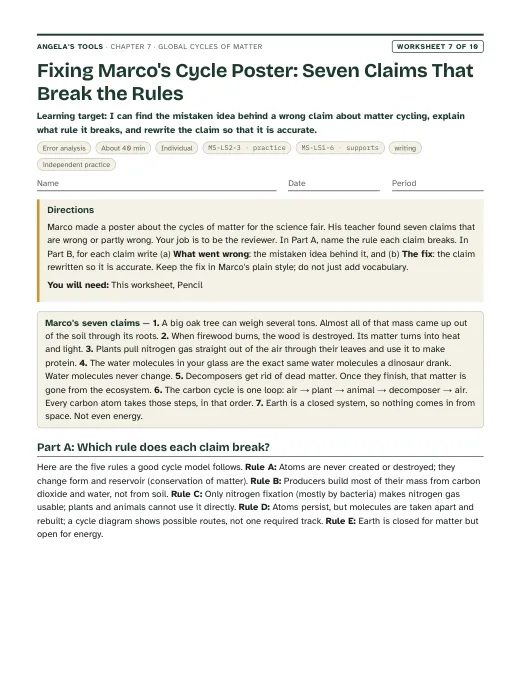
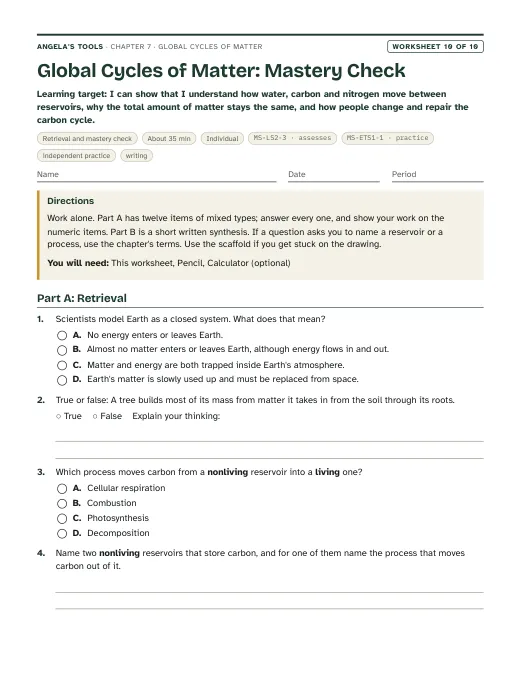
  7. Period 7: Lab 2 session 3 (final masses, open the jars, conclusion). W7 misconception repair, then slides 25-27 (combustion misconception, synthesis, exit ticket). W10 mastery as the quiz.

Materials overview: No open flames and no chemicals beyond potting soil and household fertilizer (handled only by the teacher, if used at all). Lab 1 needs six dice, printed station cards and passports. Lab 2 needs clear plastic deli containers with lids, potting soil, grass or radish seeds, a few dead leaves, tape and a balance reading to 0.1 g. Lab 3 is paper only. A clear jar of pond or aquarium water left in sunlight for a week makes a vivid live version of the phenomenon.

Common misconceptions (6)
“When wood or fuel burns, most of its matter is destroyed; that is why only a little ash is left.”
Why it happens: Students see a large log become a handful of ash and never see the gases leave. Everyday language says the fire 'used up' the wood.
Correction: Combustion rearranges atoms into carbon dioxide and water vapor, which leave as invisible gases. If you could catch every gas, the total mass of products would be greater than the log alone, because oxygen from the air joined in. Nothing was destroyed.
“A tree builds its trunk out of soil.”
Why it happens: Trees are rooted in soil, soil is heavy and visible, and fertilizer is spread on soil, so soil seems like the raw material.
Correction: Most of a tree's dry mass is carbon that came from carbon dioxide in the air through photosynthesis, plus hydrogen and oxygen from water. Soil supplies small amounts of nitrogen, phosphorus and other elements, which is why a potted plant's soil hardly loses mass as the plant grows.
“A cycle is one loop that every atom follows in the same order.”
Why it happens: Cycle diagrams are drawn as arrows around a circle, and the textbook narrates one atom's trip as a single story.
Correction: A cycle diagram is a map of possible routes. An atom may skip reservoirs, bounce between two of them, or sit in storage for a season or for millions of years. Lab 1 makes this visible: no two passports look alike.
“If Earth is a closed system, nothing gets in or out at all, including sunlight.”
Why it happens: The word closed suggests a sealed box, and the textbook does not say that energy still crosses the boundary.
Correction: Earth is nearly closed for matter but wide open for energy: sunlight streams in and heat radiates out every day. A sealed jar on a windowsill works the same way, and its plant would die in a dark closet even though the lid stays on.
“Animals get the nitrogen they need directly from the air they breathe, since air is mostly nitrogen.”
Why it happens: Students learn that 78 percent of air is nitrogen gas and that animals breathe air.
Correction: Nitrogen gas passes in and out of lungs unchanged; animal bodies cannot break its strong bond. Animals get usable nitrogen only by eating proteins, which they digest into amino acids and rebuild into their own proteins. The nitrogen in those proteins was fixed by bacteria, lightning or factories first.
“The very same water molecules have been cycling forever, so your glass holds molecules a dinosaur drank.”
Why it happens: The textbook says this directly, and it is a memorable idea.
Correction: Atoms persist; molecules do not always. Plants split water molecules during photosynthesis, and cells build new water molecules during cellular respiration. Your glass may well hold atoms that passed through a dinosaur, but many of the molecules were assembled much more recently.
Differentiation suggestions (5)
  • Multilingual learners: Pre-teach the five anchor words (reservoir, cycle, closed system, fixation, decomposer) with picture cards that show an arrow between two places; let students label the cycle maps in their home language first; pair during Lab 1 so each passport entry is read aloud before it is written.
  • Students who need more support: Provide the Lab 1 passport with the first two rounds filled in as an example, a word bank of process names (photosynthesis, cellular respiration, eating, decomposition, burning, dissolving) for every cycle map, and the Lab 3 decision matrix with the first plan already scored.
  • Students ready for extension: Ask them to add the ocean and limestone rock to the carbon-cycle model with estimated residence times, to design a fourth run of Lab 1 that models reforestation, or to research why phosphorus rather than nitrogen often limits algae in lakes and revise the pond explanation accordingly.
  • Students who need movement or alternative output: Lab 1 already moves students between stations; let the cycle model in W4 be built on the floor with rope arrows and station cards and photographed; accept a recorded 90-second spoken explanation for the Lab 2 conclusion.
  • Students with low vision or limited fine-motor control: Use large foam dice and large-print station cards in Lab 1; let a partner handle the balance in Lab 2 while the student reads and records the display aloud; provide the Lab 3 data as a large-print table and allow the matrix to be completed on a device.
Accuracy notes: where the textbook simplifies (14)
  • Closed system: the textbook says the number of atoms on Earth never changes (pp. 77, 78, 84) and then lists exceptions on p. 78. Teach that Earth is very nearly closed for matter (it gains roughly 100 tons of space dust a day and loses a few hundred tons of gas from the top of the atmosphere, both negligible against the planet's mass) and that it is open to energy: sunlight comes in and heat radiates out. The book never states the energy half, which students need for Lab 2.
  • Atoms versus molecules: p. 79 says every water molecule has been cycling since early Earth, and p. 84 says the total number of atoms and molecules never changes. Only atoms are conserved. Photosynthesis splits water molecules and cellular respiration builds new ones; a reaction can change the number of molecules while keeping every atom. Say 'the same atoms', not 'the same molecules'.
  • Oxygen from photosynthesis: p. 80 implies producers turn carbon dioxide into oxygen gas and sugar. The oxygen gas released comes from splitting water; carbon dioxide supplies the carbon in sugar. Keep this for your own understanding or for extension; MS-LS2-3 is not assessed with chemical reactions, so no student task here uses an equation.
  • Sublimation: the book's water-cycle figure (p. 79) labels the arrow from ice and snow straight to vapor as evaporation. Evaporation starts from liquid; solid to gas is sublimation. The concept spread (p. 84) also says 'water gas' where water vapor is meant.
  • Lightning and nitrogen: p. 82 says lightning's products fall as ammonia. Lightning makes nitrogen oxides, which dissolve in rain and reach the ground as nitrate (nitric acid). Ammonia is the product of bacterial and industrial fixation.
  • Industrial fixation: p. 82 says only one process fixes nitrogen and it happens two ways (lightning, bacteria). Fertilizer factories fix nitrogen on an enormous scale by the Haber-Bosch process; much of the nitrogen in food today passed through a factory. Keep the book's true point that bacteria do most natural fixation.
  • Animal nitrogen: p. 83 says you use 'the nitrates in the peanut' to build proteins. Animals cannot build protein from nitrate; they digest food proteins into amino acids and rebuild. The concept spread (p. 85) has it right: you digest protein from food.
  • Decomposition products: p. 83 says decomposers leave nitrates and ammonia. Decomposers release ammonia, which in moist soil is mostly present as ammonium; nitrifying bacteria then make nitrate. Plants can absorb both ammonium and nitrate, so 'most producers need nitrates' (p. 82) is too narrow.
  • What limits growth: p. 82 says nitrate availability limits producers in nearly all ecosystems. Nitrogen often limits growth on land, but in many lakes and ponds phosphorus is the limiting nutrient, and runoff carries both. The pond phenomenon is taught as 'nitrogen and other nutrients, especially phosphorus' for this reason.
  • Breathing versus cellular respiration: the figures use 'cellular respiration' for the arrow from animals to the air, which is fine, but keep the words separate in class: cells release carbon dioxide; lungs carry it out. Page 80 has a manatee exhaling under water; manatees surface to breathe air.
  • Fossil fuel formation: p. 81 says carbon stored 'under layers of soil' for millions of years may form fossil fuels. Fossil fuels form from organic remains buried under sediment and rock and changed by heat and pressure over millions of years; soil alone does not do it.
  • Forest carbon is not permanent: the engineering spread (pp. 86-87) never says that carbon stored in trees returns to the air if the forest burns, is cleared or decays. Any evaluation of reforestation should include long-term storage as a criterion. The spread's forest-growth map carries no date or source, so the presentation task uses an invented site table labeled simulated.
  • Share of extra carbon dioxide: p. 86 attributes climate change to fossil-fuel carbon dioxide without sizing it. Burning fossil fuels is the main source of the added carbon dioxide; clearing and burning forests and making cement add more. Do not assess a percentage.
  • Fertilizer contents: p. 82 says fertilizers include nitrates. Common fertilizers supply nitrogen as ammonium, urea or nitrate, usually along with phosphorus and potassium; soil bacteria convert the ammonium and urea forms to nitrate, which is the form that washes away most easily.

Review status: reviewed · 2026-10-19 · Re-solved every numeric and multiple-choice item in W1-W10 and Labs 1-3 (including the Lab 3 weighted matrix and W9 site arithmetic); all keys matched. Fixed one self-contradictory Lab 3 key (q2: oxygen weight 3 gives a C-E tie, not E above C). Rewrote the law-of-conservation definition in chapter.json, the presentation vocab slide and W2, which had reproduced the textbook's wording. Fixed cross-references: W6 is the decaying-log CER, not a pond CER (chapter SEP, evidenceOfLearning, sequence, three presentation links); W8 is the pond evidence task. Trimmed relatedChapters to four. Slide 13 example changed from gasoline to coal (much petroleum formed during the age of dinosaurs, so 'long before dinosaurs' was wrong for gasoline). Renderability: shortened slide 20 flow nodes and the cycle edge labels on slides 9, 12 and 17 (they overflowed their boxes); moved W1's compare bothItems into the caption (the compare renderer ignores bothItems); shortened W1 timeline descriptions. W1 key no longer cites a fertilizer mass that appears only in W8. W6 jar dataset: leaf descriptions softened and a teacher note added, because a sealed 1 L jar lacks the oxygen to decompose 60 g of leaves to crumbs; log caption now says the three-year loss is fast for oak. Lab 1 graph ticks extended to 20; Lab 2 jar mass estimate corrected; W8 teacher note no longer calls W5 'the same pond'. Standards confirmed against standards.json; MS-ESS2-1 (rock cycle) correctly left out; MS-ESS2-4 flagged as Grade 6. Labs remain physically untested.

Source references

Verified against the student edition of Bring Science Alive! 7th Grade Integrated (Student Edition). Printed page numbers appear in the book; PDF pages are the physical pages of the 524-page scan (printed + 36). The textbook is not reproduced on this site.

SectionPrinted pagesPDF pagesUsed for
Introduction: aspen forest, squirrel and decomposers; vocabulary; publisher's standards list76, 77112, 113Lesson question, the Spaceship Earth framing, the list of vocabulary terms, the publisher's MS-LS2-3 and MS-ETS1-2 claims.
1. Earth is a Closed System78114Conservation of matter, the closed-system model and its exceptions; Lab 2 and the matter-versus-energy compare diagram.
2. The Water Cycle79115The water cycle as the first reservoir map; the atoms-versus-molecules accuracy note; the sublimation note.
3. The Carbon Cycle80, 81116, 117Photosynthesis in, cellular respiration out; decomposers, soil storage, fossil fuels and combustion; Lab 1 station rules.
4. The Nitrogen Cycle82, 83118, 119Fixation by bacteria and lightning, nitrification, consumers, decomposers, denitrification; fertilizer as the link to the pond phenomenon and Lab 3.
Key Science Concept: Global Cycles of Matter and You84, 85120, 121How one person sits in all three cycles at once; the synthesis slide and the human-body check questions.
5. Designing Carbon Capture Solutions (Engineering Design)86, 87122, 123Criteria and constraints for reforestation, forest growth rates and cost; the presentation task and the decision-matrix method used in Lab 3.
Lesson Summary87123Check that every section's main idea is covered by a learning target.

External references used for accuracy checks

Related chapters