Chapter 17 · Unit 6: Processes that Shape Earth · Segment 3

The Rock Cycle

How does the rock cycle model the ways Earth's materials move and change, and where does the energy for each change come from?

MS-ESS2-1 · assessesMS-ESS2-2 · practiceMS-ESS3-1 · supports Textbook pp. 218–231 1 presentation · 10 worksheets · 3 labs

Overview

Students figure out that every rock is a temporary stop for Earth's materials. They learn to read two clues, what a rock is made of and how its grains are sized and arranged, and to connect those clues to the process that formed the rock: melting and cooling (igneous), weathering, transport, deposition and burial (sedimentary), or heat and pressure acting on solid rock (metamorphic). They then assemble the processes into the rock-cycle model, a web of routes in which any rock can become any other, and trace each route back to the energy that drives it: sunlight and gravity at the surface, Earth's hot interior below. This is the chapter where students build and use the MS-ESS2-1 model directly, and it sets up the water cycle (Lesson 18) and Earth's resources (Lesson 19).

Estimated class time: presentation about 133 minutes · worksheets about 415 minutes in total · labs 3 sessions. Seven 50-minute periods: one for the phenomenon and rock clues; one for igneous processes with the crayon lab; one for sedimentary processes; one for metamorphic processes and the mystery cards; one for the rock-cycle model and the dice system; one for energy, the California connection and the modeling task; one for synthesis and assessment. Six periods are possible if the mystery cards replace W8.

Phenomenon

The sand at the foot of the dome matches the dome

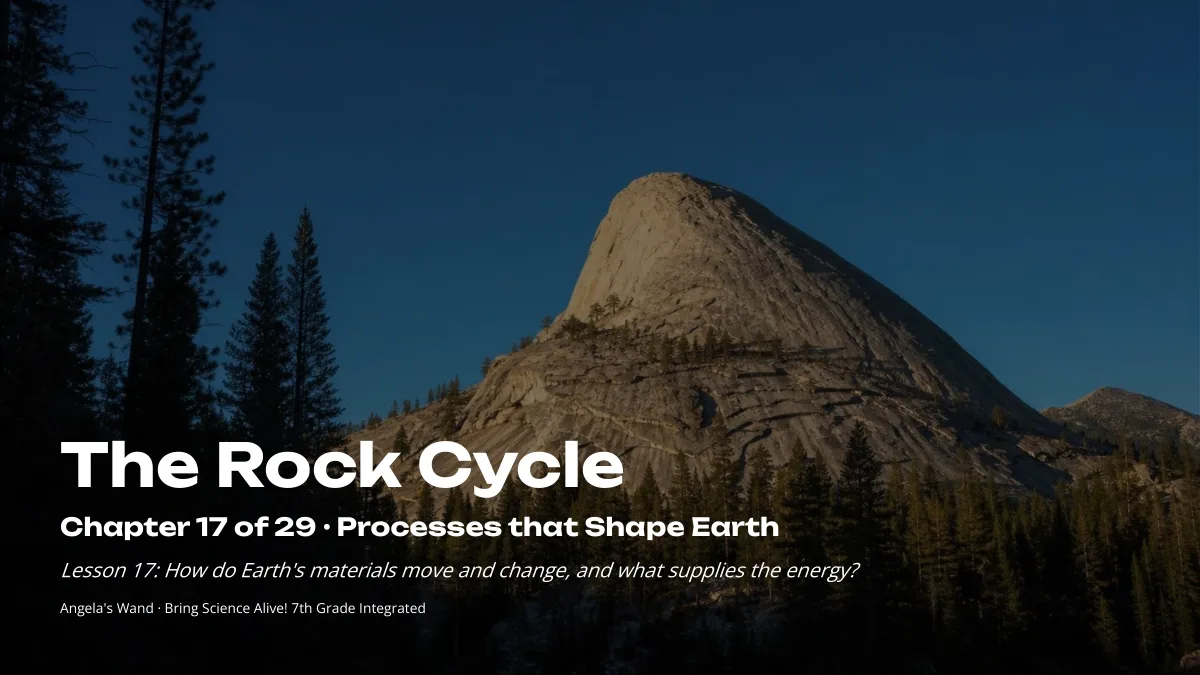
A hiker resting at the base of a bare granite dome in the Sierra Nevada scoops up a handful of gritty sand. Under a hand lens the grains are pink, white, gray and glittering black, the very same colors as the specks in the solid rock towering overhead. A geologist on the trail explains that this granite hardened several kilometers underground about 100 million years ago, and that it never erupted. Yet here it is in the open air, and here is its sand. How did rock that formed deep underground end up on a mountain top, why is it turning into sand, and what will happen to the sand next?

Notice and wonder prompts

  • What do you notice about the colors and sizes of the grains in the sand compared with the specks in the dome?
  • If the granite hardened underground, what had to happen to the rock that once lay on top of it?
  • Where will the sand be in a thousand years, and could it ever become solid rock again?
  • What supplies the energy to break a mountain into grains, and what supplied the energy to make the granite in the first place?

Learning targets

  • I can use a rock's composition and texture as clues to which rock-forming process made it: igneous, sedimentary or metamorphic.
  • I can explain how the speed of cooling controls crystal size and tell intrusive igneous rock from extrusive igneous rock.
  • I can describe how weathering, erosion, deposition, compaction and cementation turn older rock into sedimentary rock, and how dissolved material can also become rock.
  • I can explain how heat and pressure change solid rock into metamorphic rock without melting it.
  • I can develop and use a rock-cycle model that shows several routes between rock types and names the energy source that drives each process.
  • I can build an evidence-based story of how a rock formed and reached its present location, keeping observations separate from inferences.

What shows the learning happened

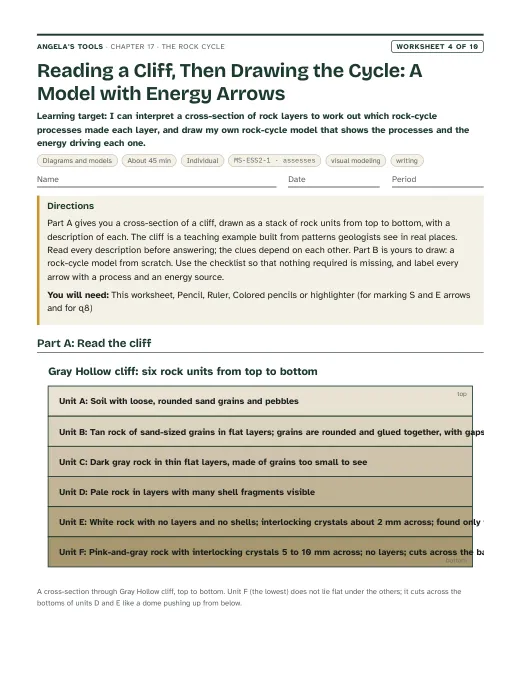
  • A completed rock-cycle model (W4 or Lab 3 recording sheet) with at least six labeled process arrows, including melting, crystallization, weathering and erosion, deposition and burial, and heat and pressure, and the energy source named for every arrow.
  • A sorted set of twelve mystery property cards (Lab 2) with each sample assigned to a rock family, the process that made it, and the energy that drove the process, with one sentence of texture evidence per card.
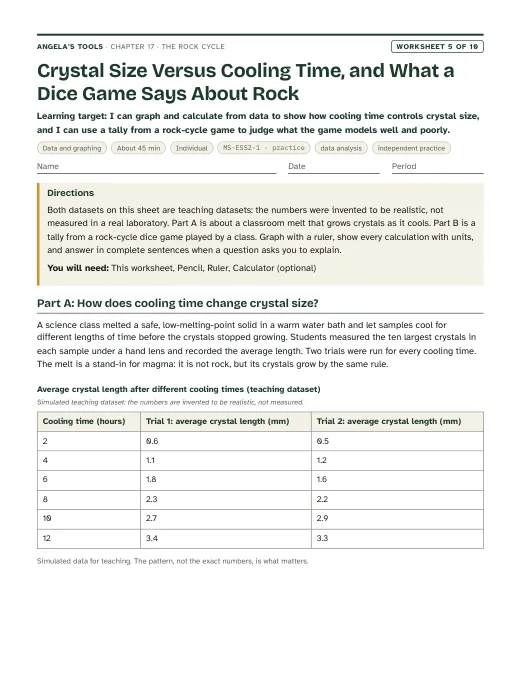
  • A data table and percentage calculation from the dice model (Lab 3) comparing the group's station counts with the class totals and explaining why the class totals are closer to the rule probabilities; W5 adds a graph of crystal size against cooling time.
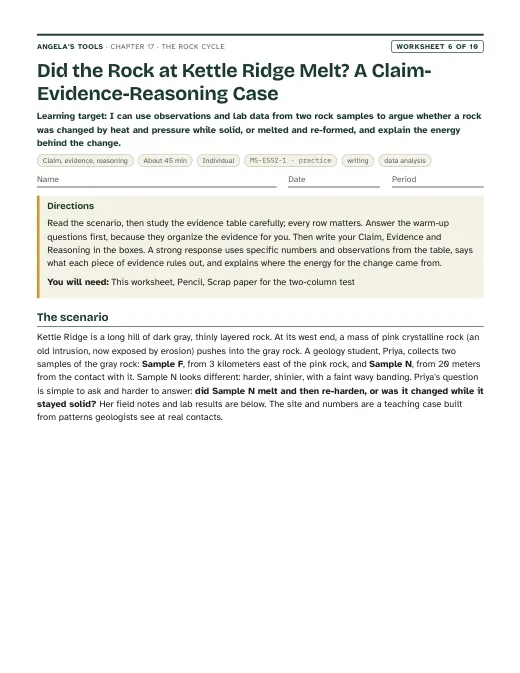
  • A Claim-Evidence-Reasoning paragraph (W6) arguing from layering, fossils, crystal size, chemistry and temperature data that a rock beside an intrusion changed while solid rather than melting, and naming the energy source; Lab 2 q5 retells how the dome's intrusive rock reached the surface.
  • Written routes (slide-21 discussion, W10 q13 or the exit ticket) that take material from one rock type to another by two different sequences of processes, with the energy source for each step.
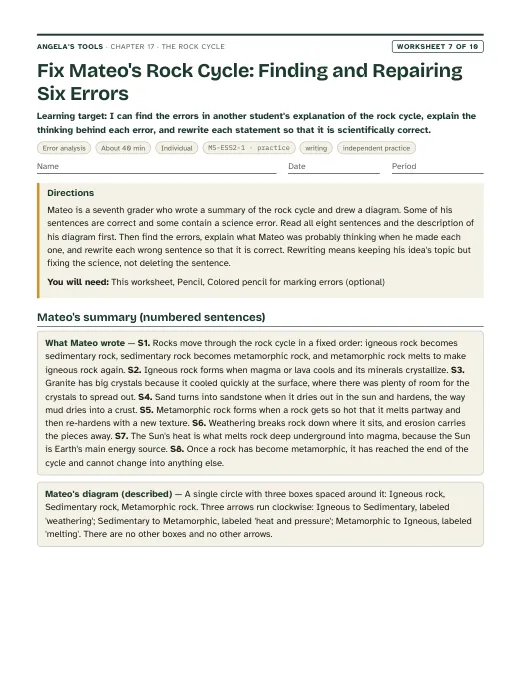
  • A corrected version of a fictional student's rock-cycle diagram (W7) that removes the single-loop error and the claim that metamorphic rock melts.

Key vocabulary 12 terms

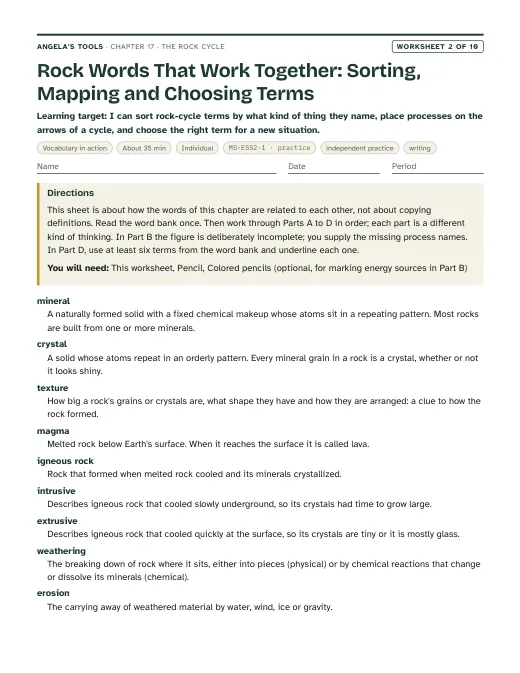
mineralA naturally formed solid with a set chemical makeup whose atoms are packed in a repeating pattern. Most rocks are built from one or more minerals locked together.The pink, white, gray and black specks in granite are four different minerals locked together.
textureHow big a rock's grains or crystals are, what shape they have and how they fit together; this is the main clue to how the rock formed.A coarse texture with interlocking crystals tells a geologist the rock cooled slowly from melted rock.
igneous rockRock that forms when melted rock, called magma underground or lava at the surface, cools and hardens.Both the granite of a mountain dome and the dark basalt of a lava flow are igneous rock.
intrusive rockIgneous rock that hardened slowly below the surface, giving its crystals time to grow large enough to see.Because granite is intrusive, finding it at the surface means the rock above it was removed.
extrusive rockIgneous rock that hardened quickly at the surface, so its crystals are tiny or the rock is mostly natural glass.Basalt from a lava flow is extrusive, which is why you need a lens to see its crystals.
weatheringThe breakdown of rock at Earth's surface, either physically, by cracking into pieces, or chemically, by reactions that change or dissolve its minerals.Years of freezing, thawing and rain are weathering the dome into loose grains.
sedimentLoose pieces of rock, mineral grains or shells that wind, water, ice or gravity can move and later drop.The river slowed as it entered the lake and dropped its sediment in a fan near the mouth.
sedimentary rockRock made from sediment that was deposited, buried, pressed together and cemented by minerals, or from minerals that crystallized out of water.The flat layers in the canyon wall are sedimentary rock built from sand dropped by an ancient river.
metamorphic rockOlder rock whose texture or mineral makeup was changed by heat, pressure or hot fluids while it stayed solid.Marble is metamorphic rock: it was limestone until heat regrew its crystals.
deformationThe slow bending and squeezing of solid rock by tectonic forces, which flattens its crystals and lines them up, often in bands.Deformation where two plates collide produced the wavy light and dark bands in the gneiss.
recrystallizationThe regrowth of the crystals inside solid rock into new or larger crystals, for example when heat flows in from nearby magma.Recrystallization turned the sand grains of a sandstone into the fused crystals of quartzite.
rock cycleA model of the many routes by which rock material is recycled: any rock can be weathered into sediment, changed by heat and pressure, or melted, and then become a new rock.In the rock cycle model there is no required order, so a rock can skip straight from igneous to metamorphic.
Standards alignment

California NGSS, Grade 7 Preferred Integrated Course Model. Each entry says whether this chapter's work assesses the performance expectation, gives practice toward it, or supports it as background; the resource lists below repeat this for every worksheet and lab.

MS-ESS2-1Assesses: the whole PE: a model of cycling Earth's materials and the energy that drives itCA Grade 7

Develop a model to describe the cycling of Earth’s materials and the flow of energy that drives this process.

The lesson's core is the rock cycle model. Lab 3, W4 and the slide-23 task require students to build or complete a model with melting, crystallization, weathering, deformation and sedimentation and to label the energy source for each arrow, which is direct evidence toward this PE. Nothing asks students to identify or name minerals, so the assessment boundary is respected.

Assessment boundary: Assessment does not include the identification and naming of minerals.

MS-ESS2-2Practice toward: explaining surface change from evidence, at the scale of a single formationCA Grade 7

Construct an explanation based on evidence for how geoscience processes have changed Earth’s surface at varying time and spatial scales.

The phenomenon (an intrusive dome now exposed and weathering) and the rock-detective slides ask students to explain from texture and setting how a formation reached the surface and is changing. This builds the explanation practice; the time-and-space-scale comparison the PE requires is developed in Lessons 11 and 26.

MS-ESS3-1Supports: the geologic-process background for uneven resource distributionCA Grade 7

Construct a scientific explanation based on evidence for how the uneven distributions of Earth’s mineral, energy, and groundwater resources are the result of past and current geoscience processes.

Students see that each rock type forms only under certain conditions (slow cooling at depth, evaporating lakes, plate collisions), which is the background for why building stone, salt and metal ores are found in some places and not others. The lesson itself does not construct the resource-distribution explanation.

Science and engineering practices

  • Developing and Using Models. Students make and recycle crayon-wax rocks (Lab 1), run a dice-driven rock-cycle system and revise its rules for a new setting (Lab 3), complete the cycle diagram with energy labels (W4), and evaluate where each model matches and fails to match Earth.
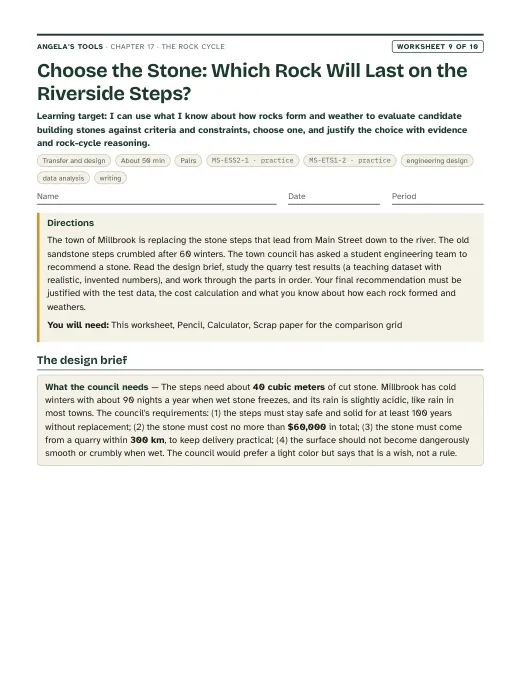
  • Constructing Explanations. Students explain from texture and setting how an unlabeled sample formed and reached its location (Lab 2, W8), argue from data whether a rock melted or changed while solid (W6 CER), and justify a building-stone choice from how each rock formed (W9), separating observations from inferences the way a field geologist does.
  • Analyzing and Interpreting Data. Students pool class dice data to find how often material sits at each station and compare group results with class results and with the rule probabilities (Lab 3); they graph crystal size against cooling time and interpret a game tally (W5).

Disciplinary core ideas

  • ESS2.A Earth's Materials and Systems. All Earth processes result from energy flowing and matter cycling; the energy comes from the Sun and Earth's hot interior. Melting, crystallization, weathering, deformation and sedimentation act together to form the rocks of the geosphere.
  • ESS2.C The Roles of Water in Earth's Surface Processes. Water weathers rock physically and chemically, carries sediment and dissolved material, drops sediment when it slows, and leaves minerals behind when it evaporates. This is background here and the focus of Lesson 18.

Crosscutting concepts

  • Energy and Matter. Every arrow in the rock cycle is a flow of matter driven by a flow of energy. Students must name the energy source for each process and notice that rock material is conserved while its form changes.
  • Stability and Change. A mountain looks permanent on a human timescale but is changing on a geologic one. The dice model shows material spending many turns in one state before a change, and the class data shows change as the long-run rule.
  • Patterns. Texture patterns (interlocking crystals, layered grains, flattened and banded crystals) repeat across rocks formed the same way, which lets students infer a process from a sample they have never seen.

Presentation 28 slides

The Rock Cycle: every rock is a temporary stop. Original, editable slides with speaker notes: a phenomenon opener, learning targets, the chapter's concepts with diagrams, vocabulary in context, 4 checks for understanding, 2 discussion prompts, an application task, a misconception check, a synthesis and an exit ticket.

Worksheets 10 of 10

Ten different tasks, one per instructional blueprint. Each has a student PDF (low ink, US Letter), an editable DOCX, an HTML preview, and a separate teacher answer key with reasoning.

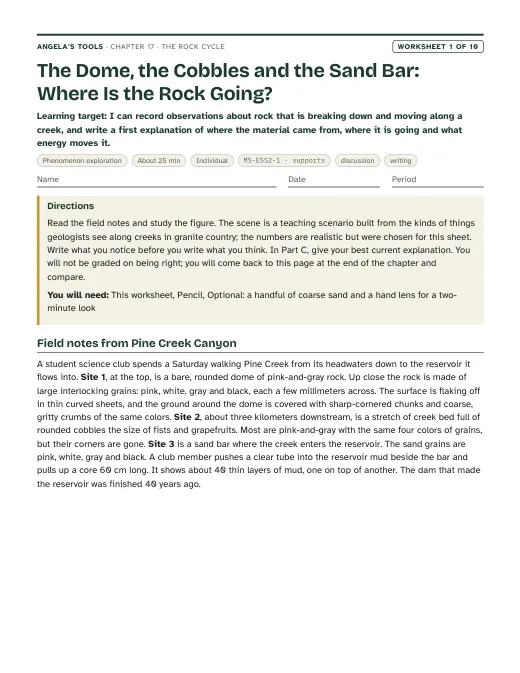
First page of The Dome, the Cobbles and the Sand Bar: Where Is the Rock Going?
Worksheet 1 · Phenomenon exploration

The Dome, the Cobbles and the Sand Bar: Where Is the Rock Going?

I can record observations about rock that is breaking down and moving along a creek, and write a first explanation of where the material came from, where it is going and what energy moves it.

25 minindividualActivates prior knowledgeDiscussionWriting MS-ESS2-1 · supports
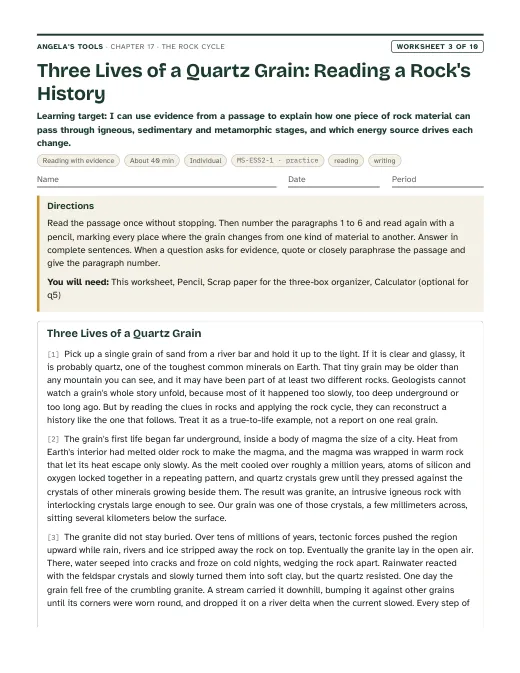
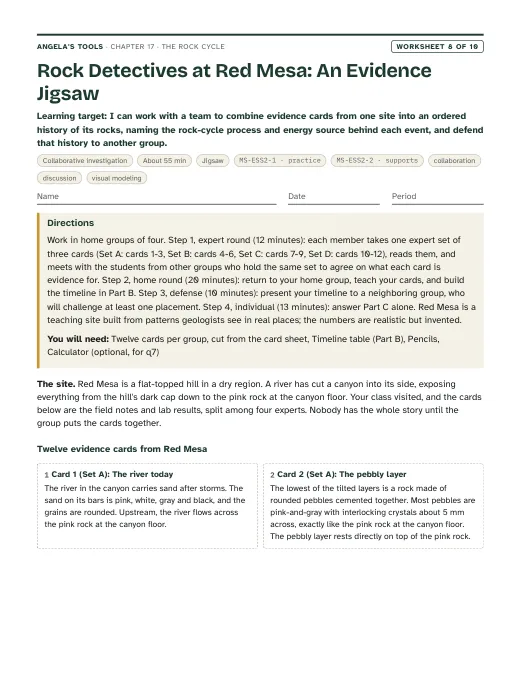
First page of Did the Rock at Kettle Ridge Melt? A Claim-Evidence-Reasoning Case
Worksheet 6 · Claim, evidence, reasoning

Did the Rock at Kettle Ridge Melt? A Claim-Evidence-Reasoning Case

I can use observations and lab data from two rock samples to argue whether a rock was changed by heat and pressure while solid, or melted and re-formed, and explain the energy behind the change.

45 minindividualPracticeWritingData analysis MS-ESS2-1 · practice
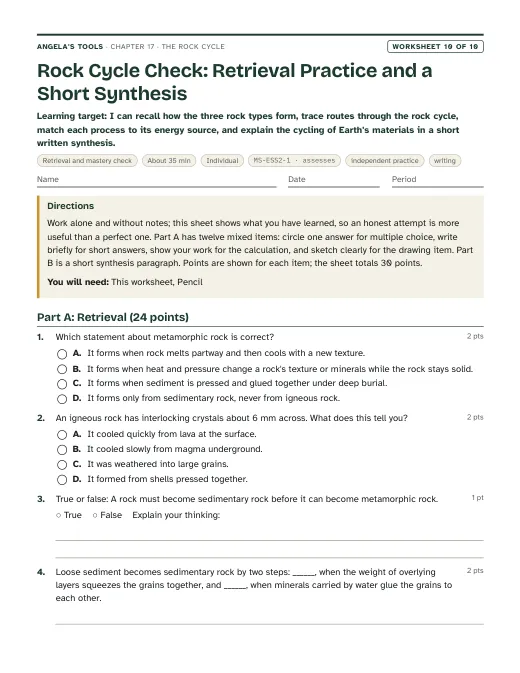
First page of Rock Cycle Check: Retrieval Practice and a Short Synthesis
Worksheet 10 · Retrieval and mastery check

Rock Cycle Check: Retrieval Practice and a Short Synthesis

I can recall how the three rock types form, trace routes through the rock cycle, match each process to its energy source, and explain the cycling of Earth's materials in a short written synthesis.

35 minindividualAssessmentIndependent practiceWriting MS-ESS2-1 · assesses

Collaborative labs 3 of 3

Three different investigation approaches. Each has a teacher guide (purpose, materials with quantities, estimated cost, prep, safety, procedure, expected observations, debrief, answer key, assessment criteria, accessibility adaptations, low-cost alternative) and a student recording sheet.

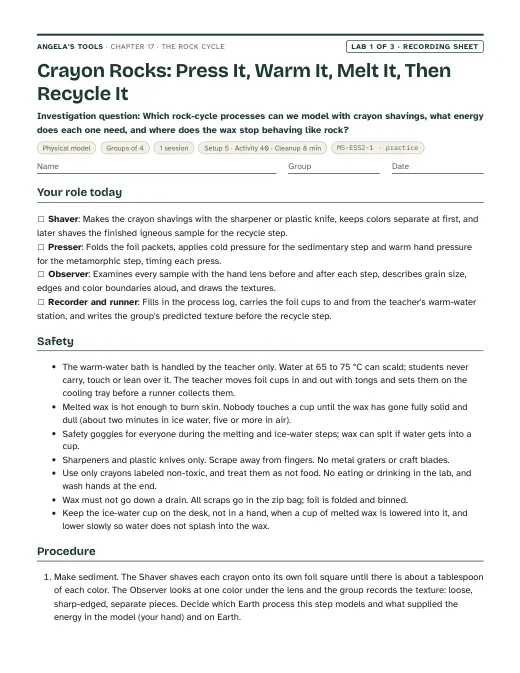
First page of the Crayon Rocks: Press It, Warm It, Melt It, Then Recycle It recording sheet
Lab 1 · Physical model

Crayon Rocks: Press It, Warm It, Melt It, Then Recycle It

Which rock-cycle processes can we model with crayon shavings, what energy does each one need, and where does the wax stop behaving like rock?

Groups of 41 session40 min activityEst. 8 to 12 per classOld crayons, paper removed, in three or four contrasting colorsHandheld pencil sharpener or plastic picnic knifeAluminum foil squares, about 15 cm MS-ESS2-1 · practice
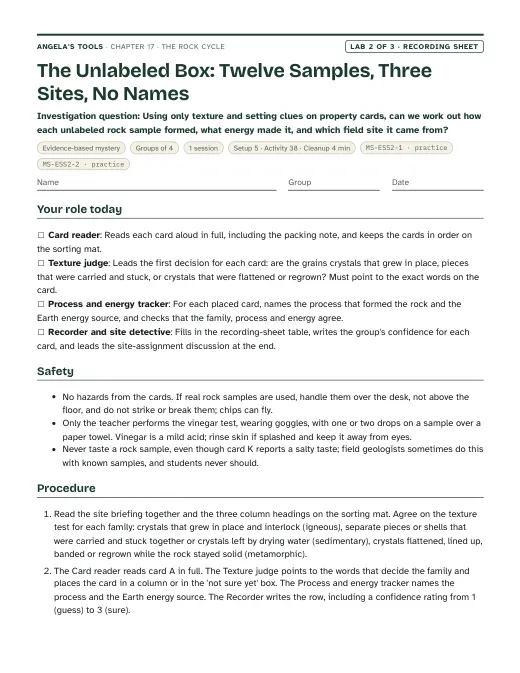
First page of the The Unlabeled Box: Twelve Samples, Three Sites, No Names recording sheet
Lab 2 · Evidence-based mystery

The Unlabeled Box: Twelve Samples, Three Sites, No Names

Using only texture and setting clues on property cards, can we work out how each unlabeled rock sample formed, what energy made it, and which field site it came from?

Groups of 41 session38 min activityEst. 1 to 3 per class for printing; 20 to 40 if a rock sample kit is boughtPrinted property card set (twelve cards, A to L), cut apartSorting mat: a sheet with three family columns and a 'not sure yet' boxSite briefing sheet describing Sites 1, 2 and 3 MS-ESS2-1 · practiceMS-ESS2-2 · practice
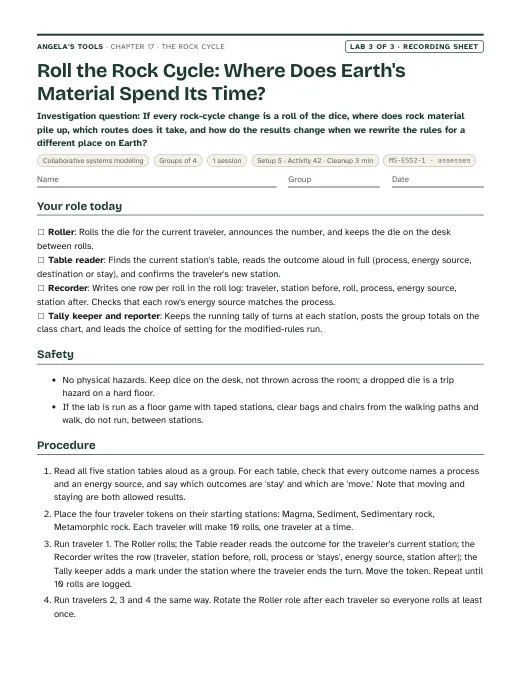
First page of the Roll the Rock Cycle: Where Does Earth's Material Spend Its Time? recording sheet
Lab 3 · Collaborative systems modeling

Roll the Rock Cycle: Where Does Earth's Material Spend Its Time?

If every rock-cycle change is a roll of the dice, where does rock material pile up, which routes does it take, and how do the results change when we rewrite the rules for a different place on Earth?

Groups of 41 session42 min activityEst. 0 to 5 per classSix-sided dieStation tables sheet (five tables, A4, one per group)Four traveler tokens (coins, buttons or counters) MS-ESS2-1 · assesses

Teacher guidance

Suggested sequence (7 steps)
  1. Period 1: Slides 1-7 (phenomenon, targets, minerals and the two clues, the three families, first check). W1 phenomenon worksheet opens the period; W2 vocabulary relationships closes it or goes home.
  2. Period 2: Slides 8-11 (cooling speed and crystal size, intrusive versus extrusive, vocab, check). Lab 1, the crayon-wax rock cycle, runs in the second half; the teacher handles the warm-water bath. W3 reading passage for homework.
  3. Period 3: Slides 12-15 (weathering to sandstone, dissolved material to limestone and halite, the river-mouth discussion). W5 Part A (crystal size versus cooling time) reviews Period 2 here or as homework.
  4. Period 4: Slides 16-18 (metamorphism without melting, vocab, the cookie-dough check). Lab 2, the mystery property cards, fills the rest of the period. W8, the 55-minute Red Mesa evidence jigsaw, can replace Lab 2 or run in Period 6.
  5. Period 5: Slides 19-21 (the cycle as a web, energy sources, the no-melting-route discussion). Lab 3, the dice-driven rock cycle, including the class data pool. W5 Part B (a dice-game tally) follows the class data pool.
  6. Period 6: Slides 22-25 (California connection, the route-tracing task, energy check, how geologists investigate). W4 diagram worksheet and W6 CER on whether the Kettle Ridge rock melted. W9 transfer task for students who finish early.
  7. Period 7: Slides 26-28 (misconception, synthesis, exit ticket). W7 misconception repair as the warm-up, then W10 mastery as the quiz.

Materials overview: No open flames anywhere in the chapter. Lab 1 uses old crayons, pencil sharpeners or plastic knives, aluminum foil, paper muffin liners, hand lenses, a cup of ice water and a teacher-only bath of hot tap or kettle water at about 65 to 75 °C handled with tongs. Lab 2 uses printed property cards and sorting mats; a few real rock samples and a dropper of white vinegar are optional. Lab 3 uses dice, printed station tables and the recording sheet. A hand lens and a small bag of coarse sand make the phenomenon concrete; a photo of a Sierra Nevada dome works otherwise.

Common misconceptions (5)
“The rock cycle runs in one fixed order: igneous, then sedimentary, then metamorphic, then back to igneous.”
Why it happens: Most textbook diagrams, including this one, are drawn as a loop, and the word cycle suggests a sequence like the seasons.
Correction: The rock cycle is a web of possible routes, not a loop. Any rock can be weathered into sediment, changed by heat and pressure, or melted. A granite can become sand, then sandstone, then quartzite without ever melting, and a basalt can melt and harden twice in a row.
“Metamorphic rock forms when rock gets hot enough to soften or partly melt.”
Why it happens: The lesson's cookie-dough comparison and the words heat and pressure suggest something soft being baked. Students also know that heat melts things.
Correction: Metamorphism happens to solid rock. Atoms rearrange inside the crystals and crystals regrow or line up, but the rock never becomes liquid. If a rock melts, it leaves the metamorphic path and becomes magma, and whatever hardens from it is igneous.
“Rocks are permanent; a mountain or a boulder has always looked the way it does now and always will.”
Why it happens: Rock changes are far too slow to see in a lifetime, and everyday language uses rock to mean unchanging.
Correction: Every rock is a temporary form. The dome in the phenomenon is losing grains every year, and over millions of years it will be gone. The dice model shows material sitting in one state for many turns and still changing eventually.
“Where you find a rock tells you what kind it is: rock at the surface must have formed at the surface.”
Why it happens: Students reason that intrusive rock formed underground, so it should still be underground.
Correction: Uplift by tectonic forces and erosion of the overlying rock bring deep rocks to the surface. Finding granite on a mountain top is evidence that kilometers of rock above it were removed. Texture, not location, tells you how a rock formed.
“Big crystals mean the rock is made of different minerals than small crystals.”
Why it happens: Students link the look of a rock to its ingredients because that works for food and for most everyday objects.
Correction: Crystal size mainly records cooling time. Magma of the same makeup grows large crystals if it cools slowly underground and tiny ones if it cools fast at the surface, so gabbro, with crystals you can see, and basalt, with crystals too small to see, can share the same ingredients and still look quite different.
Differentiation suggestions (5)
  • Multilingual learners: Pre-teach the three family names with a gesture for each (melt and cool, settle and press, squeeze and heat) and a picture card showing the texture. Provide the process words as a labeled strip (weathering, erosion, deposition, burial, melting, cooling, heat and pressure) that students keep out during Labs 1-3. Let the property cards in Lab 2 be read aloud by a partner.
  • Students who need more support: Give a rock-cycle diagram with the five stations already placed and only the arrows to label; provide a two-column energy bank (Sun and gravity; Earth's interior) for every process; in Lab 3 reduce the rolls to six per traveler and supply the tally table with the class totals already entered.
  • Students ready for extension: Ask them to add a sixth station to the dice model (dissolved material in the ocean) with their own rule table and justify each probability; to explain why pumice can float; or to research how the Sierra Nevada granite was dated and how long a magma body that size takes to cool.
  • Students who need movement or alternative output: Run Lab 3 as a floor game with five taped stations and students walking as rock material; let the W4 model be built with string and labeled cards on a table instead of drawn; accept a recorded 60-second spoken route for the exit ticket.
  • Students with limited fine-motor control or low vision: Pre-shave the crayons for Lab 1 and use large foil squares; print the property cards in large type with raised-dot codes for the three families; let a partner roll the die while the student reads the table and calls the destination.
Accuracy notes: where the textbook simplifies (12)
  • Mineral definition: the book (pp. 219, 221, 231) defines a mineral as a crystalline substance with a set chemical makeup and shape, which would admit table sugar. Teach that a mineral forms naturally, is solid, has a set chemical makeup (some, like plagioclase feldspar, vary within limits) and has atoms in a repeating pattern. The MS-ESS2-1 boundary excludes identifying and naming minerals, so never assess mineral names.
  • Light versus heavy elements: Figures 3A and 3B say granite forms from magma rich in light elements like silicon and gabbro and basalt from magma rich in heavy elements like iron. Gabbro and basalt are also rich in magnesium, which is lighter than silicon. Say instead that granite is silica-rich and light colored while gabbro and basalt are iron- and magnesium-rich, dark and denser.
  • Pumice: the book says pumice is made mostly of silica, or glass, and has no crystals at all (p. 223). Silica is a compound; glass is a non-crystalline solid. Pumice is mostly frothy natural glass but often carries crystals that grew in the magma before the eruption. Say that pumice cooled too fast for new crystals to grow.
  • Pyroclastic material and lava: the book calls magma that erupts explosively pyroclastic material and magma that erupts non-explosively lava. Geologists use pyroclastic for the fragments blasted out in explosive eruptions and lava for any molten rock that reaches the surface.
  • Limestone and evaporation: p. 225 says minerals crystallizing as water evaporates form rock such as limestone. Evaporation mainly leaves evaporite rocks such as halite (rock salt) and gypsum; most limestone forms from the shells and skeletons of marine organisms. The deck uses halite as the evaporation example and shells as the limestone example. The book's term dissolved sediment is replaced with dissolved material or dissolved minerals.
  • Breccia versus sandstone: Figure 4A explains the difference by slope steepness. The more general idea is transport distance: angular pieces in breccia traveled only a short way, while long transport by water rounds and sorts grains. The deck teaches both the energy-of-the-carrier idea and the distance idea.
  • Deformation and recrystallization: Section 5 presents these as two kinds of metamorphic rock. Geologists distinguish regional metamorphism (wide areas, plate collisions, which both deforms and recrystallizes) from contact metamorphism (local heating beside magma, driven mainly by heat, not high pressure). Recrystallization happens in both. The deck keeps the book's two labels as a simplified model and says so. Hot fluids also drive metamorphism; the book omits them.
  • Metamorphism is not melting: the cookie-dough comparison (pp. 226-227) can suggest softening or baking. Metamorphic rock stays solid throughout; rock that melts becomes magma and the result is igneous. At the most extreme temperatures some rock partly melts, which is beyond this grade.
  • The cycle is a web, not a loop: the book's text says any rock type can change into any other, but Figure 6 reads as a single loop and gives no timescales. Teach the model as a map of possibilities with no required order and with timescales from moments (pumice freezing in an eruption, a rockfall) to millions of years (an intrusion cooling, a mountain eroding). Shortcut arrows such as sedimentary rock straight to magma are model simplifications: rock heated toward melting is normally metamorphosed on the way, so the shortcut means no lasting metamorphic rock forms, not that the rock skipped the heating.
  • Cooling speed and crystal size: p. 222 says texture is determined by how fast magma cools. Cooling time is the main control at this level, but magma makeup matters too; water-rich magma can grow very large crystals (pegmatite) without unusually slow cooling. Say main control, not only control.
  • Formation ages: the p. 220 photo labels give rounded ages (Enchanted Rock about 1 billion years, Navajo Sandstone about 200 million years, Antelope Island rock about 1.7 billion years). These are approximate and are not assessed. The phenomenon's Sierra Nevada granite age of about 100 million years is a rounded figure for the main pulses of the Sierra Nevada batholith, which range from roughly 120 to 85 million years.
  • OCR gaps: printed p. 218 is a full-page photo; the standards box on p. 219, the figure labels on pp. 221, 223, 224 and 226, the p. 228 cycle diagram and the p. 229 metamorphic callout are garbled or missing in the text file. Diagram facts used here (granite's four minerals; schist at moderately high and gneiss at very high temperature; any rock type can become metamorphic) come from the prior reviewed notes for this lesson, which were checked against rendered pages.

Review status: reviewed · 2026-10-19 · Re-solved every numeric, multiple-choice, true/false, fill and table item in W1-W10 and Labs 1-3 (rates in W1 q5, W3 q5, W5 q2/q4/q7, W8 q7, W9 q2/q4, W10 q7; Lab 1 q8; Lab 3 q3/q4); keys agree with independent solutions except as noted. Lab 3: recomputed the dice model's long-run fractions exactly (16, 12, 25, 15 and 21 parts of 89); igneous is 13 percent, not 14, corrected in prep, debrief and teacher notes. A simulation (20,000 groups, 5,000 classes) replaced the 'typically within 5 points' claim with measured odds, and q1's 'fewest' station now allows sedimentary rock as well as igneous. Uplift outcomes now say Earth's interior does the lifting. W5 Part B tally was internally impossible (the moves required at least 26 starting students for a class of 24); rows rebalanced so moves in and out reconcile, keeping 240 rolls, 120 stays, 60 metamorphic rolls and every keyed answer; q9 and q11 keys updated. Science fixes: granite and basalt do not share ingredients (slide 9 caption and misconception 5 now use gabbro and basalt); W6 Sample F peak raised from 40 to 100 °C to fit burial beside a pluton, and its key no longer says the even weight of overlying rock aligns crystals; W4 q6 grains no longer travel uphill; slide 8 lava cooling time matches slide 9; Lab 1 q8 no longer credits wax evaporation; Sierra foothills belt and Mono Craters wording tightened; accuracy note added that shortcut arrows such as sedimentary rock to magma are model simplifications. Ambiguity fixes: W2 q1 hint that only one bin has three words (all three do); W1 q5 now asks for years after the dam was finished; W4 q4 key no longer asserts B and C predate the intrusion; Lab 2 Site 2 now includes the canyon that card C's packing note names. Consistency: W5 is about crystal size and a dice tally, W6 about the Kettle Ridge contact and W8 about the Red Mesa jigsaw; chapter sequence, evidenceOfLearning, threeDimensions and slide links corrected to match. Lab 1 step reference, MS-ESS2-2 lesson numbers in W8 and estimatedMinutes (133, the pacing sum) fixed; caGrade added to W1 and all lab standards. Originality sweep: fourteen 6-plus-word runs shared with the lesson text (texture definition, mineral ladder, color list, pumice quote) reworded; none remain outside sourceReferences. Dome facts (granite cooled several kilometers deep, about 100 million years ago with main pulses roughly 120 to 85 million years, later uplifted and exposed by erosion) checked against standard geology; the cited NPS page was not re-fetched in review. Labs remain physically untested.

Source references

Verified against the student edition of Bring Science Alive! 7th Grade Integrated (Student Edition). Printed page numbers appear in the book; PDF pages are the physical pages of the 524-page scan (printed + 36). The textbook is not reproduced on this site.

SectionPrinted pagesPDF pagesUsed for
Introduction: the Rock Castle and the traveling sand218, 219254, 255Lesson question, the idea that rock breaks into sand that will become rock again, vocabulary list, the publisher's standards box.
1. Observing Rocks: composition and texture, three field-trip formations220256The two clues (composition, texture), the three families defined by process, Lab 2 property cards, slide 6.
2. Materials That Make Up Rocks: atoms, crystals, minerals221257Mineral vocabulary, the atoms-to-crystal-to-mineral-to-rock ladder on slide 4, accuracy note on the mineral definition.
3. Igneous Processes: intrusion and extrusion222, 223258, 259Cooling speed and crystal size, intrusive versus extrusive, uplift and erosion of an intrusion (the phenomenon), Lab 1 fast and slow cooling, accuracy notes on pumice and element density.
4. Sedimentary Processes: physical and chemical sedimentation224, 225260, 261Weathering, transport, deposition, compaction and cementation flow (slide 13), dissolved material to shells and halite (slide 14), Lab 1 pressing step, Lab 2 limestone and halite cards.
5. Metamorphic Processes: deformation and recrystallization226, 227262, 263Heat and pressure on solid rock, banding and foliation, marble and quartzite pairs, Lab 1 warm-pressing step, accuracy notes on the cookie analogy and the two-category simplification.
6. Recycling the Three Types of Rock and Key Science Concept: Modeling the Rock Cycle228, 229264, 265The cycle as a model, any rock to any other, energy from the Sun, gravity and Earth's interior; slides 19-21, Lab 3 station tables, W4 model.
7. How Scientists Investigate Rocks and Lesson Summary230, 231266, 267Field and lab methods, observation versus inference, rock-detective slide 25, Lab 2 site assignment, the lesson summary used to check coverage.

External references used for accuracy checks

  • What is the difference between a rock and a mineral? (U.S. Geological Survey): Accurate mineral definition (naturally occurring, orderly internal structure, characteristic composition) used in the vocabulary and accuracy notes.
  • What are metamorphic rocks? (U.S. Geological Survey): Metamorphism does not melt rock; heat, pressure and hot fluids; foliation from aligned minerals.
  • Igneous Rocks; Sedimentary Rocks; Metamorphic Rocks (Geology subject pages) (U.S. National Park Service): Felsic versus mafic composition, pumice as frothy glass, biologic versus chemical sedimentary rock, contact versus regional metamorphism.
  • Rock Cycle (National Geographic Society (Education)): Any rock type can become any other without a required order; intrusions take thousands to millions of years to cool.
  • Geology of Yosemite National Park (U.S. National Park Service): Sierra Nevada granite formed from magma that cooled kilometers underground and was later uplifted and exposed by erosion; used for the phenomenon and the California connection.

Related chapters