Chapter 13 · Unit 5: Chemical Reactions · Segment 2

Atoms in Chemical Reactions

What happens to atoms during a chemical reaction, and why does the mass of a sealed system never change?

MS-PS1-5 · assessesMS-ETS1-3 · assessesMS-ETS1-1 · practiceMS-PS1-2 · supports Textbook pp. 162–171 1 presentation · 10 worksheets · 3 labs

Overview

Students figure out what happens to atoms when a chemical reaction makes new substances: bonds break and new bonds form, so the same atoms regroup into different molecules and extended structures, but no atom is created, destroyed or changed into another element. Because every atom keeps its mass, the products have the same total mass as the reactants, which a sealed container shows directly and an open one only seems to break when a gas leaves or joins. Students learn to read a chemical equation as an atom inventory, build physical models of three regrouping patterns, and use atom accounting the way chemical engineers do when they redesign a process so more reactant atoms end up in products and fewer in waste.

Estimated class time: presentation about 125 minutes · worksheets about 375 minutes in total · labs 5 sessions. Seven 50-minute periods: one for the phenomenon and the atom-regrouping idea, one for reading equations and the bead lab, one for the three regrouping patterns and the mystery-balance lab setup, one for conservation of matter and the lab readings, two for the engineering strand and the gas-trap design challenge, one for synthesis and mastery. Lab 1 needs a three- to five-day wait between its two sessions, so set it up early in the week.

Phenomenon

Two balances, two surprises

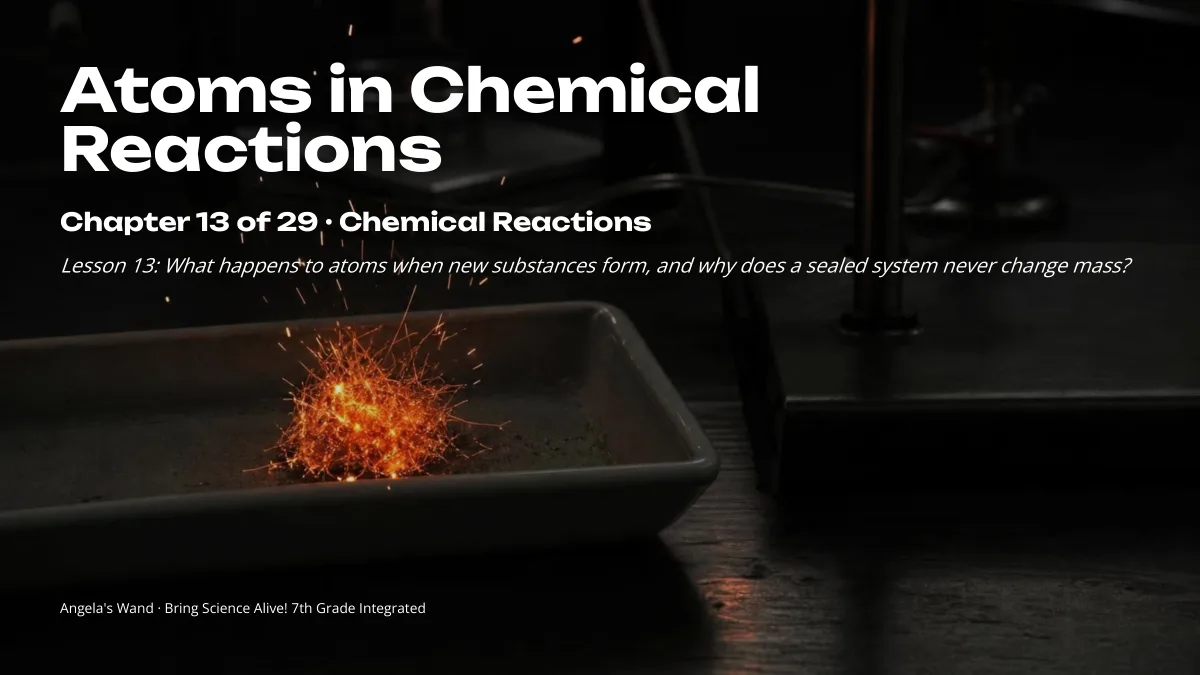
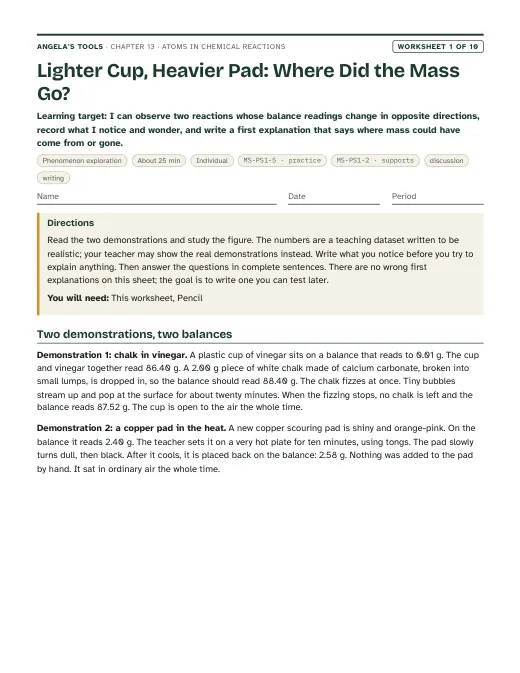
On the first balance sits a cup of vinegar with a small paper scoop of baking soda beside it: 142.6 g in all. The teacher tips the baking soda in. The mixture fizzes for two minutes, then the reading settles at 141.5 g. On the second balance, a tuft of fine steel wool reads 2.00 g. The teacher carries it to a heat-proof tray, lights it with a lighter (teacher only, behind a shield), lets it sparkle and go dark, cools it and puts every crumb back on the balance: 2.14 g. (The readings are illustrative values, realistic for these amounts.) One reaction seems to lose matter and the other seems to gain it. Where did 1.1 g go, and where did 0.14 g come from?

Notice and wonder prompts

  • What left the cup while it fizzed, and did it have mass?
  • The steel wool got heavier after burning. What could have been added to it, and from where?
  • If both reactions ran inside sealed, see-through bags on the balance, what would each reading do?
  • Could you ever get the 1.1 g back? Could you make the steel wool weigh 2.00 g again?

Learning targets

  • I can explain that a chemical reaction breaks bonds and forms new bonds so the same atoms regroup into new substances, without any atom being created, destroyed or changed into another element.
  • I can read a chemical equation, tell a coefficient from a subscript, and count the atoms of each element on both sides.
  • I can sort a reaction by how its atoms regroup: breaking apart, joining together, swapping partners, or a mix.
  • I can use an atom model to explain why the mass of a closed system stays the same during a reaction, and why an open system can seem to lose or gain mass.
  • I can analyze data from several chemical process designs and choose the best features of each to combine so that more reactant atoms end up in useful products.

What shows the learning happened

  • A bead-model record (Lab 2) for at least four reactions showing the count of each element before and after, the regrouping pattern, and a correct verdict on which claimed reactions break the atom rule.
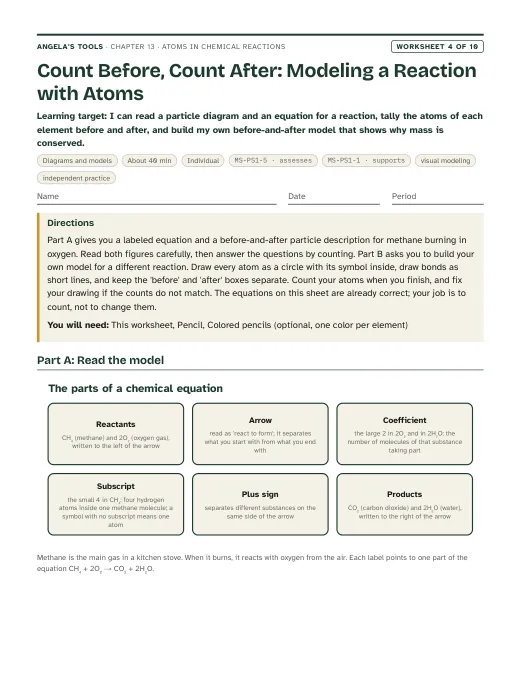
  • A labeled before-and-after atom drawing of a reaction in a closed system (the Lab 1 sealed bag or the W4 water-forming model) that shows the same atoms regrouped and explains why the total mass cannot change.
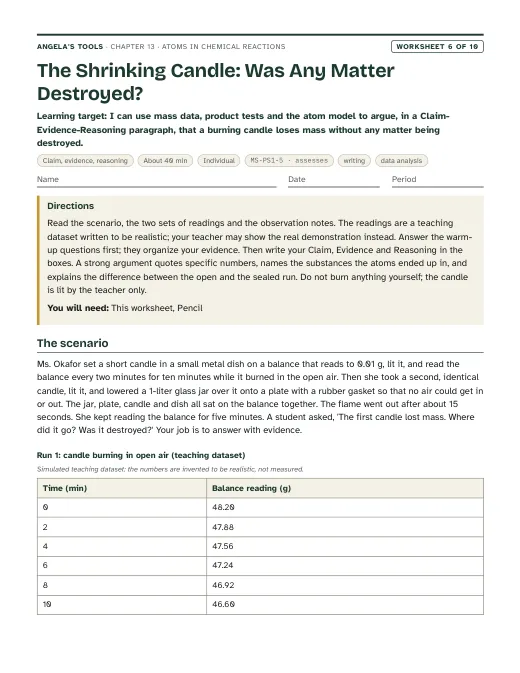
  • A Claim-Evidence-Reasoning paragraph (W6) arguing from open-air and sealed-jar mass data that a burning candle lost mass without any matter being destroyed, naming carbon dioxide and water vapor as where the lost mass went.
  • A completed gas-trap test table and redesign sketch (Lab 3) that cites pooled class data to justify which feature was taken from each starter design.
  • A short response that counts atoms in a given equation correctly, distinguishing coefficient from subscript (for example, 3O₂ is six oxygen atoms), and sorts the reaction by regrouping pattern.
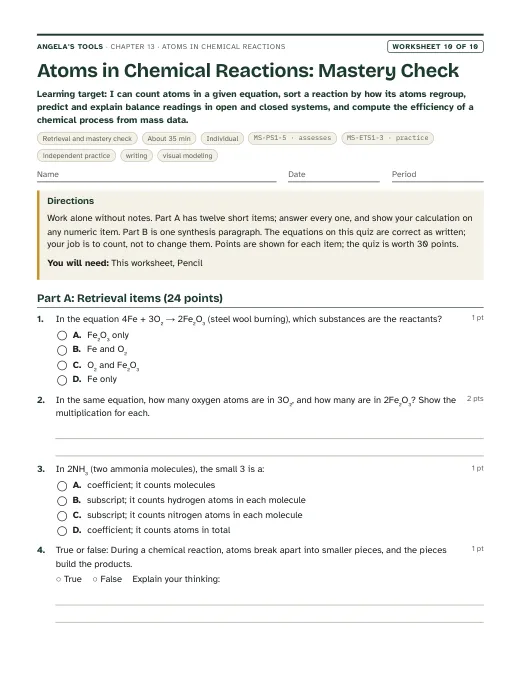
  • A mastery quiz (W10) score showing students can explain both the fizzing cup's lost mass and the steel wool's gained mass with the same atom rule.

Key vocabulary 12 terms

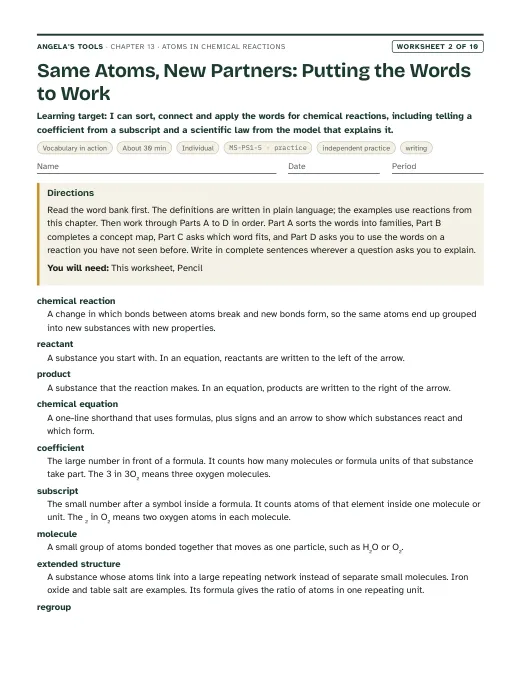
reactantA substance you start with in a chemical reaction. Its atoms are the only atoms the products can be built from. In an equation, reactants are written to the left of the arrow.Iron and oxygen are the reactants when steel wool burns, so every atom in the product came from one of them.
productA new substance formed by a chemical reaction, built from the regrouped atoms of the reactants. Products are written to the right of the arrow.Carbon dioxide is one product of the vinegar and baking soda reaction, and it is the product that bubbles away.
chemical equationA one-line record of a reaction using formulas: reactants, an arrow, products, with plus signs between substances. Read correctly, it is an inventory of atoms on each side.The chemical equation 2H₂O₂ → 2H₂O + O₂ lets you check that four hydrogen and four oxygen atoms appear on both sides.
coefficientThe whole number written in front of a formula that tells how many molecules or formula units of that substance take part. It multiplies every atom in the formula.The coefficient 3 in 3O₂ means three oxygen molecules, which is six oxygen atoms.
subscriptThe small number after an element symbol inside a formula that tells how many atoms of that element are in one molecule or formula unit. Changing a subscript changes the substance.The subscript 2 in H₂O counts hydrogen atoms in one water molecule; writing H₂O₂ instead would describe hydrogen peroxide, a different substance.
formula unitThe smallest repeating group of atoms in an extended structure, used for counting when a substance has no separate molecules. Fe₂O₃ is a formula unit of iron oxide, not a free-floating molecule.When we build 2Fe₂O₃ from beads we are building two formula units, because real iron oxide is one continuous network of iron and oxygen atoms.
law of conservation of matterThe scientific law that in any ordinary physical or chemical change, matter is neither created nor destroyed: each element keeps the same number of atoms, so the total mass after equals the total mass before.The law of conservation of matter predicts that vinegar, baking soda and the gas they make, sealed together in a container, have the same total mass before and after the reaction.
scientific lawA statement, in words or math, of a pattern that has held in every careful test. A law describes what happens; a model or theory explains why.Conservation of matter is a scientific law; the atom model is what explains it, because atoms are only rearranged, never made or lost.
closed systemA region, such as a sealed bag or capped container, that matter cannot enter or leave during the change you are studying. Energy such as heat or light can still cross the boundary.A zip bag sealed before the reaction starts is a closed system, so every gram of carbon dioxide stays on the balance.
open systemA region whose boundary matter can cross. In an open system, a balance reading can rise or fall during a reaction because atoms come in from the air or leave as gas, not because matter was made or destroyed.A cup on a lab bench is an open system, which is why the fizzing cup lost 1.1 g of carbon dioxide to the room.
catalystA substance that helps a reaction happen faster without being used up, so it can be recovered and used again instead of becoming waste.A reusable catalyst let chemical engineers make ibuprofen in three reaction steps instead of six.
atom economyThe percentage of the reactants' mass that ends up in wanted products rather than in waste, worked out from the balanced equations. Chemists use it to compare how efficient process designs are at using atoms.A process with an atom economy of 77 percent sends more than three quarters of its reactant mass into the product and less than a quarter into waste.


Standards alignment

California NGSS, Grade 7 Preferred Integrated Course Model. Each entry says whether this chapter's work assesses the performance expectation, gives practice toward it, or supports it as background; the resource lists below repeat this for every worksheet and lab.

MS-PS1-5Assesses: the whole PE: a model showing atom counts unchanged and mass therefore conservedCA Grade 7

Develop and use a model to describe how the total number of atoms does not change in a chemical reaction and thus mass is conserved.

Lab 2's bead models, W4's drawn models and W10's tally and drawing items all require students to show that each element has the same number of atoms before and after a reaction and to use that count to explain the mass readings in Lab 1 and Lab 3. Tasks stay inside the assessment boundary: students count atoms and compare masses from a balance; they are never asked to use atomic masses or to balance symbolic equations as the assessed skill.

Assessment boundary: Assessment does not include the use of atomic masses, balancing symbolic equations, or intermolecular forces.

MS-ETS1-3Assesses: analyzing pooled test data from several designs to combine their best characteristicsCA Grade 6-8

Analyze data from tests to determine similarities and differences among several design solutions to identify the best characteristics of each that can be combined into a new solution to better meet the criteria for success.

The lesson's engineering spread shows how two improvements to an ibuprofen process were combined into a better one. In Lab 3 the class tests three gas-trap designs, pools the mass-change, sealing-time and cost data, identifies the strongest feature of each design and builds a combined version; W9 and the slide task repeat the same analysis with simulated process data. This PE is listed for grades 6-8 in the California sequence.

MS-ETS1-1Practice toward: defining criteria and constraints before testingCA Grade 6-8

Define the criteria and constraints of a design problem with sufficient precision to ensure a successful solution, taking into account relevant scientific principles and potential impacts on people and the natural environment that may limit possible solutions.

Lab 3 opens with each group writing measurable criteria (mass change, sealing time, cost) and the constraints (materials, amounts, no rigid sealed containers) before any trap is built; the precision of those criteria is what makes the later data comparison possible. Listed for grades 6-8 in the California sequence; it is practiced here, not assessed.

MS-PS1-2Supports: property evidence that a reaction has occurred, carried over from Lesson 12CA Grade 7

Analyze and interpret data on the properties of substances before and after the substances interact to determine if a chemical reaction has occurred.

Students must already accept that fizzing, color change and the dark crumbly product of burned steel wool signal new substances before they can ask where the atoms went. The chapter uses those property changes as given evidence and does not re-assess them.

Assessment boundary: Assessment is limited to analysis of the following properties: density, melting point, boiling point, solubility, flammability, and odor.

Science and engineering practices

  • Developing and Using Models. Students build bead models of reactions (Lab 2), draw before-and-after atom pictures of the sealed bag (Lab 1) and of hydrogen and oxygen forming water (W4) and use those models to predict and explain balance readings rather than just describe them.
  • Analyzing and Interpreting Data. Students interpret mass-change data from open and closed systems (Lab 1, W5) and compare pooled test results from several gas-trap designs (Lab 3) and several process designs (W9, slide task) to find the strongest feature of each.
  • Constructing Explanations and Designing Solutions. Students write a Claim-Evidence-Reasoning argument, from an open run and a sealed-jar run, that a burning candle loses mass without any matter being destroyed (W6), and design a container that makes an open-air reaction into a fair mass test (Lab 3).

Disciplinary core ideas

  • PS1.B Chemical Reactions. In a chemical process the reactants' atoms are rearranged into different molecules and extended structures with different properties; the total number of each kind of atom is conserved, so mass is conserved.
  • ETS1.B Developing Possible Solutions. Students evaluate gas-trap designs against the same criteria, and learn that features taken from several designs can be merged into one that beats each of them.
  • ETS1.C Optimizing the Design Solution. Pooled test data in Lab 3 show that no single starter design wins every test; students identify which characteristic performed best in each test and carry it into the redesign.

Crosscutting concepts

  • Energy and Matter. Matter is conserved because atoms are conserved: students track atoms into and out of open and closed systems and explain every change in a balance reading as atoms crossing a boundary.
  • Patterns. Students connect a macroscopic pattern (sealed systems keep their mass; open ones can seem to gain or lose it) to the atomic-level rule that bonds change while atoms do not.
  • Systems and System Models. Students define the boundary of each system they weigh and decide what can cross it, which is what turns a confusing balance reading into evidence for a law.

Presentation 25 slides

Atoms in Chemical Reactions: same atoms, new partners, same mass. Original, editable slides with speaker notes: a phenomenon opener, learning targets, the chapter's concepts with diagrams, vocabulary in context, 3 checks for understanding, 2 discussion prompts, an application task, a misconception check, a synthesis and an exit ticket.

Worksheets 10 of 10

Ten different tasks, one per instructional blueprint. Each has a student PDF (low ink, US Letter), an editable DOCX, an HTML preview, and a separate teacher answer key with reasoning.

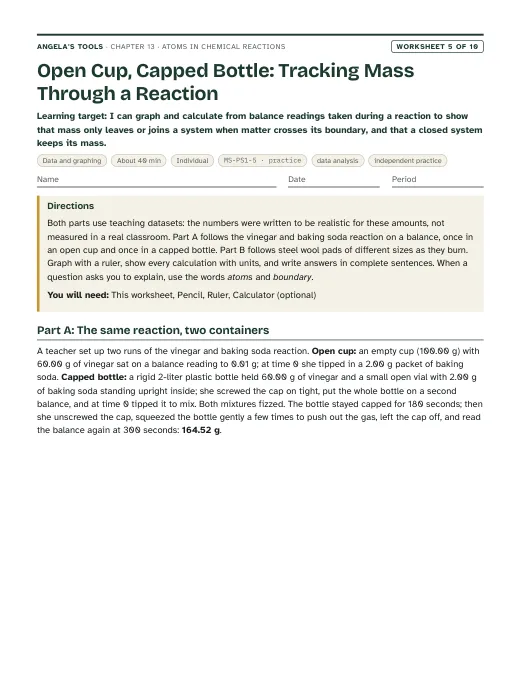
First page of Open Cup, Capped Bottle: Tracking Mass Through a Reaction
Worksheet 5 · Data and graphing

Open Cup, Capped Bottle: Tracking Mass Through a Reaction

I can graph and calculate from balance readings taken during a reaction to show that mass only leaves or joins a system when matter crosses its boundary, and that a closed system keeps its mass.

40 minindividualPracticeData analysisIndependent practice MS-PS1-5 · practice
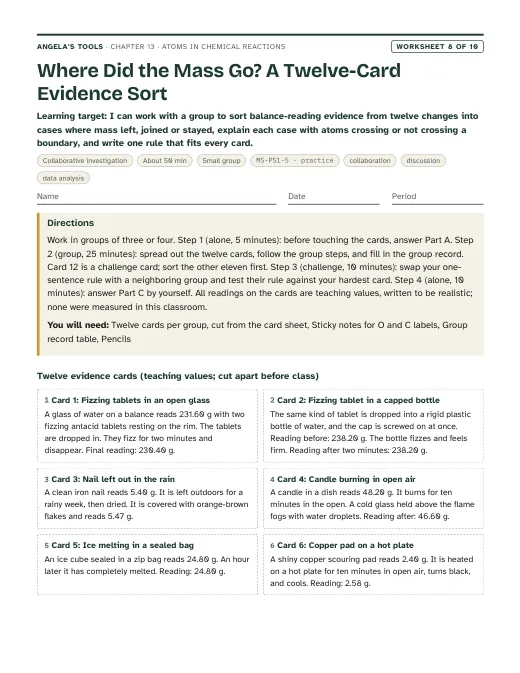
First page of Where Did the Mass Go? A Twelve-Card Evidence Sort
Worksheet 8 · Collaborative investigation

Where Did the Mass Go? A Twelve-Card Evidence Sort

I can work with a group to sort balance-reading evidence from twelve changes into cases where mass left, joined or stayed, explain each case with atoms crossing or not crossing a boundary, and write one rule that fits every card.

50 minsmall groupPracticeCollaborationDiscussionData analysis MS-PS1-5 · practice
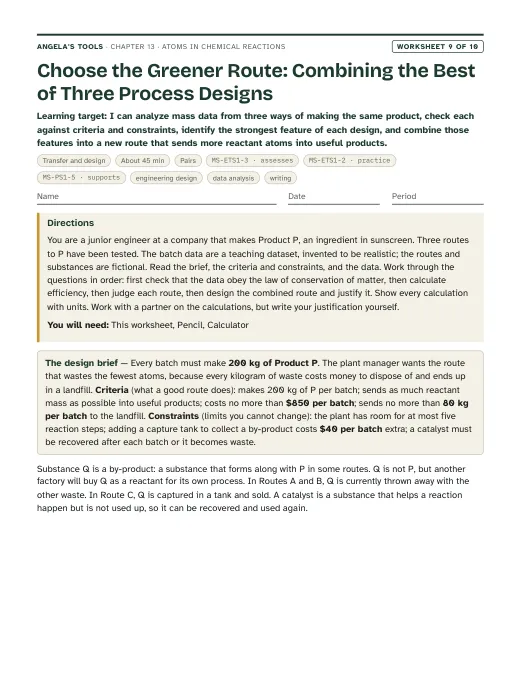
First page of Choose the Greener Route: Combining the Best of Three Process Designs
Worksheet 9 · Transfer and design

Choose the Greener Route: Combining the Best of Three Process Designs

I can analyze mass data from three ways of making the same product, check each against criteria and constraints, identify the strongest feature of each design, and combine those features into a new route that sends more reactant atoms into useful products.

45 minpairsExtensionEngineering designData analysisWriting MS-ETS1-3 · assessesMS-ETS1-2 · practiceMS-PS1-5 · supports

Collaborative labs 3 of 3

Three different investigation approaches. Each has a teacher guide (purpose, materials with quantities, estimated cost, prep, safety, procedure, expected observations, debrief, answer key, assessment criteria, accessibility adaptations, low-cost alternative) and a student recording sheet.

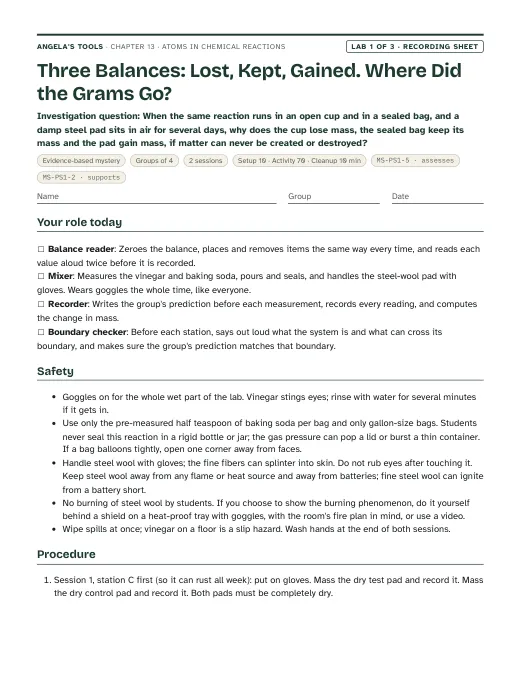
First page of the Three Balances: Lost, Kept, Gained. Where Did the Grams Go? recording sheet
Lab 1 · Evidence-based mystery

Three Balances: Lost, Kept, Gained. Where Did the Grams Go?

When the same reaction runs in an open cup and in a sealed bag, and a damp steel pad sits in air for several days, why does the cup lose mass, the sealed bag keep its mass and the pad gain mass, if matter can never be created or destroyed?

Groups of 42 sessions70 min activityEst. 12 to 18 per classDigital balance reading to 0.1 g (0.01 g if available, for the steel-wool pads)White vinegar (5 percent)Baking soda MS-PS1-5 · assessesMS-PS1-2 · supports
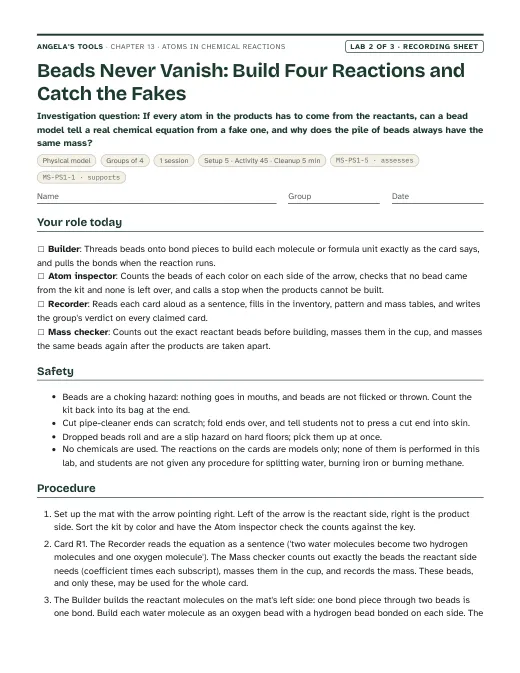
First page of the Beads Never Vanish: Build Four Reactions and Catch the Fakes recording sheet
Lab 2 · Physical model

Beads Never Vanish: Build Four Reactions and Catch the Fakes

If every atom in the products has to come from the reactants, can a bead model tell a real chemical equation from a fake one, and why does the pile of beads always have the same mass?

Groups of 41 session45 min activityEst. 12 to 18 per classPony beads (9 mm) in eight colors, kitted per group: 12 white (H), 12 red (O), 6 gray (Fe), 4 black (C), 2 blue (Pb), 4 purple (K), 4 yellow (I), 4 green (N)Pipe cleaners cut into 3 cm bond piecesReaction mat: a sheet of paper with a large arrow drawn across the middle (reactants left, products right) MS-PS1-5 · assessesMS-PS1-1 · supports
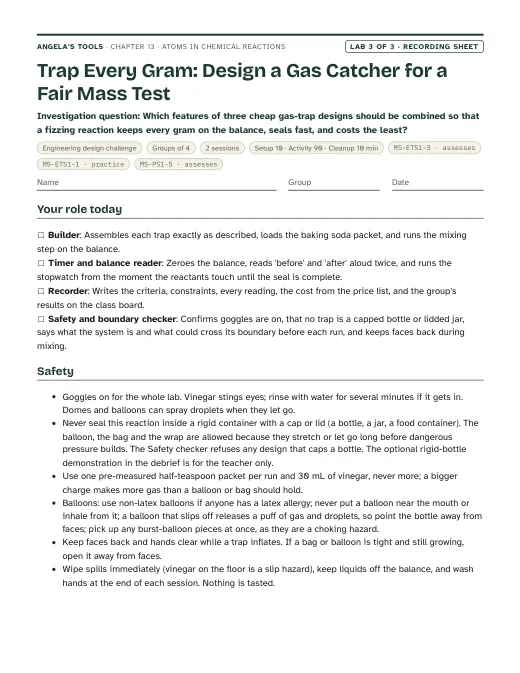
First page of the Trap Every Gram: Design a Gas Catcher for a Fair Mass Test recording sheet
Lab 3 · Engineering design challenge

Trap Every Gram: Design a Gas Catcher for a Fair Mass Test

Which features of three cheap gas-trap designs should be combined so that a fizzing reaction keeps every gram on the balance, seals fast, and costs the least?

Groups of 42 sessions90 min activityEst. 15 to 25 per classWhite vinegar (5 percent)Baking soda, pre-measured half teaspoons (about 2.5 g) in folded paper packetsEmpty 500 mL plastic water bottle, rinsed, label removed, no cap MS-ETS1-3 · assessesMS-ETS1-1 · practiceMS-PS1-5 · assesses

Teacher guidance

Suggested sequence (7 steps)
  1. Period 1: Presentation slides 1-6 (two-balance phenomenon, targets, what changes and what stays, reactant/product/equation vocabulary). W1 phenomenon worksheet records predictions for both balances. Set up the steel-wool station of Lab 1 at the end of class so it can rust during the week.
  2. Period 2: Slides 7-8 (reading an equation, coefficient versus subscript, counting atoms, first check). Lab 2, the bead regrouping models, fills the rest of the period. W2 vocabulary relationships as homework.
  3. Period 3: Slides 9-13 (three regrouping patterns, the steel-wool equation, the mass-gain discussion, coefficient and subscript vocabulary and check). Lab 1 session 1: the open cup and the sealed bag, with predictions written before each. W4 diagram worksheet consolidates the atom drawings.
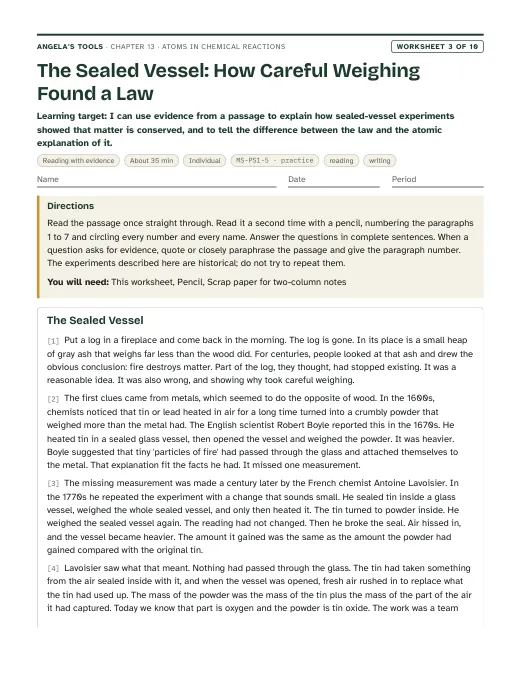
  4. Period 4: Slides 14-18 (conservation of matter, open versus closed systems, the balance-reading check, law and boundary vocabulary, the Golden Gate connection). Lab 1 session 2: read the steel-wool pads, pool class data, finish the analysis. W3 reading passage and W5 data worksheet follow; W6, the CER on a candle burning in open air and under a sealed jar, is the written assessment for conservation.
  5. Period 5: Slides 19-21 (atom accounting in industry, the ibuprofen efficiency bars, the process-design task). Lab 3 session 1: define criteria and constraints, build and test the three starter gas-trap designs, pool the data. W7 misconception repair as homework.
  6. Period 6: Lab 3 session 2: analyze pooled data, combine the best features, build and test the redesign. W8 collaborative stations and W9 transfer problem share the design-comparison reasoning and can be assigned to groups that finish early.
  7. Period 7: Slides 22-25 (waste discussion, the burning-wood misconception, synthesis, exit ticket). W10 mastery as the quiz.

Materials overview: Household chemicals only: white vinegar, baking soda, fine steel wool pads, water. Students never use open flame; burning steel wool is a teacher demonstration behind a shield or a described phenomenon. Balances reading to 0.1 g are needed for Labs 1 and 3 (0.01 g helps with the steel-wool pads). Lab 2 uses pony beads in eight colors (one per element on the cards) and pipe cleaners cut into short bond pieces. Lab 3 adds balloons, empty plastic bottles, zip bags, cups, plastic wrap, rubber bands, tissue paper and a stopwatch. Goggles for every wet activity.

Common misconceptions (5)
“When something burns, most of its matter is destroyed; only the ash is left.”
Why it happens: A log becomes a small pile of ash, and the smoke and gases that carry the rest away are invisible or quickly gone.
Correction: Burning joins the fuel's carbon and hydrogen atoms with oxygen from the air to make carbon dioxide and water vapor, which float away. If you collected the ash plus every gas, their mass would equal the wood plus the oxygen it used. In a sealed container the mass would not change at all.
“The steel wool got heavier because heat or energy was added to it.”
Why it happens: Students see the flame and the sparks and reach for the only thing they saw being added.
Correction: Heat is energy, not matter, and does not register on a balance. The extra mass is oxygen atoms from the air that bonded to iron atoms. Burn the same steel wool in a sealed glass container with the air included and the total reads the same before and after.
“In a chemical reaction the atoms themselves break apart or turn into other kinds of atoms.”
Why it happens: The book's concept spread says atoms 'break apart' before they rejoin, and everyday language says substances 'break down.'
Correction: Bonds break, not atoms. An oxygen atom that leaves a water molecule is still an oxygen atom when it joins an oxygen molecule. Only nuclear changes, a separate topic, turn one element into another.
“A gas that escapes does not count because gases have no mass, so the open cup really did lose matter.”
Why it happens: Students cannot see or feel the carbon dioxide that leaves, and nothing visible is missing from the cup.
Correction: Every carbon dioxide molecule carries one carbon atom and two oxygen atoms, each with mass. Trap the gas in a sealed, rigid container on the same balance and the reading does not fall; the 1.1 g is in the container, not gone.
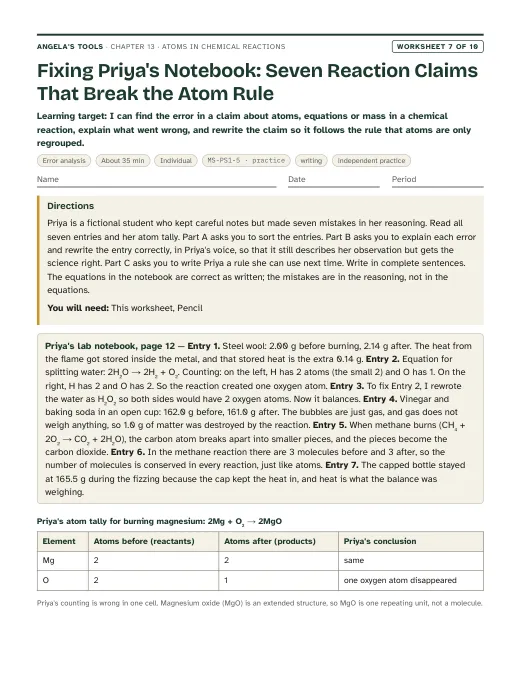
“To fix an equation that does not balance, you can change a subscript, for example writing H₂O₂ to get more oxygen.”
Why it happens: Subscripts and coefficients are both just numbers to a beginner, and changing the one inside the formula seems quicker.
Correction: A subscript is part of the substance's identity: H₂O is water and H₂O₂ is hydrogen peroxide. Only the number of whole molecules or formula units (the coefficient) can change, because you can add another molecule but you cannot add an atom to a molecule without making a different substance.
Differentiation suggestions (5)
  • Multilingual learners: Pre-teach reactant, product, coefficient and subscript with a color-coded equation card (coefficients in one color, subscripts in another) and bead pictures; let students narrate the bead rearrangement in Lab 2 in their home language before writing in English; provide sentence frames for the Lab 1 explanations ('The reading went ___ because ___ atoms ___ the system').
  • Students who need more support: Give a partially completed atom-count table for the first two reactions in Lab 2, a prediction word bank (up, down, same) for Lab 1, and a two-column criteria/constraints organizer for Lab 3 with one example filled in. Limit the bead lab to three reactions and the claimed-reaction cards to three.
  • Students ready for extension: Ask them to work out how many of each product unit can be built from a given set of reactant beads with none left over, to explain why a candle in a sealed jar gains nothing on the balance even though it burns, or to research one real process honored by a Green Chemistry Challenge award and report its atom economy.
  • Students who need movement or alternative output: Run the regrouping patterns as a human model in open floor space (students holding element cards link arms as bonds, then regroup); allow the Lab 3 redesign to be presented as a labeled physical prototype with a spoken justification instead of a written one.
  • Students with limited fine-motor control or low vision: Use large pony beads and pipe-cleaner bonds, or magnetic tiles, in Lab 2; let a partner pour in Lab 1 while the student reads the balance aloud and records; provide large-print equation cards with coefficients boxed.
Accuracy notes: where the textbook simplifies (15)
  • Bonds break, atoms do not: the Key Science Concept spread (p. 169) says that in most reactions atoms 'break apart' before joining again. Teach that bonds between atoms break and form while every atom stays whole and keeps its identity; do not claim what 'most' reactions do.
  • Misprint on p. 166: the steel-wool equation is printed with the product '2F₂O₃'. F is fluorine. Use 4Fe + 3O₂ → 2Fe₂O₃ everywhere (4 Fe and 6 O on each side). Fe₂O₃ is the model product; steel wool burned in plenty of air can also form black Fe₃O₄, so never assess which exact oxide forms.
  • Coefficients count molecules or formula units, not only molecules (p. 165). Iron oxide, lead iodide, potassium nitrate and calcium chloride are extended structures with no separate molecules; their formulas give the ratio of atoms in one repeating unit.
  • 'Twice as much gas' (p. 164): hydrogen produced by splitting water has twice the volume (and twice the number of molecules) of the oxygen, not twice the mass. The oxygen is about eight times heavier. Say 'twice the volume' and keep atomic masses out of student tasks.
  • Rust (p. 163): the rusting car is explained as iron plus oxygen only. Real rust is a hydrated iron oxide and forms when iron meets both oxygen and water, which is why Lab 1's pads are kept damp. Treat Fe₂O₃ as the model for the steel-wool reaction, not as a full description of rust.
  • Scope of the law (p. 168): the book says matter is conserved in 'any other changes in matter.' The atom-count rule holds for ordinary physical and chemical changes. Nuclear changes convert one element into another and are outside this lesson; never test them.
  • Ibuprofen numbers (p. 170): the figure caption says 75 percent for the catalytic process while the text and the figure's fraction say 77 percent, and the beaker label reads 256 g where the fraction uses 266 g. Use about 40 percent for the 1960s six-step process and about 77 percent for the three-step process (206 ÷ 266); EPA and OpenStax round it to about 80 percent. The 99 percent figure counts the recovered acetic acid as a useful product.
  • What the efficiency is (p. 170): it is not found by weighing a batch. It is the atom economy, a percentage computed from the masses in the balanced equations. Keep it separate from reaction speed and from the actual yield of a real batch, and say mass rather than weight.
  • Ibuprofen history (pp. 170-171): the three catalytic steps and the recovery of acetic acid as a useful by-product are verified from EPA's Green Chemistry Challenge records. The polyvinyl alcohol detail and the count of awards are not verified; teach 'combine the best features of two solutions' as a design strategy, not as a precise history.
  • Swapping partners (p. 167): the figure draws potassium nitrate as bonded pairs after the reaction. In water, potassium nitrate stays dissolved as separate ions; only lead iodide comes out as a solid. The swap picture is bookkeeping for where atoms end up, which is all the regrouping sort needs.
  • Antacid spread (p. 169): the equation CaCO₃ + 2HCl → CO₂ + H₂O + CaCl₂ and its tally (9 atoms each side) are correct, but calcium carbonate and calcium chloride are ionic networks and hydrochloric acid is HCl dissolved in water. Use it as a counting model only; give no medical framing or dosing.
  • Open-cup mass loss: the vinegar reaction (C₂H₄O₂ + NaHCO₃ → CO₂ + H₂O + NaC₂H₃O₂) has 14 atoms on each side, as the book says. The balance drops only by the mass of carbon dioxide that leaves; some stays dissolved, so the open-cup loss is a little less than the full amount, which is a fair question for students who notice.
  • Mass versus weight: a balance compares masses; say mass throughout. The book's engineering pages say 'weight' where mass is meant.
  • Safety framing: the lesson shows electrolysis producing hydrogen, hydrogen peroxide breaking down, and burning steel wool. These are atom-counting models in this chapter; students get no procedure for producing hydrogen, and the only flame is a teacher demonstration or a described phenomenon.
  • Sealed-bag and balloon demonstrations: a trap that puffs up is lifted by the air it displaces, about 1.2 g for every liter of puff. Half a teaspoon of baking soda in 30 mL of vinegar makes about 1.1 g of carbon dioxide, which fills about 0.6 L, so a perfectly sealed bag or balloon reads about 0.6 to 0.7 g low after the reaction, roughly two-thirds of what an open cup loses (carbon dioxide is only about 1.5 times as dense as air). This is a measurement effect, like the lift on a helium balloon, not lost matter. Lab 1 and Lab 3 teach it at its real size, use the further drop when the trap is opened as evidence that the gas was still inside, and point to a rigid container (a teacher-only capped carbonated-drink bottle) as the closed system that reads exactly the same.

Review status: reviewed · 2026-10-19 · Atom tallies and mass sums re-solved in every file: the vinegar reaction (14 atoms a side), 4Fe + 3O2 -> 2Fe2O3, the four Lab 2 cards and three fake cards (bead kit of 48 is sufficient), methane, peroxide, water formation, Mg/MgO (0.24 g -> 0.40 g), antacid spread (9 a side), NH3, W5, W9 and slide-task mass balances. All keys correct except the items fixed below. Buoyancy, corrected in size everywhere it appears (chapter accuracy note, slides 15-17 and 25, Lab 1, Lab 3, W5, W6, W8 notes): half a teaspoon of baking soda with 30 mL of vinegar makes about 1.1 g of CO2 filling about 0.6 L, so a freely puffing bag or balloon reads about 0.6-0.7 g low, not 'a few tenths'. Lab 1's leak threshold (0.5 g) would have flagged every good seal; Lab 1 q2, q3, q7, q8, debrief, expected observations and teacher notes now use the real size and the vent-and-compare test, and Lab 1 is retitled 'Lost, Kept, Gained'. Lab 3's expected design results, q5 and the teacher notes were corrected, and q6 (fraction of gas escaped) now measures between the perfect-trap mark (-0.7 g) and the open-cup mark (-1.1 g); the old subtraction counted the lift as escaped gas. Closed-system wording made precise: 'reads the same' is kept only for rigid containers (slide 15 compare diagram, slide 17 vocab example, exit ticket item 4, W3 paragraph 7, W10 scaffold, W5 q10); bag examples now speak of mass. Added a ChemEd X reference for the balloon buoyancy effect. W6 is the candle CER as written; chapter.json sequence (Period 4), evidenceOfLearning and the CER practice in threeDimensions now describe it that way, and slide 16 links say W6 applies the open-versus-sealed reasoning to a candle. W6 itself: a 1 L jar holds only about 0.28 g of oxygen, so the flame goes out in roughly 15 s after burning a few hundredths of a gram of wax; the 40 s flame-out and 'visibly shorter candle' were changed to match. Lavoisier/Boyle history in W3 checked: Boyle's 1673 sealed-retort tin experiments and 'fire particles'; Lavoisier's 1774 sealed-vessel calcination of tin (no change while sealed, gain on opening matching the tin's gain); the 1789 Traite; Marie-Anne Paulze Lavoisier's translating, records and drawings. Accurate. Paragraph numbers cited in questions and keys match. Other science fixes: W1 chalk demo made consistent (the 0.88 g loss needs all 2.00 g of CaCO3 to react, so the chalk now dissolves completely; note that many classroom chalks are gypsum); W5 capped bottle is now a teacher demo and is squeezed to flush the dense CO2 before the 300 s reading, and the sealed-flask refill is 0.14 g (air refills the oxygen's volume and is lighter per liter than O2); W7 q7 key said the bottle warmed, but vinegar and baking soda absorb energy; W8 Card 1 now uses two tablets (one tablet gives at most about 0.8 g of CO2, not 1.2 g) and the dough card notes its own lift; W9 keys referred to a '2 percent catalyst loss' that is not on the sheet; slide 13 bicycle example used 2 x 2 = 2 + 2; slide 20 notes now say 77 percent is the textbook figure, not EPA's. Ambiguity fixed: Lab 1 q9 offered overlapping choices ('at least' and 'possibly more'); now less than, exactly, or 1.1 g or more. Consistency: chapter sequence slide ranges were off by one from Period 2 on and Period 7 cited a slide 26 that does not exist; slide 2 parking-lot slide numbers likewise; standards note for MS-PS1-5 named a 'presentation task' that is the ETS1-3 task. presentation estimatedMinutes set to the pacing sum (125). caGrade added to every lab standards entry. Originality: 6-word runs shared with the lesson text rewritten in Lab 2 procedure, slide 6 notes, W2 law definition, W4 coefficient label, the chapter DCI lines and the Lab 3 q7 prompt; quoted textbook errors in the accuracy notes shortened to 'break apart'. Remaining matches are section titles and the term 'law of conservation of matter'. Renderability: W5 and W6 dataset values are now strings so trailing zeros on 0.01 g readings print (162.00, not 162.0). Slide text limits, diagram fields, W3 passage length (700 words, 7 paragraphs) and answer-key coverage all checked. Labs remain untested physically, as their modelLimitations say.

Source references

Verified against the student edition of Bring Science Alive! 7th Grade Integrated (Student Edition). Printed page numbers appear in the book; PDF pages are the physical pages of the 524-page scan (printed + 36). The textbook is not reproduced on this site.

SectionPrinted pagesPDF pagesUsed for
Introduction: the rusting car and the lesson question162, 163198, 199Mass-gain hook, lesson preview, the publisher's standards listing (MS-PS1-5, MS-ETS1-3) and vocabulary box.
1. Atoms Regroup in Chemical Reactions: electrolysis, writing equations, hydrogen peroxide164, 165200, 201Bonds break and form, reactant/product layout of an equation, coefficient meaning, the two break-apart examples used in Lab 2 and the slides.
2. Ways Atoms Regroup in Chemical Reactions: break apart, join, swap166, 167202, 203The three regrouping patterns, the steel-wool and lead-iodide examples, the regrouping-pattern diagram and Lab 2 sort.
3. Conservation of Matter: vinegar and baking soda, the law and the open-air caveat168204Law of conservation of matter, scientific law definition, the 14-atom count, the escaping-gas idea behind Lab 1 and Lab 3.
Key Science Concept: Equations Model Conservation of Matter169205Atom tally layout for the counting tables; the 'atoms break apart' wording flagged in accuracyNotes.
4. Engineering Green Medicines: efficiency, catalysts, reusing a by-product, combining solutions169, 170, 171205, 206, 207Atom accounting in industry, the ibuprofen efficiency comparison, the combine-the-best-features strategy behind Lab 3 and the slide task.
Lesson Summary171207Check that the four strands (regrouping, patterns, conservation, engineering) are all covered by the targets.

External references used for accuracy checks

Related chapters