Warm Pouch, Cold Pouch: Energy Moving Two Ways
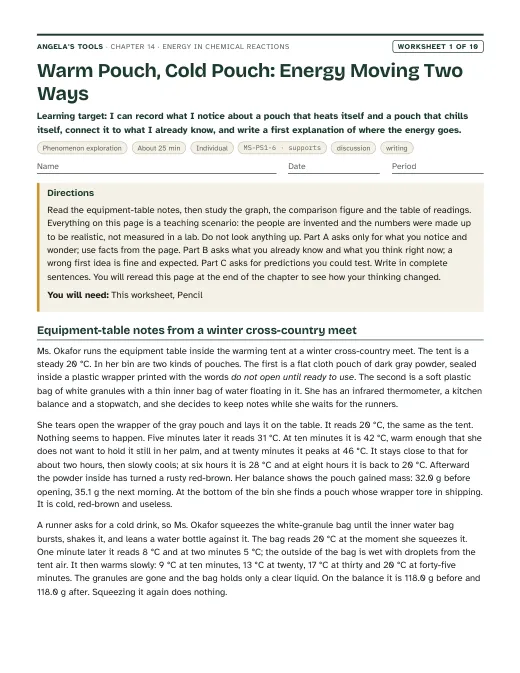
I can record what I notice about a pouch that heats itself and a pouch that chills itself, connect it to what I already know, and write a first explanation of where the energy goes.
Chapter 14 · Unit 5: Chemical Reactions · Segment 2
How does energy move between a chemical reaction and its surroundings, and how can engineers control that flow to build a useful device?
Students figure out that every chemical reaction moves energy across a boundary between the reacting matter (the system) and everything around it (the surroundings), and that the direction of the net flow is what makes a reaction exothermic or endothermic. They learn to read that direction from evidence (warming, cooling, light, sound), to explain it qualitatively with bond breaking and bond forming, and to show it in a chemical equation. The second half of the chapter is engineering: students design, test and improve a pack that warms or cools using safe reagents, judging each prototype by amount, time and temperature exactly as hand-warmer engineers do. The chapter builds on the atom-regrouping ideas of Lesson 13 and sets up the chemical-engineering decisions of Lesson 15.
Estimated class time: presentation about 120 minutes · worksheets about 380 minutes in total · labs 4 sessions. Seven 50-minute periods: two for the phenomenon, system and surroundings, and the exothermic/endothermic distinction with the mystery-packet lab; one for bonds, conservation and energy in equations; three for the engineering strand (prototype story, design-challenge lab across two sessions, data-decision lab); one for synthesis and mastery.
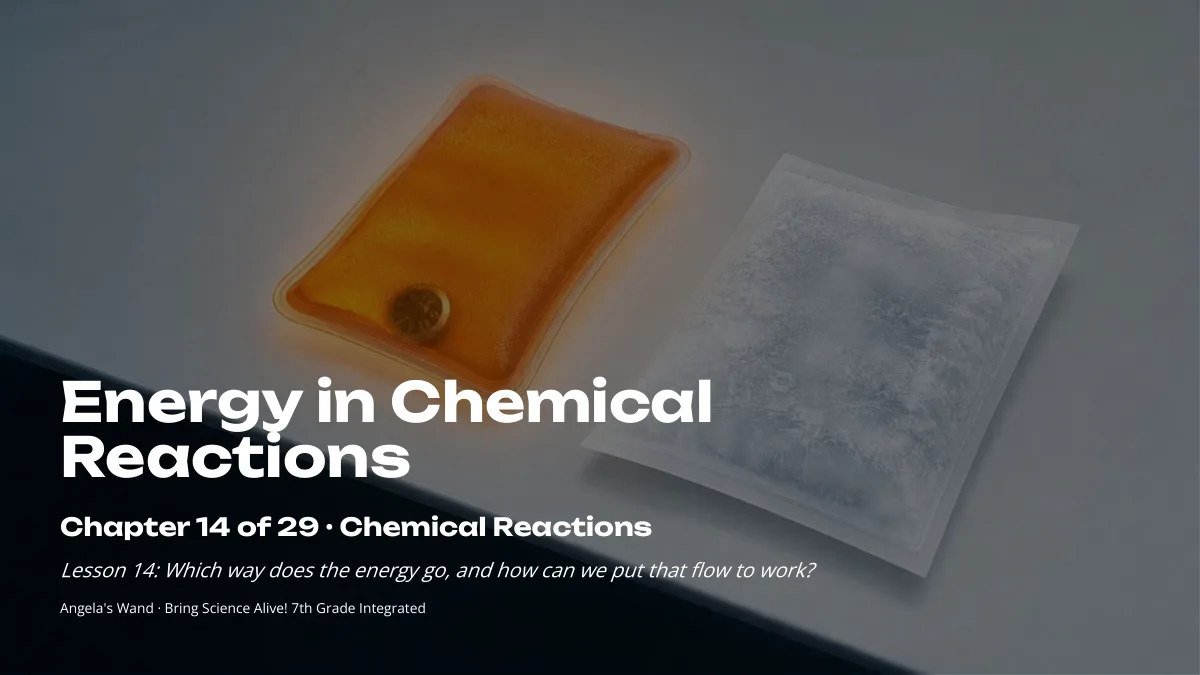
A camping-store clerk sets two identical-looking white pouches on the counter. Each holds a dry powder and a small inner bubble of water. She squeezes the first pouch until the bubble bursts and hands it over: within a minute it is almost too warm to hold, and a thermometer pressed against it reads about 45 °C. She squeezes the second one the same way: it turns cold enough to fog with condensation, and the thermometer reads about 5 °C. (These readings are illustrative values, typical for instant hot and cold packs.) Nothing was plugged in, lit, or chilled. The same action warmed one pouch and chilled the other. Where did the energy come from in the first pouch, and where did it go in the second?
Notice and wonder prompts
California NGSS, Grade 7 Preferred Integrated Course Model. Each entry says whether this chapter's work assesses the performance expectation, gives practice toward it, or supports it as background; the resource lists below repeat this for every worksheet and lab.
Undertake a design project to construct, test, and modify a device that either releases or absorbs thermal energy by chemical processes.
Lab 2 has students build a warming or cooling pack from teacher-measured safe reagents, test it against criteria of amount, time and temperature, and modify it twice across three prototypes, which is the evidence the PE asks for and stays inside its assessment boundary. W9 is the paper version of the same design task. The clarification statement names dissolving calcium chloride and ammonium chloride as acceptable chemical processes, so the calcium chloride hot pack qualifies even though dissolving is not a reaction in the strict sense.
Assessment boundary: Assessment is limited to the criteria of amount, time, and temperature of substance in testing the device.
Analyze data from tests to determine similarities and differences among several design solutions to identify the best characteristics of each that can be combined into a new solution to better meet the criteria for success.
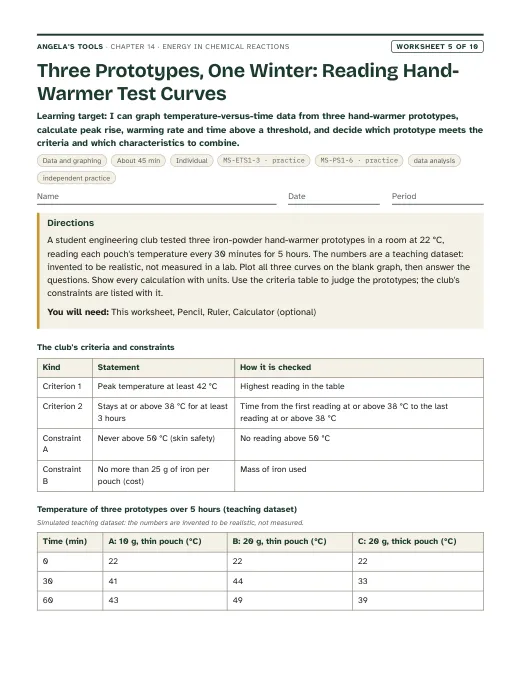
Lab 3 gives students test data from six simulated hand-warmer prototypes, asks what each did well and badly for three different users, and requires them to propose a new design that combines the best characteristics. W5 practices the same data analysis on a smaller set.
Develop a model to generate data for iterative testing and modification of a proposed object, tool, or process such that an optimal design can be achieved.
In Lab 2 the prototype pack is the model that generates temperature-over-time data, and students use that data to modify the next version. The lesson text models this cycle with the hand-warmer engineers. Students do not develop their own model from scratch, so this is practice toward the PE rather than full evidence of it.
Evaluate competing design solutions using a systematic process to determine how well they meet the criteria and constraints of the problem.
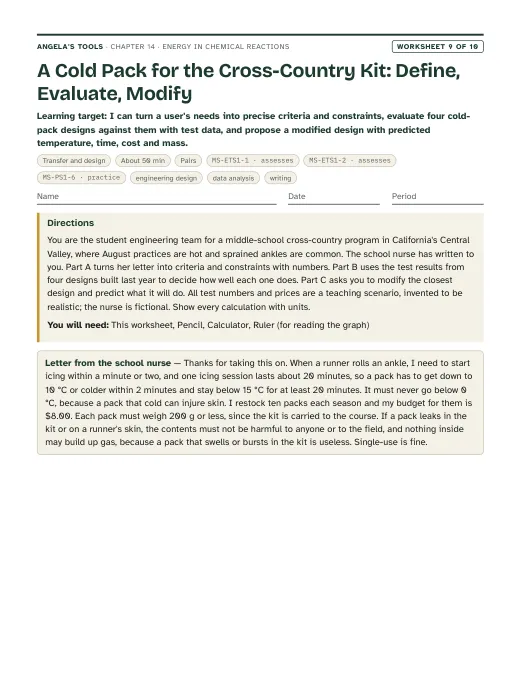
W9 produces evidence for it: students evaluate four cold-pack designs in a pass-or-fail decision table against criteria and constraints they wrote themselves from a user's letter. Lab 3, W8 and the slide-21 task practice the same systematic process with supplied criteria.
Define the criteria and constraints of a design problem with sufficient precision to ensure a successful solution, taking into account relevant scientific principles and potential impacts on people and the natural environment that may limit possible solutions.
W9 has students turn a school nurse's letter into six precise criteria and constraints, computing the per-pack cost limit and naming the rules that protect runners and the playing field. Lab 2 supports it by having teams restate a supplied brief in their own words and say how each item will be tested.
Energy in Chemical Reactions: tracking the flow and building a device that uses it. Original, editable slides with speaker notes: a phenomenon opener, learning targets, the chapter's concepts with diagrams, vocabulary in context, 4 checks for understanding, 2 discussion prompts, an application task, a misconception check, a synthesis and an exit ticket.

Ten different tasks, one per instructional blueprint. Each has a student PDF (low ink, US Letter), an editable DOCX, an HTML preview, and a separate teacher answer key with reasoning.
I can record what I notice about a pouch that heats itself and a pouch that chills itself, connect it to what I already know, and write a first explanation of where the energy goes.
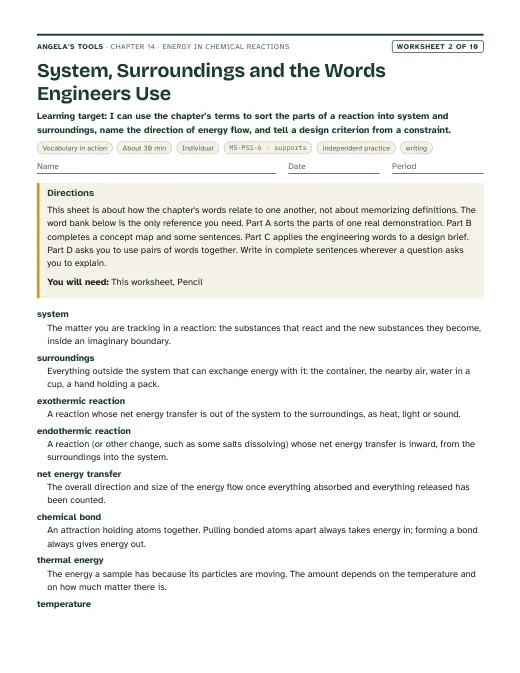
I can use the chapter's terms to sort the parts of a reaction into system and surroundings, name the direction of energy flow, and tell a design criterion from a constraint.
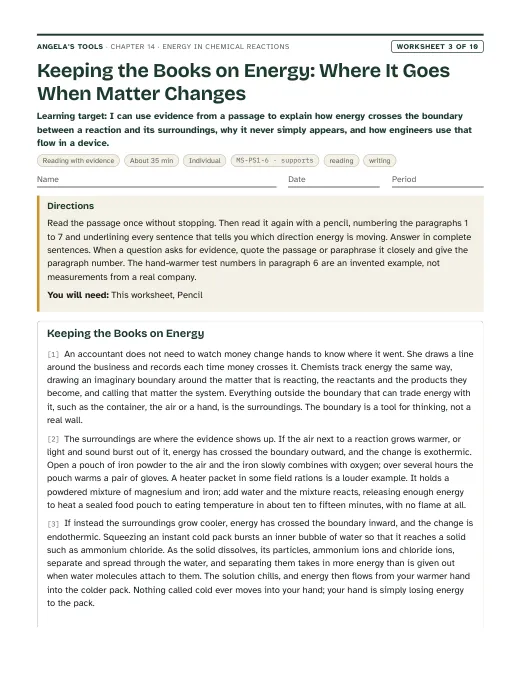
I can use evidence from a passage to explain how energy crosses the boundary between a reaction and its surroundings, why it never simply appears, and how engineers use that flow in a device.
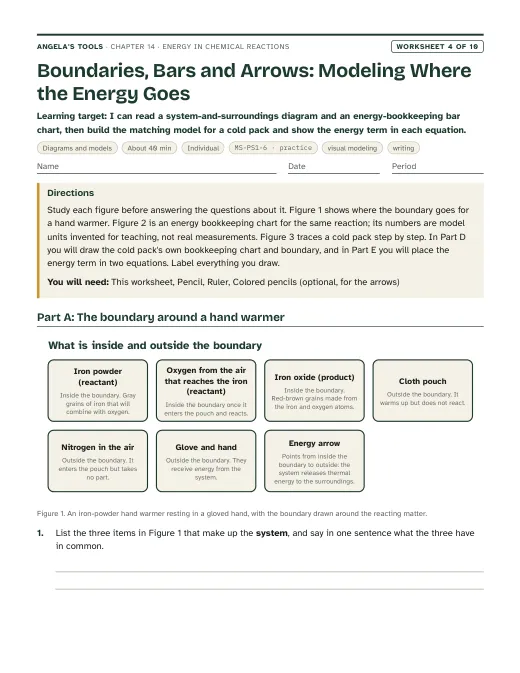
I can read a system-and-surroundings diagram and an energy-bookkeeping bar chart, then build the matching model for a cold pack and show the energy term in each equation.
I can graph temperature-versus-time data from three hand-warmer prototypes, calculate peak rise, warming rate and time above a threshold, and decide which prototype meets the criteria and which characteristics to combine.
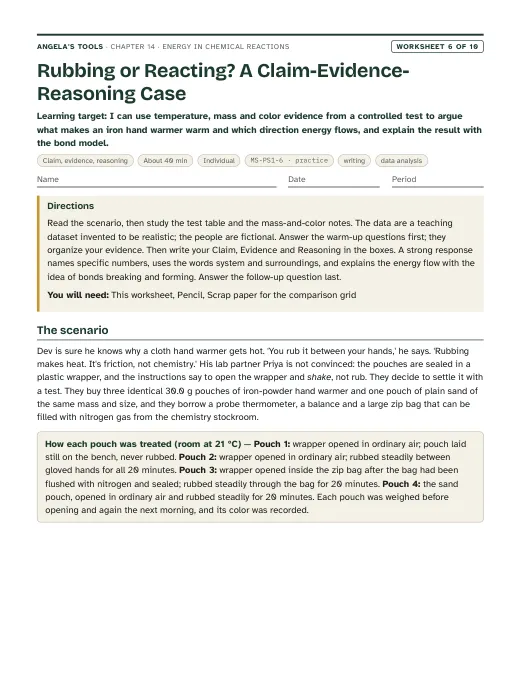
I can use temperature, mass and color evidence from a controlled test to argue what makes an iron hand warmer warm and which direction energy flows, and explain the result with the bond model.
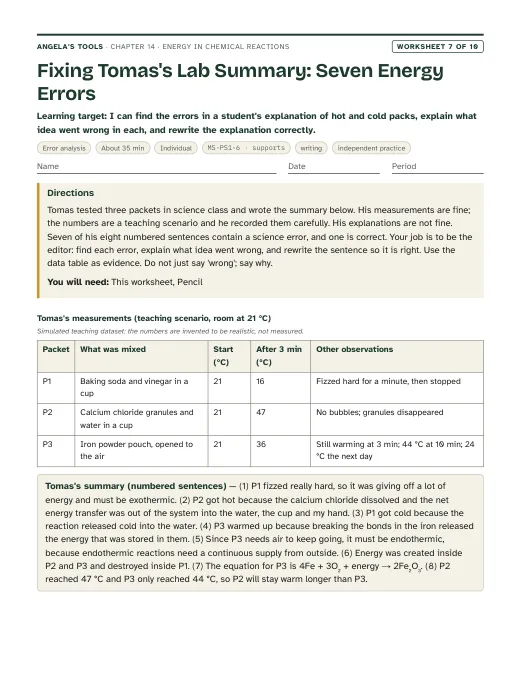
I can find the errors in a student's explanation of hot and cold packs, explain what idea went wrong in each, and rewrite the explanation correctly.
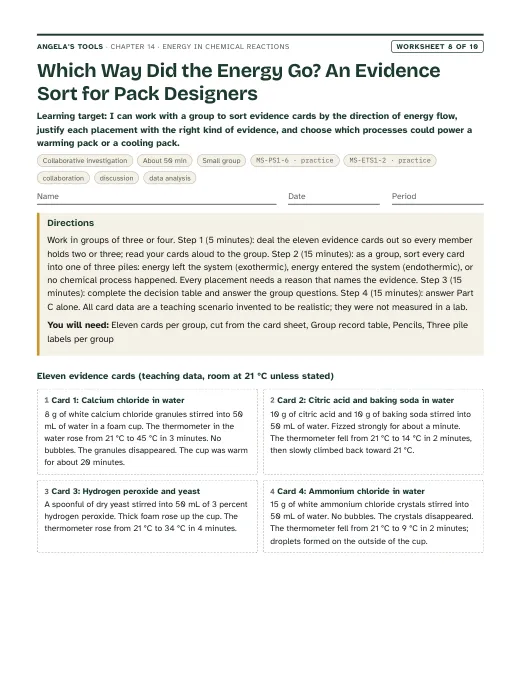
I can work with a group to sort evidence cards by the direction of energy flow, justify each placement with the right kind of evidence, and choose which processes could power a warming pack or a cooling pack.
I can turn a user's needs into precise criteria and constraints, evaluate four cold-pack designs against them with test data, and propose a modified design with predicted temperature, time, cost and mass.
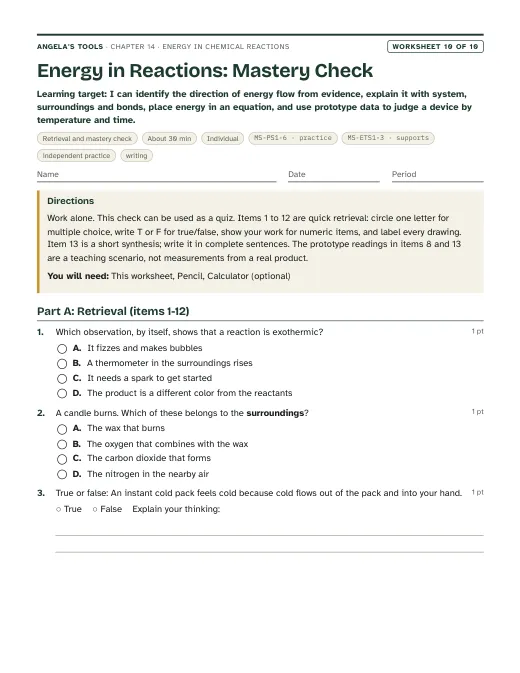
I can identify the direction of energy flow from evidence, explain it with system, surroundings and bonds, place energy in an equation, and use prototype data to judge a device by temperature and time.
Three different investigation approaches. Each has a teacher guide (purpose, materials with quantities, estimated cost, prep, safety, procedure, expected observations, debrief, answer key, assessment criteria, accessibility adaptations, low-cost alternative) and a student recording sheet.
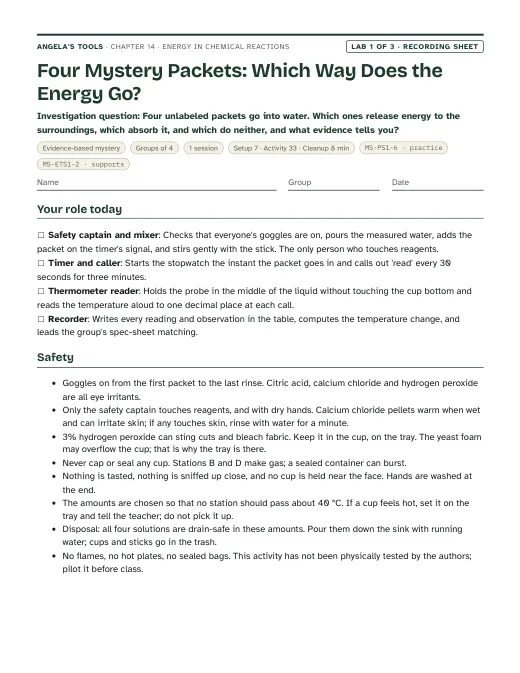
Four unlabeled packets go into water. Which ones release energy to the surroundings, which absorb it, and which do neither, and what evidence tells you?
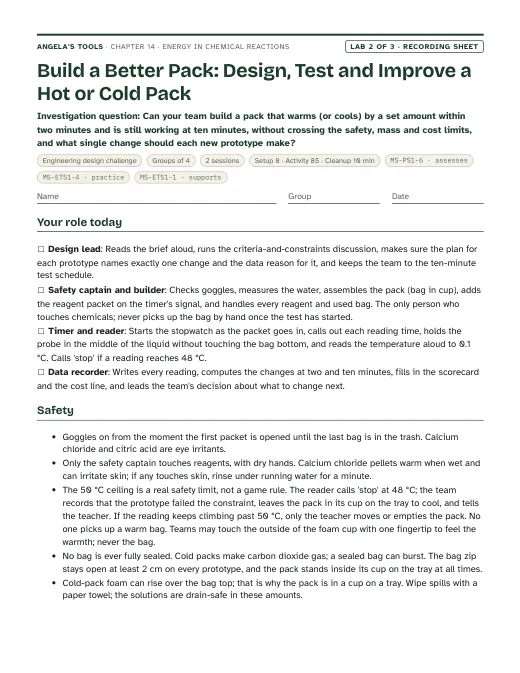
Can your team build a pack that warms (or cools) by a set amount within two minutes and is still working at ten minutes, without crossing the safety, mass and cost limits, and what single change should each new prototype make?
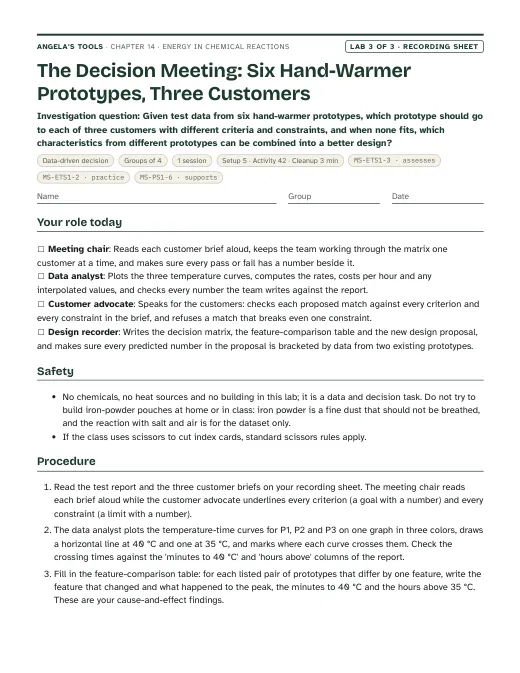
Given test data from six hand-warmer prototypes, which prototype should go to each of three customers with different criteria and constraints, and when none fits, which characteristics from different prototypes can be combined into a better design?
Materials overview: No open flames anywhere in the chapter; the magnesium flash and the match are described, never demonstrated. Lab 1 and Lab 2 use food-grade or hardware-store reagents in teacher-measured amounts: calcium chloride pellets (ice melt or pickling grade), citric acid, baking soda, 3% hydrogen peroxide, dry yeast and table salt, with digital thermometers, foam cups, snack-size zip bags, measuring cups and goggles. Lab 3 uses printed data cards, graph paper and calculators only. A pair of commercial instant hot and cold packs makes the phenomenon a live demonstration; otherwise describe it with the numbers in the phenomenon text.
Review status: reviewed · 2026-10-19 · Chemistry checked against standard values: anhydrous CaCl2 dissolving (about -81 kJ/mol) gives about +10 °C for 3 g in 50 mL and up to about +30 °C for 9 g, so the Lab 2 rule (stop at 48 °C, pilot 9 g and drop to 6 g if it reaches 48 °C) is sound; the pilot now uses the most insulation a team could add, and the bag is moved only by the teacher above 50 °C. NH4Cl, citric acid + baking soda, vinegar + baking soda and H2O2 + yeast directions and sizes verified; Lab 1 station A and C expectations and the q9 class range were tightened to physically reachable values; vinegar alternatives now say 'a few degrees'. Every numeric, multiple-choice, true/false, fill and table item in W1-W10 and Labs 1-3 re-solved. Fixed: W1 iron mass behind the 3.1 g gain (about 7 g, not 11 g); W5 q7 (B, not A, warmed fastest); W7 counts (seven errors, one correct sentence); W8 card 1 (8 g giving +24 °C, matching Lab 1/Lab 2 rates) and card 3's 3-minute criterion; W10 point total (17 + 4 = 21) and the q8 interpolation note; Lab 3 Dani design predictions now meet her 15-minute start, 70 g and $2.00 limits. Lab 3 decision matrix verified from the data: P3 for Maya, P1 for Mr. Alvarez, none for Dani; costs, masses, crossing times and cost-per-hour values recomputed and correct. Energy language: removed 'produced heat ... cold' from the phenomenon, 'burning' for the iron hand warmer, and creation-style wording; DCI and debrief text now say released to / absorbed from the surroundings, with storage in the arrangement of atoms, never in bonds that break. The textbook's NH4OH + HCl cold-pack equation was removed from W10 item 5 (replaced by a water-as-product distractor), matching the chapter rule never to show it; W2 and W8 no longer suggest demonstrating burning magnesium, and W2 notes that a little nitrogen reacts. Originality: definitions and bullets that echoed the book's 6+ word runs (exothermic/endothermic definitions, 'cooled back to room temperature within', 'from the surroundings to the system', 'on the basis of the test results') rewritten; only section titles in sourceReferences remain. Standards: caGrade added to all eight lab standards entries; MS-ETS1-1 added to the chapter and MS-ETS1-2 raised to assesses to match W9, where students write their own criteria and constraints and evaluate four designs against them. Consistency: estimatedMinutes set to the 120-minute pacing sum; slide links corrected (W2/W3 examples, Lab 1 stations, W8 not W9 for choosing a warming process); Lessons 23-24 described as a preview; W3 scaffold no longer cites photosynthesis, which the passage does not contain; W4 cold-pack boundary note now matches Labs 1-2 and the slide-5 rule that either boundary is acceptable.
Verified against the student edition of Bring Science Alive! 7th Grade Integrated (Student Edition). Printed page numbers appear in the book; PDF pages are the physical pages of the 524-page scan (printed + 36). The textbook is not reproduced on this site.
| Section | Printed pages | PDF pages | Used for |
|---|---|---|---|
| Introduction: fireworks, the lesson question and vocabulary | 172, 173 | 208, 209 | Lesson question, the three vocabulary terms (exothermic, endothermic, prototype) and the publisher's standards list. |
| 1. Exothermic Reactions: system and surroundings, the burning match, charcoal and iron hand warmers | 174, 175 | 210, 211 | System-and-surroundings boundary model, exothermic examples, the iron hand warmer that Lab 3 and the slide task model. |
| 2. Endothermic Reactions: cooking, ammonium chloride and the instant cold pack | 176, 177 | 212, 213 | Endothermic examples, the cold-pack mechanism (rewritten with ions), accuracy notes on continuous heating and cooking. |
| Key Science Concept: Reactions Release and Absorb Energy (bonds break, bonds form) | 178 | 214 | The qualitative bond-breaking and bond-forming model on slide 13, W4 and the misconception slide. |
| 3. Showing Energy in Chemical Equations | 179 | 215 | The placement rule for the energy term and the iron equation; the cold-pack equation is replaced with an ion version. |
| 4. Testing and Improving Hand Warmers: prototypes, temperature tests, time tests | 180, 181 | 216, 217 | The design-cycle diagram, the criteria of temperature and time, and the structure of Lab 2 and Lab 3. |