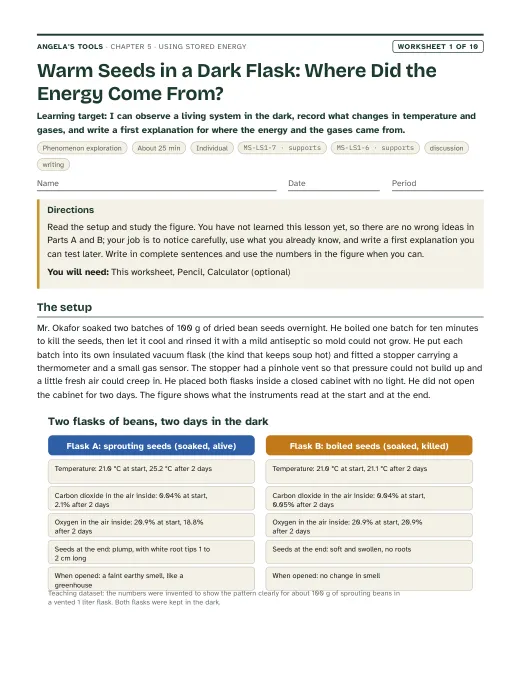
Warm Seeds in a Dark Flask: Where Did the Energy Come From?
I can observe a living system in the dark, record what changes in temperature and gases, and write a first explanation for where the energy and the gases came from.
Chapter 05 · Unit 2: Energy and Matter in Ecosystems · Segment 1
How do living things get usable energy and building materials out of food, and where does the matter go?
Students figure out that every living thing, from an oak root to a squirrel to a single-celled amoeba, runs its cells on the same fuel: chemical energy stored in sugar. They model cellular respiration as a rearrangement of atoms (sugar and oxygen become carbon dioxide and water) in which no atom is lost and stored energy is released for the cell's work, and they gather their own evidence that plants respire too, day and night, in every living cell. They then follow a meal from the mouth to the cells to see that digested food is used two ways, as fuel and as building blocks for the body's own carbohydrates, fats and proteins. The chapter closes by setting photosynthesis beside cellular respiration so that matter can be traced in a loop while energy flows one way, which is the foundation for food webs in Lesson 6 and global cycles in Lesson 7.
Estimated class time: presentation about 136 minutes · worksheets about 405 minutes in total · labs 4 sessions. Seven 50-minute periods: one to launch the phenomenon and set up the seed jars, one to read the jars and model the reaction, one for the atom-token lab, one for energy, plant respiration and the California connection, one for the exercise field investigation, one for digestion, building blocks and the comparison, and one for synthesis and mastery.
A handful of dried peas is soaked overnight, rinsed and sealed in a jar with a small cup of blue indicator liquid and a thermometer, then placed in a dark cupboard. Twenty-four hours later the seeds have sprouted roots several millimeters long, the thermometer reads a few degrees warmer than the cupboard, and the indicator has turned yellow, the color it shows when carbon dioxide dissolves in it. A second jar holding dry peas shows no change, and a third jar holding soaked peas that were boiled first stays blue and cool. No light reached any jar. Something inside the living seeds is releasing energy, giving off a gas, and building new plant parts out of a seed that is slowly getting lighter.
Notice and wonder prompts
California NGSS, Grade 7 Preferred Integrated Course Model. Each entry says whether this chapter's work assesses the performance expectation, gives practice toward it, or supports it as background; the resource lists below repeat this for every worksheet and lab.
Develop a model to describe how food is rearranged through chemical reactions forming new molecules that support growth and/or release energy as this matter moves through an organism.
The chapter's core product is a student model of cellular respiration and of food-to-body matter flow: Lab 2 rearranges atom tokens from sugar and oxygen into carbon dioxide and water, W4 and W6 ask students to model and explain where the atoms and the energy go, and W9 traces a meal into fuel and building blocks. The assessment boundary excludes details of the reactions, so no task asks for intermediate steps, ATP or enzyme names.
Assessment boundary: Assessment does not include details of the chemical reactions for photosynthesis or respiration.
Develop and use a model to describe how the total number of atoms does not change in a chemical reaction and thus mass is conserved.
Lab 2 and the atom-count slides use beads and tokens to show that the 6 carbon, 12 hydrogen and 18 oxygen atoms entering respiration all come out in the products, with mass unchanged. This builds the practice toward the PE, which is taught fully in Lessons 12-13; students are never asked to balance a symbolic equation.
Assessment boundary: Assessment does not include the use of atomic masses, balancing symbolic equations, or intermolecular forces.
Construct a scientific explanation based on evidence for the role of photosynthesis in the cycling of matter and flow of energy into and out of organisms.
Lesson 4 assessed this PE. Here photosynthesis is the background that explains where sugar and oxygen come from; the comparison slides and W9 use it to trace matter and energy into and out of organisms, but no task constructs the photosynthesis explanation itself.
Assessment boundary: Assessment does not include the biochemical mechanisms of photosynthesis.
Develop a model to describe the cycling of matter and flow of energy among living and nonliving parts of an ecosystem.
The closing comparison of the two processes shows matter looping between carbon dioxide and sugar while energy enters as light and leaves as heat. That is the organism-scale idea that Lessons 6 and 7 scale up to ecosystems, where this PE is addressed.
Assessment boundary: Assessment does not include the use of chemical reactions to describe the processes.
Using Stored Energy: how living things run on sugar. Original, editable slides with speaker notes: a phenomenon opener, learning targets, the chapter's concepts with diagrams, vocabulary in context, 3 checks for understanding, 2 discussion prompts, an application task, a misconception check, a synthesis and an exit ticket.

Ten different tasks, one per instructional blueprint. Each has a student PDF (low ink, US Letter), an editable DOCX, an HTML preview, and a separate teacher answer key with reasoning.
I can observe a living system in the dark, record what changes in temperature and gases, and write a first explanation for where the energy and the gases came from.
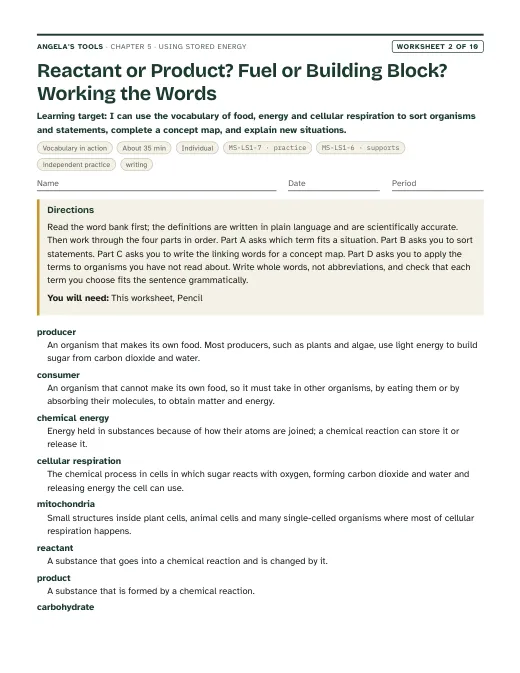
I can use the vocabulary of food, energy and cellular respiration to sort organisms and statements, complete a concept map, and explain new situations.
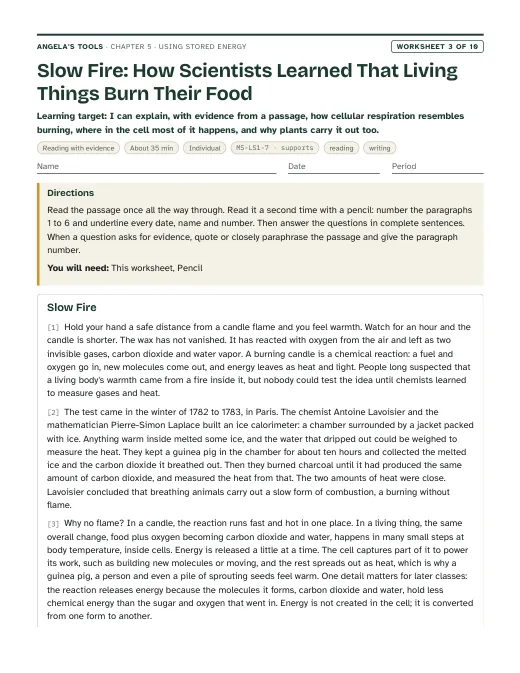
I can explain, with evidence from a passage, how cellular respiration resembles burning, where in the cell most of it happens, and why plants carry it out too.
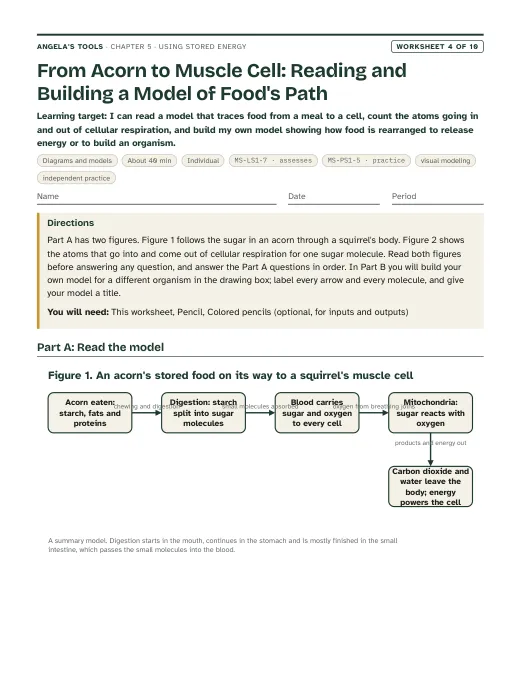
I can read a model that traces food from a meal to a cell, count the atoms going in and out of cellular respiration, and build my own model showing how food is rearranged to release energy or to build an organism.
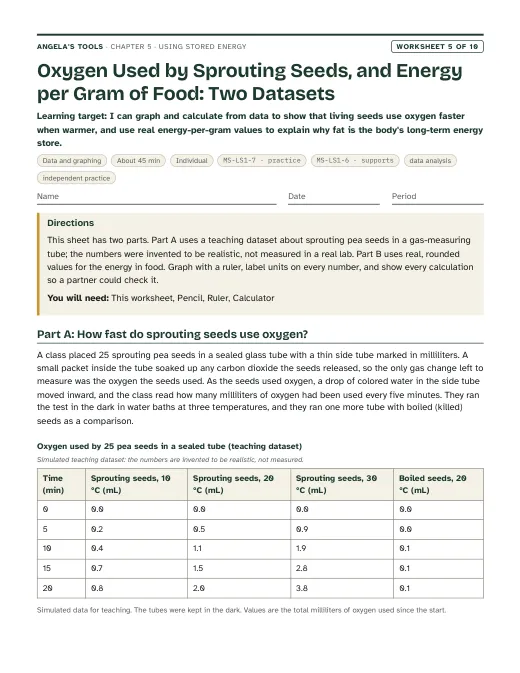
I can graph and calculate from data to show that living seeds use oxygen faster when warmer, and use real energy-per-gram values to explain why fat is the body's long-term energy store.
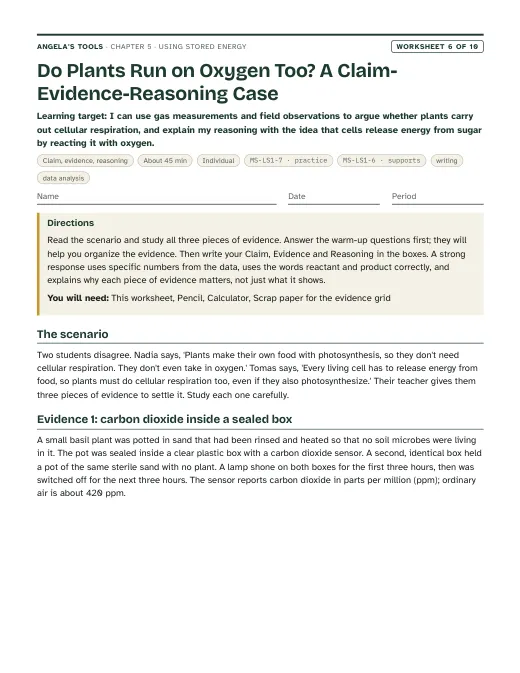
I can use gas measurements and field observations to argue whether plants carry out cellular respiration, and explain my reasoning with the idea that cells release energy from sugar by reacting it with oxygen.
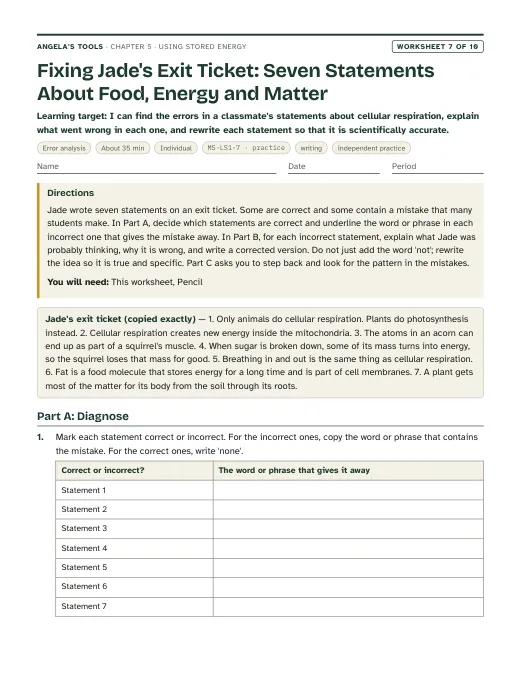
I can find the errors in a classmate's statements about cellular respiration, explain what went wrong in each one, and rewrite each statement so that it is scientifically accurate.
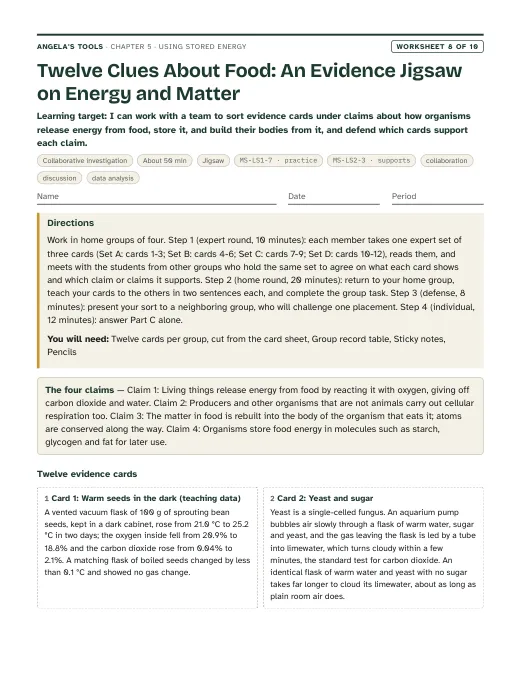
I can work with a team to sort evidence cards under claims about how organisms release energy from food, store it, and build their bodies from it, and defend which cards support each claim.
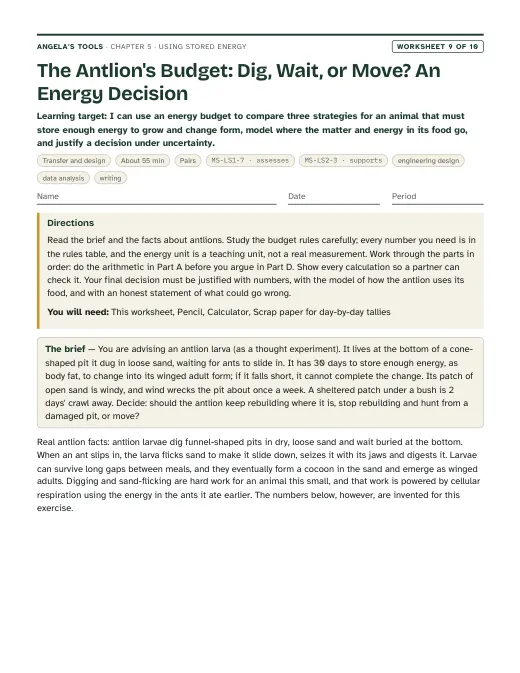
I can use an energy budget to compare three strategies for an animal that must store enough energy to grow and change form, model where the matter and energy in its food go, and justify a decision under uncertainty.
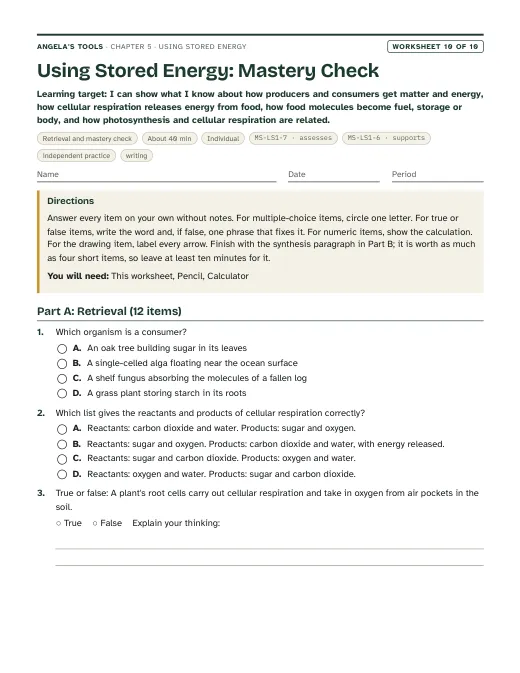
I can show what I know about how producers and consumers get matter and energy, how cellular respiration releases energy from food, how food molecules become fuel, storage or body, and how photosynthesis and cellular respiration are related.
Three different investigation approaches. Each has a teacher guide (purpose, materials with quantities, estimated cost, prep, safety, procedure, expected observations, debrief, answer key, assessment criteria, accessibility adaptations, low-cost alternative) and a student recording sheet.
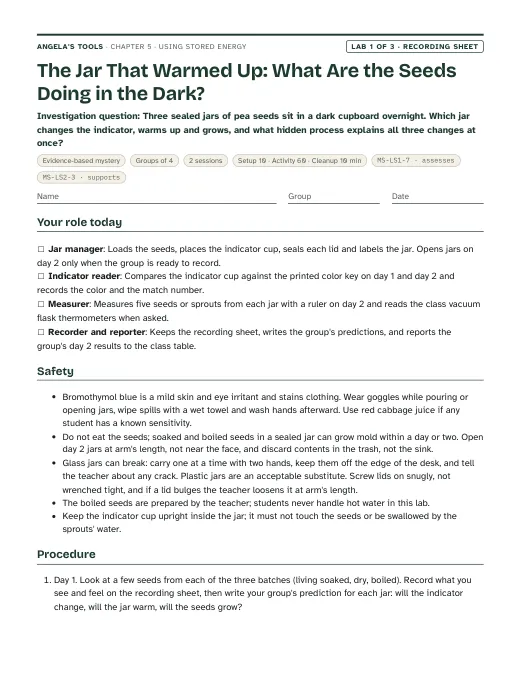
Three sealed jars of pea seeds sit in a dark cupboard overnight. Which jar changes the indicator, warms up and grows, and what hidden process explains all three changes at once?
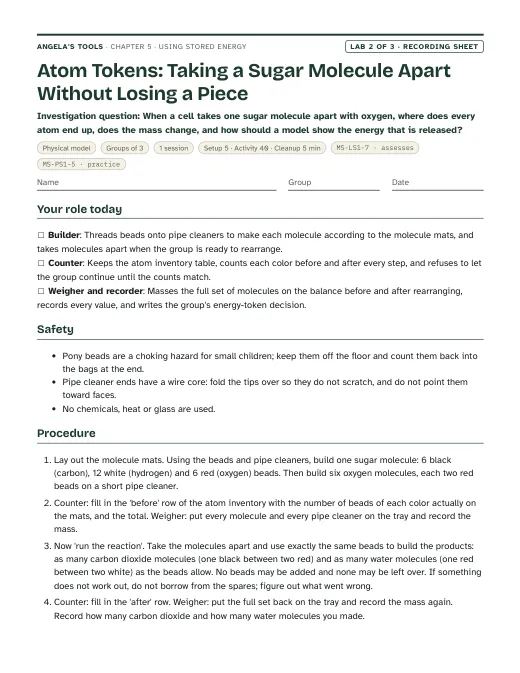
When a cell takes one sugar molecule apart with oxygen, where does every atom end up, does the mass change, and how should a model show the energy that is released?
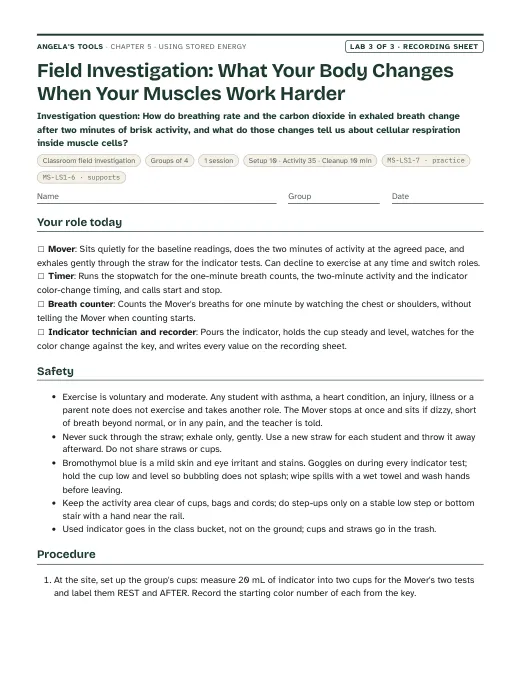
How do breathing rate and the carbon dioxide in exhaled breath change after two minutes of brisk activity, and what do those changes tell us about cellular respiration inside muscle cells?
Materials overview: No flames and no strong chemicals. Lab 1 uses dried peas, jars with lids, bromothymol blue indicator (or red cabbage juice), thermometers and two vacuum flasks for the class temperature comparison. Lab 2 uses pony beads in three colors, pipe cleaners and a balance. Lab 3 uses stopwatches, drinking straws, small cups of bromothymol blue and an open hallway, gym or yard. Bromothymol blue is a mild irritant and stains; wear goggles and wipe spills. The phenomenon can be run live with the Lab 1 jars or described with the numbers in the phenomenon text.
Review status: reviewed · 2026-10-18 · Re-solved every numeric and multiple-choice item in W1-W10 and Labs 1-3 (atom counts, rates, kcal and kJ totals, percentages, the antlion budget and its recomputations); all keys agreed. Rewrote the consumer definition (chapter vocabulary and slide 6), which repeated a six-word phrase from the textbook. Corrected the claim that plant oxygen comes from water (slide 5, accuracy note, W7 q6 key) to a wording that assigns only carbon to carbon dioxide and hydrogen to water. Slide 9 flow diagram no longer describes stages of the reaction (assessment boundary); reduced to four nodes with three arrow labels to match the renderer. Slide 17 note said yeast lacks mitochondria-rich tissue; replaced with 'a single cell with no lungs'. W8 Card 2 rewritten from a sealed yeast bottle (mostly fermentation, so weak evidence for reaction with oxygen) to an air-bubbled flask with limewater; Card 1 and the q4 key updated to match. W1 flask given a pinhole vent and the caption no longer calls the two-day gas readings realistic for a sealed 1 L flask (100 g of seeds would exhaust the oxygen in hours). W5 teacher note on respirometer rates softened to the range classroom respirometers actually give. Lab 1: lids snug not wrenched tight, and modelLimitations now says a small sealed jar runs out of oxygen within hours rather than days. Lab 2: pipe cleaners raised from 20 to 30 so the two-sugar scaling step can build all 24 product molecules. Labs have not been physically tested; see each lab's modelLimitations.
Verified against the student edition of Bring Science Alive! 7th Grade Integrated (Student Edition). Printed page numbers appear in the book; PDF pages are the physical pages of the 524-page scan (printed + 36). The textbook is not reproduced on this site.
| Section | Printed pages | PDF pages | Used for |
|---|---|---|---|
| Introduction: the acorn and the squirrel; lesson question | 54, 55 | 90, 91 | Lesson question, the stored-energy-in-a-seed idea behind the phenomenon, vocabulary list, standards listed by the publisher. |
| 1. Consumers | 56 | 92 | Consumer definition, the amoeba and dolphin examples, the idea that producers and consumers both use and store sugar. |
| 2. Sources of Matter and Energy | 57 | 93 | Producer versus consumer compare diagram, the sources-of-matter correction in accuracyNotes, W2 relationships. |
| 3. Cellular Respiration: site, process, gases | 58, 59 | 94, 95 | Mitochondria, the word and chemical equations, atom counting (Lab 2, W4), the breathing versus respiration distinction and the plant-oxygen correction. |
| Key Science Concept: Matter and Energy in Cellular Respiration | 60 | 96 | The verified equation and the idea that the same amount of matter leaves as enters; basis for the conservation slides and Lab 2. |
| 4. How You Get Energy and Matter: carbohydrates, fats, proteins | 61, 62 | 97, 98 | Digestion flow, the fuel-versus-building-block idea, the three food molecule types and the W9 transfer task. |
| 5. Comparing Photosynthesis and Cellular Respiration; lesson summary | 63 | 99 | The paired equations, the cycle diagram, the energy-flow discussion and the synthesis slide. |