Chapter 05 · Unit 2: Energy and Matter in Ecosystems · Segment 1

Using Stored Energy

How do living things get usable energy and building materials out of food, and where does the matter go?

MS-LS1-7 · assessesMS-PS1-5 · practiceMS-LS1-6 · supportsMS-LS2-3 · supports Textbook pp. 54–63 1 presentation · 10 worksheets · 3 labs

Overview

Students figure out that every living thing, from an oak root to a squirrel to a single-celled amoeba, runs its cells on the same fuel: chemical energy stored in sugar. They model cellular respiration as a rearrangement of atoms (sugar and oxygen become carbon dioxide and water) in which no atom is lost and stored energy is released for the cell's work, and they gather their own evidence that plants respire too, day and night, in every living cell. They then follow a meal from the mouth to the cells to see that digested food is used two ways, as fuel and as building blocks for the body's own carbohydrates, fats and proteins. The chapter closes by setting photosynthesis beside cellular respiration so that matter can be traced in a loop while energy flows one way, which is the foundation for food webs in Lesson 6 and global cycles in Lesson 7.

Estimated class time: presentation about 136 minutes · worksheets about 405 minutes in total · labs 4 sessions. Seven 50-minute periods: one to launch the phenomenon and set up the seed jars, one to read the jars and model the reaction, one for the atom-token lab, one for energy, plant respiration and the California connection, one for the exercise field investigation, one for digestion, building blocks and the comparison, and one for synthesis and mastery.

Phenomenon

The seeds that grow in the dark

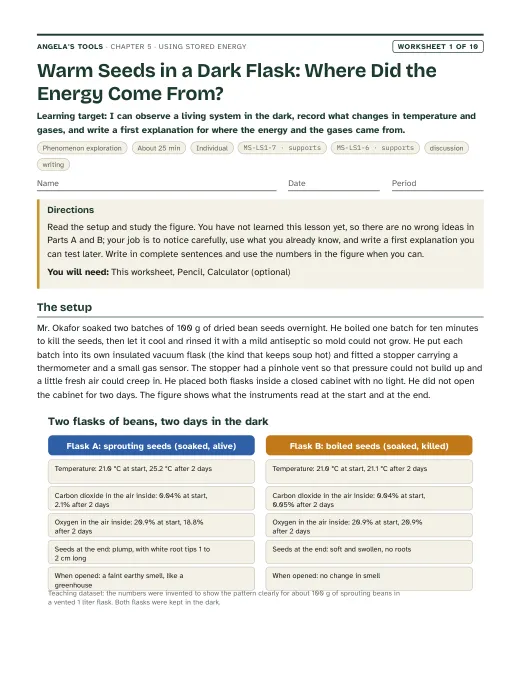
A handful of dried peas is soaked overnight, rinsed and sealed in a jar with a small cup of blue indicator liquid and a thermometer, then placed in a dark cupboard. Twenty-four hours later the seeds have sprouted roots several millimeters long, the thermometer reads a few degrees warmer than the cupboard, and the indicator has turned yellow, the color it shows when carbon dioxide dissolves in it. A second jar holding dry peas shows no change, and a third jar holding soaked peas that were boiled first stays blue and cool. No light reached any jar. Something inside the living seeds is releasing energy, giving off a gas, and building new plant parts out of a seed that is slowly getting lighter.

Notice and wonder prompts

  • Where did the energy to warm the jar and push out a root come from, if no light got in?
  • What gas turned the indicator yellow, and what was it made from?
  • Why did the boiled seeds and the dry seeds behave so differently from the living soaked ones?
  • If the sprouting seeds are losing stored material, where is that matter going?

Learning targets

  • I can tell producers from consumers by where they get matter and energy, and explain that both run their cells on sugar.
  • I can model cellular respiration with a word equation and atom counts to show that atoms are rearranged, not lost, while stored chemical energy is released.
  • I can use evidence to argue that plants carry out cellular respiration as animals do, and tell breathing apart from cellular respiration.
  • I can describe how digestion breaks food into small molecules that are used either as fuel or as building blocks for the body's carbohydrates, fats and proteins.
  • I can compare photosynthesis and cellular respiration and trace how matter cycles while energy flows through living things.

What shows the learning happened

  • A completed atom-token model (Lab 2) with an inventory table showing 6 C, 12 H and 18 O atoms before and after, the same mass on the balance, and a written justification of how energy is represented.
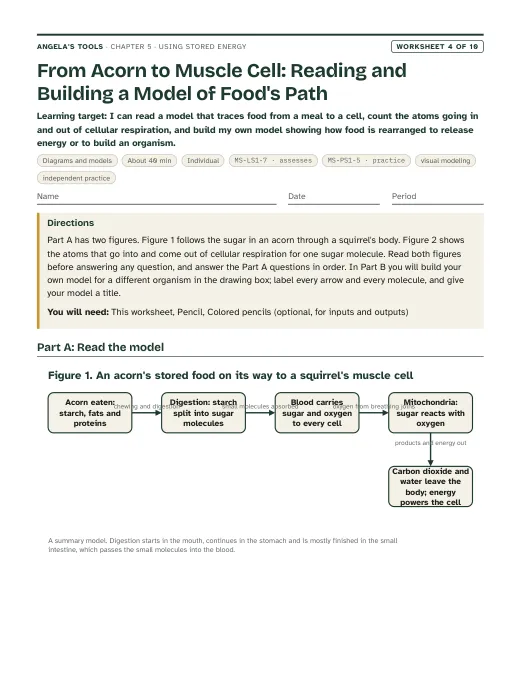
  • A labeled molecule-flow model (W4) tracing sugar and oxygen into carbon dioxide, water and released energy, with the mitochondrion placed correctly.
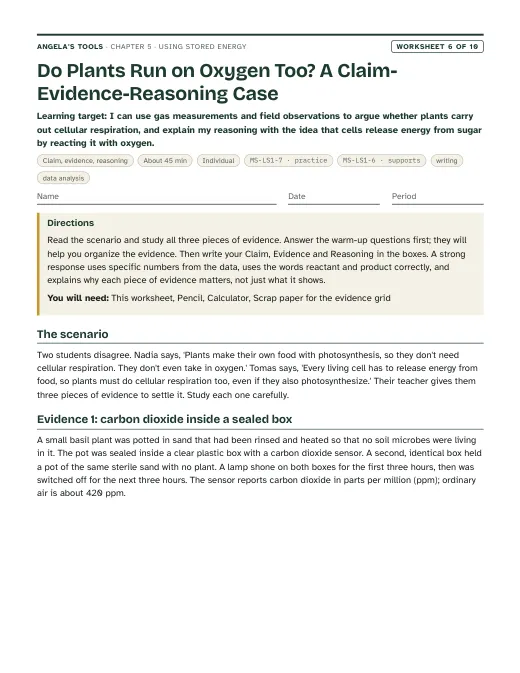
  • A Claim-Evidence-Reasoning paragraph (W6 or Lab 1) arguing from indicator, temperature and growth evidence that living seeds carry out cellular respiration without light.
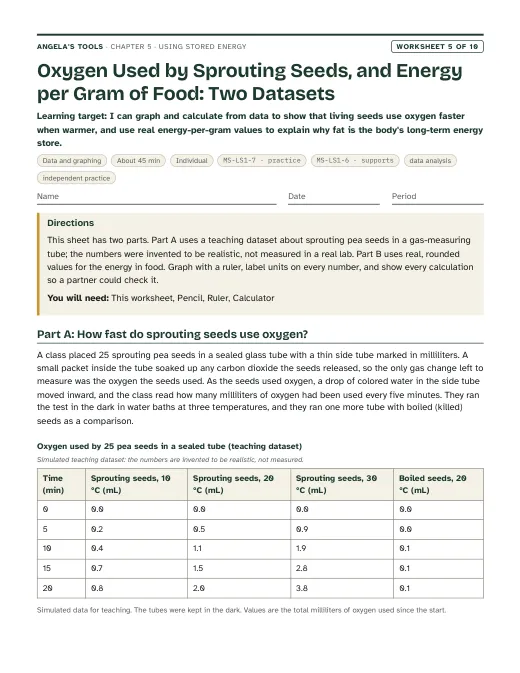
  • A data analysis (W5 or the presentation task) that explains why sprouting seeds lose dry mass while growing and where the missing carbon went.
  • A written comparison (W9 or W10) of photosynthesis and cellular respiration that correctly identifies the reactants, products, energy direction and the fact that both happen in a plant.
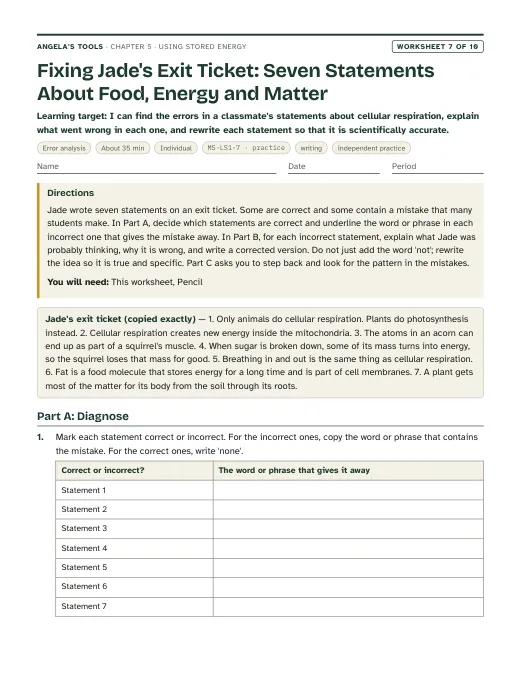
  • A corrected explanation (W7) of a fictional student's claim that plants do not need oxygen or that breathing is the same as cellular respiration.

Key vocabulary 12 terms

producerAn organism that makes its own food. Most producers, such as plants and algae, build sugar from carbon dioxide and water using energy captured from sunlight; a few, such as some deep-sea bacteria, use chemical energy instead.A kelp frond is a producer: it builds sugar from carbon dioxide dissolved in seawater, using light that reaches it near the surface.
consumerAn organism that cannot make its own food, so it must take both its matter and its energy from other living things, either by eating them or by soaking up their molecules.A mushroom is a consumer; it absorbs molecules from the rotting log it grows on rather than making sugar itself.
chemical energyEnergy held in the arrangement of atoms in a molecule. Reactions that rearrange atoms into new molecules can store this energy or release it.An acorn is dense with chemical energy, which is why a squirrel can run for hours on a few of them.
cellular respirationThe series of reactions inside cells that combines sugar with oxygen, rearranging the atoms into carbon dioxide and water and releasing energy the cell can use.Cellular respiration in a sprouting pea seed releases the energy that pushes the first root into the soil.
mitochondrionA structure inside plant cells, animal cells and many single-celled organisms where most of the steps of cellular respiration take place. (Plural: mitochondria.)Heart muscle cells are packed with mitochondria because they must release energy without a pause for a lifetime.
reactantA substance that goes into a chemical reaction and is changed by it. Cellular respiration has two reactants: sugar and oxygen.If a cell runs short of either reactant, sugar or oxygen, respiration slows.
productA substance formed by a chemical reaction. The products of cellular respiration are carbon dioxide and water.The carbon dioxide you breathe out is a product of respiration in trillions of your cells.
digestionThe breakdown of food into molecules small enough to pass into the blood. It begins in the mouth, continues in the stomach and is mostly completed in the small intestine.Digestion turns the starch in a slice of bread into sugar molecules that cells can use.
carbohydrateA molecule made of carbon, hydrogen and oxygen that stores energy or builds structure. Sugars are single units or pairs of units; starch, glycogen and cellulose are long chains of sugar units.A potato stores most of its energy as the carbohydrate starch, a long chain of sugar units.
glycogenA complex carbohydrate that animals build from spare sugar and keep in the liver and muscles as a short-term energy reserve.During a long race, a runner's muscles break glycogen back into sugar to keep respiration going.
fatAn energy-rich molecule used for long-term energy storage and, together with its close relatives, for building cell membranes. Fats that are liquid at room temperature are called oils.A migrating bird stores fat before its journey because fat holds more energy per gram than sugar or starch.
proteinA large molecule built from smaller units called amino acids. Proteins form muscle and other structures, move materials into and out of cells and speed up reactions.Your body takes apart the proteins in a bean and reuses the pieces to build its own muscle proteins.


Standards alignment

California NGSS, Grade 7 Preferred Integrated Course Model. Each entry says whether this chapter's work assesses the performance expectation, gives practice toward it, or supports it as background; the resource lists below repeat this for every worksheet and lab.

MS-LS1-7Assesses: developing a model of how food molecules are broken apart and rearranged to release energy and to build new moleculesCA Grade 7

Develop a model to describe how food is rearranged through chemical reactions forming new molecules that support growth and/or release energy as this matter moves through an organism.

The chapter's core product is a student model of cellular respiration and of food-to-body matter flow: Lab 2 rearranges atom tokens from sugar and oxygen into carbon dioxide and water, W4 and W6 ask students to model and explain where the atoms and the energy go, and W9 traces a meal into fuel and building blocks. The assessment boundary excludes details of the reactions, so no task asks for intermediate steps, ATP or enzyme names.

Assessment boundary: Assessment does not include details of the chemical reactions for photosynthesis or respiration.

MS-PS1-5Practice toward: using a physical model of atoms to show that atoms are conserved in a reactionCA Grade 7

Develop and use a model to describe how the total number of atoms does not change in a chemical reaction and thus mass is conserved.

Lab 2 and the atom-count slides use beads and tokens to show that the 6 carbon, 12 hydrogen and 18 oxygen atoms entering respiration all come out in the products, with mass unchanged. This builds the practice toward the PE, which is taught fully in Lessons 12-13; students are never asked to balance a symbolic equation.

Assessment boundary: Assessment does not include the use of atomic masses, balancing symbolic equations, or intermolecular forces.

MS-LS1-6Supports: the role of photosynthesis in storing energy and matter that respiration later releasesCA Grade 7

Construct a scientific explanation based on evidence for the role of photosynthesis in the cycling of matter and flow of energy into and out of organisms.

Lesson 4 assessed this PE. Here photosynthesis is the background that explains where sugar and oxygen come from; the comparison slides and W9 use it to trace matter and energy into and out of organisms, but no task constructs the photosynthesis explanation itself.

Assessment boundary: Assessment does not include the biochemical mechanisms of photosynthesis.

MS-LS2-3Supports: the organism-level piece of matter cycling and energy flowCA Grade 7

Develop a model to describe the cycling of matter and flow of energy among living and nonliving parts of an ecosystem.

The closing comparison of the two processes shows matter looping between carbon dioxide and sugar while energy enters as light and leaves as heat. That is the organism-scale idea that Lessons 6 and 7 scale up to ecosystems, where this PE is addressed.

Assessment boundary: Assessment does not include the use of chemical reactions to describe the processes.

Science and engineering practices

  • Developing and Using Models. Students build the respiration reaction with atom tokens (Lab 2), draw and complete molecule-flow models (W4), and use the paired photosynthesis and respiration equations as models to predict where matter and energy go (W9).
  • Planning and Carrying Out Investigations. Students set up sealed seed jars with controls (Lab 1) and measure their own breathing rate and exhaled carbon dioxide before and after exercise (Lab 3), deciding what to control and how many readings to take.
  • Engaging in Argument from Evidence. Students argue from indicator color, temperature and sprout growth that living seeds respire in the dark (Lab 1, W6) and defend the claim that plants need oxygen (W7, slide discussions).
  • Analyzing and Interpreting Data. Students read a simulated dry-mass and gas-release dataset for sprouting seeds (presentation task, W5) and pooled class data from the exercise investigation (Lab 3).

Disciplinary core ideas

  • LS1.C Organization for Matter and Energy Flow in Organisms. Food moves through an organism in a chain of reactions that break molecules apart and rearrange them, releasing energy and supplying atoms to build the body's own molecules.
  • PS3.D Energy in Chemical Processes and Everyday Life. Cellular respiration in plants and animals is a reaction with oxygen that releases stored energy; carbon-containing molecules react with oxygen to make carbon dioxide and water.
  • PS1.B Chemical Reactions. Atoms are conserved: the same 36 atoms that enter the respiration reaction leave it, regrouped into new molecules, so mass is unchanged.

Crosscutting concepts

  • Energy and Matter. Students track atoms through respiration and digestion to see matter conserved, and track energy from sunlight into sugar, out of sugar into the cell's work, and finally into heat.
  • Systems and System Models. A sealed jar of seeds, a cell, and a body are treated as systems with inputs (sugar, oxygen) and outputs (carbon dioxide, water, heat), and students define where the boundary is.
  • Cause and Effect. Harder work by muscles causes faster breathing and more exhaled carbon dioxide; a flooded root loses oxygen and dies; a boiled seed cannot respire.

Presentation 27 slides

Using Stored Energy: how living things run on sugar. Original, editable slides with speaker notes: a phenomenon opener, learning targets, the chapter's concepts with diagrams, vocabulary in context, 3 checks for understanding, 2 discussion prompts, an application task, a misconception check, a synthesis and an exit ticket.

Worksheets 10 of 10

Ten different tasks, one per instructional blueprint. Each has a student PDF (low ink, US Letter), an editable DOCX, an HTML preview, and a separate teacher answer key with reasoning.

First page of From Acorn to Muscle Cell: Reading and Building a Model of Food's Path
Worksheet 4 · Diagrams and models

From Acorn to Muscle Cell: Reading and Building a Model of Food's Path

I can read a model that traces food from a meal to a cell, count the atoms going in and out of cellular respiration, and build my own model showing how food is rearranged to release energy or to build an organism.

40 minindividualBuilds understandingVisual modelingIndependent practice MS-LS1-7 · assessesMS-PS1-5 · practice
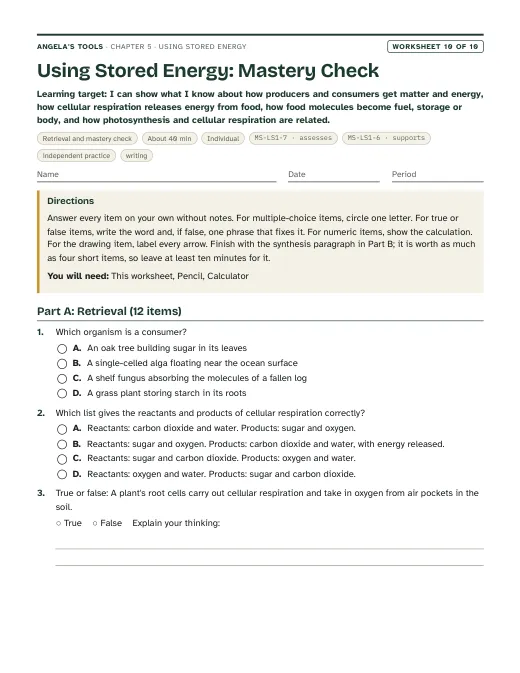
First page of Using Stored Energy: Mastery Check
Worksheet 10 · Retrieval and mastery check

Using Stored Energy: Mastery Check

I can show what I know about how producers and consumers get matter and energy, how cellular respiration releases energy from food, how food molecules become fuel, storage or body, and how photosynthesis and cellular respiration are related.

40 minindividualAssessmentIndependent practiceWriting MS-LS1-7 · assessesMS-LS1-6 · supports

Collaborative labs 3 of 3

Three different investigation approaches. Each has a teacher guide (purpose, materials with quantities, estimated cost, prep, safety, procedure, expected observations, debrief, answer key, assessment criteria, accessibility adaptations, low-cost alternative) and a student recording sheet.

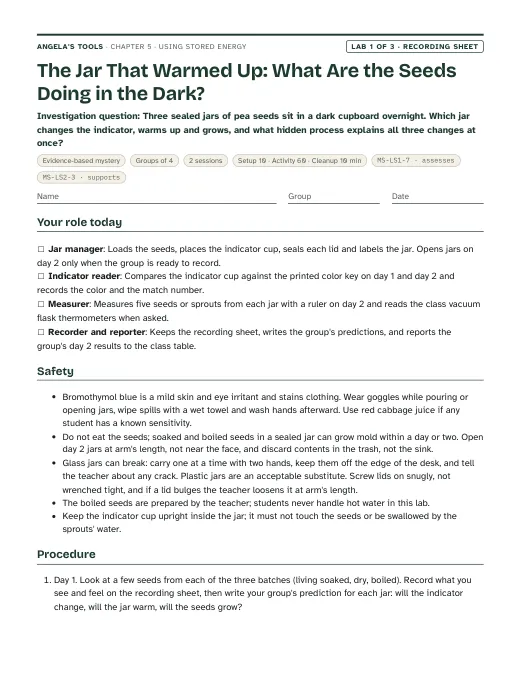
First page of the The Jar That Warmed Up: What Are the Seeds Doing in the Dark? recording sheet
Lab 1 · Evidence-based mystery

The Jar That Warmed Up: What Are the Seeds Doing in the Dark?

Three sealed jars of pea seeds sit in a dark cupboard overnight. Which jar changes the indicator, warms up and grows, and what hidden process explains all three changes at once?

Groups of 42 sessions60 min activityEst. 12 to 18 per classDried whole peas (grocery store), soaked 24 h by the teacherDried whole peas, unsoakedSoaked peas boiled 10 minutes and cooled (teacher-prepared) MS-LS1-7 · assessesMS-LS2-3 · supports
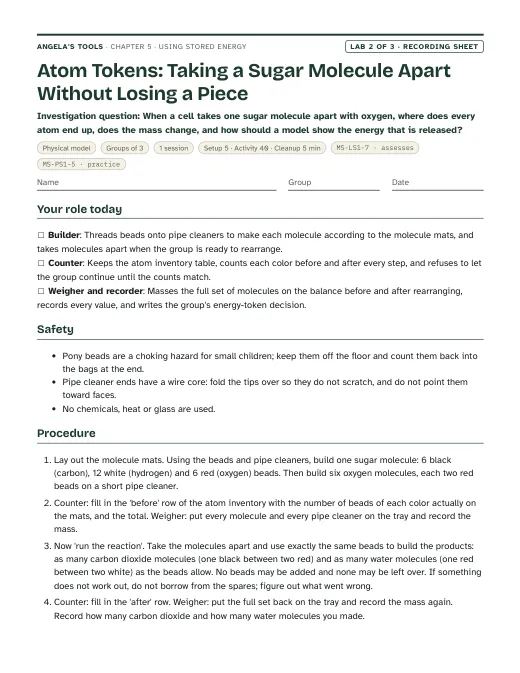
First page of the Atom Tokens: Taking a Sugar Molecule Apart Without Losing a Piece recording sheet
Lab 2 · Physical model

Atom Tokens: Taking a Sugar Molecule Apart Without Losing a Piece

When a cell takes one sugar molecule apart with oxygen, where does every atom end up, does the mass change, and how should a model show the energy that is released?

Groups of 31 session40 min activityEst. 8 to 12 per class, reusableBlack pony beads (carbon)White pony beads (hydrogen)Red pony beads (oxygen) MS-LS1-7 · assessesMS-PS1-5 · practice
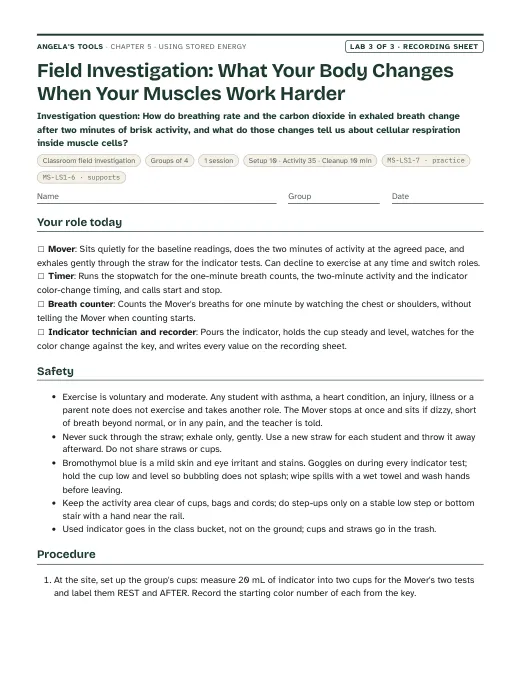
First page of the Field Investigation: What Your Body Changes When Your Muscles Work Harder recording sheet
Lab 3 · Classroom field investigation

Field Investigation: What Your Body Changes When Your Muscles Work Harder

How do breathing rate and the carbon dioxide in exhaled breath change after two minutes of brisk activity, and what do those changes tell us about cellular respiration inside muscle cells?

Groups of 41 session35 min activityEst. 10 to 15 per classStopwatch or phone timerBromothymol blue indicator, 0.04% solutionClear plastic cups, 150-250 mL MS-LS1-7 · practiceMS-LS1-6 · supports

Teacher guidance

Suggested sequence (7 steps)
  1. Period 1: Presentation slides 1-7 (seeds in the dark, targets, producers and consumers). W1 phenomenon worksheet as the opener. Lab 1 session 1 in the last 20 minutes: groups set up the three sealed seed jars and record starting conditions.
  2. Period 2: Lab 1 session 2 first (read indicator color, temperature and sprout length, then analysis). Slides 8-12 (food as fuel, the respiration flow, counting atoms, vocabulary, atom-count check). W2 vocabulary relationships to close.
  3. Period 3: Lab 2, atom tokens (one session): build sugar and oxygen, rearrange into carbon dioxide and water, check the balance, decide how to show energy. W4 diagram worksheet follows directly or as homework.
  4. Period 4: Slides 13-17 (where the energy comes from, do plants breathe, where a plant respires, the Salinas lettuce connection, breathing versus respiration check). W3 reading passage in class or at home; W7 misconception repair as the exit.
  5. Period 5: Lab 3, the breathing-rate and exhaled carbon dioxide field investigation (one session, hallway, gym or yard). W5 data worksheet uses the same kind of pooled data and can follow or be assigned.
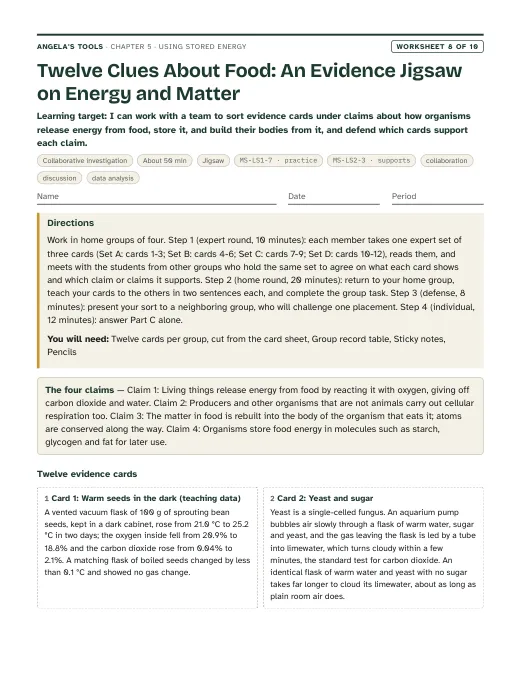
  6. Period 6: Slides 18-24 (from lunch to cells, what food becomes, carbohydrates fats and proteins, the sprouting-seed data task, comparing the two processes, the cycle diagram, the sun discussion). W8 collaborative evidence cards; W9 transfer task.
  7. Period 7: Slides 25-27 (misconception, synthesis, exit). W6 CER on the seed-jar evidence as the written assessment, then W10 mastery as the quiz.

Materials overview: No flames and no strong chemicals. Lab 1 uses dried peas, jars with lids, bromothymol blue indicator (or red cabbage juice), thermometers and two vacuum flasks for the class temperature comparison. Lab 2 uses pony beads in three colors, pipe cleaners and a balance. Lab 3 uses stopwatches, drinking straws, small cups of bromothymol blue and an open hallway, gym or yard. Bromothymol blue is a mild irritant and stains; wear goggles and wipe spills. The phenomenon can be run live with the Lab 1 jars or described with the numbers in the phenomenon text.

Common misconceptions (6)
“Plants get their energy straight from the sun, so they do not carry out cellular respiration and do not need oxygen.”
Why it happens: Photosynthesis is taught first and is the plant's famous process; the textbook also says producers already have all the oxygen they need from photosynthesis.
Correction: Light energy is used to build sugar. Every living plant cell, including roots, seeds and leaves at night, then releases that stored energy by cellular respiration, which needs oxygen. Roots in waterlogged soil die from lack of oxygen, and sprouting seeds in the dark warm up and give off carbon dioxide.
“Breathing and cellular respiration are the same thing.”
Why it happens: The two words share a root, and breathing is the visible part of getting oxygen in and carbon dioxide out.
Correction: Breathing moves air in and out of the lungs. Cellular respiration is the chemical reaction inside cells that uses the oxygen and makes the carbon dioxide. Plants, yeast and amoebas respire without breathing at all.
“Food is burned up and turns into energy, so the matter disappears.”
Why it happens: Everyday language says we 'burn calories', and the energy is the part students notice, not the invisible gases.
Correction: Atoms are never turned into energy in respiration. The carbon and oxygen atoms in sugar leave the body as carbon dioxide and the hydrogen leaves in water. When a person loses body fat, most of its mass leaves through the lungs as carbon dioxide.
“Energy is packed inside chemical bonds and pops out when a bond breaks.”
Why it happens: The textbook says energy is stored in the bonds of sugar and released when the molecule is broken down, which sounds like opening a box.
Correction: Breaking any bond costs energy. Respiration releases energy overall because the new bonds in carbon dioxide and water are stronger than the bonds in sugar and oxygen, so more energy is given off forming them than was spent breaking the old ones. At this level say 'energy stored in the molecule' and 'released by the reaction'.
“Animals build their bodies out of the air and water they take in, and plants build theirs out of soil.”
Why it happens: Air, water and soil are the visible things organisms take in, and plants are rooted in soil.
Correction: Plants build most of their mass from carbon dioxide and water; soil supplies only small amounts of minerals. Animals do use water as a large part of their bodies, but every carbon-containing molecule they are built from comes from the food they eat.
“Photosynthesis and cellular respiration are one reaction running forward and backward, and plants do one by day and the other by night.”
Why it happens: The overall equations are mirror images, and the day-night pattern is a tidy story.
Correction: The two processes are different chains of steps in different parts of the cell. Respiration runs in every living plant cell all the time; photosynthesis adds to it in green cells when light is available. The overall equations are summaries that are useful for tracking atoms and energy.
Differentiation suggestions (6)
  • Multilingual learners: Pre-teach producer, consumer, reactant, product and respiration with a picture card set; keep the word equation posted with the three colored atom types beside it so students can point rather than name; pair for Lab 1 so the observation table is talked through before it is written; accept the W6 claim in the home language with the evidence in English.
  • Students who need more support: Provide the Lab 2 inventory table with the reactant side pre-filled and a 'what goes where' checklist; give a sentence frame for the CER ('The living seeds ___, which shows ___ because ___'); offer the digestion flow as cut-out cards to sequence before writing; reduce Lab 3 to one baseline reading.
  • Students ready for extension: Ask them to explain why most of the weight a person loses leaves through the lungs, to find out how yeast releases energy from sugar when no oxygen is present and compare it with the token model, to research why Salinas lettuce is vacuum-cooled within hours of harvest, or to estimate how much carbon dioxide the class exhales in a period.
  • Students who need movement or alternative output: Run the respiration equation as a floor model with students wearing atom cards who regroup themselves; let the W4 model be built with the Lab 2 beads and photographed instead of drawn; accept the synthesis as a 60-second spoken explanation; make them Mover or Timer in Lab 3.
  • Students who cannot exercise or have breathing conditions: Assign the Timer, Recorder or Indicator role in Lab 3 and have them analyze the pooled class data; never require anyone to exercise or to blow through a straw. Lab 1 and Lab 2 carry the same learning targets without exertion.
  • Students with low vision or limited fine-motor control: Use large pony beads and pipe cleaners in Lab 2 and let a partner thread while the student directs and counts; read indicator colors against a printed three-color key with large swatches; allow a partner to read thermometers aloud.
Accuracy notes: where the textbook simplifies (15)
  • The respiration equation: the OCR of the lesson garbles every formula and the printed Figure 3B (p. 59) has a stray '+' before the arrow. The correct summary is C₆H₁₂O₆ + 6O₂ → 6CO₂ + 6H₂O + energy, with 6 carbon, 12 hydrogen and 18 oxygen atoms on each side. All counts in this chapter were checked against that equation.
  • Plants and oxygen: the book says producers do not need to take in oxygen because photosynthesis supplies it (p. 59). That holds only for a sunlit green cell. Roots, seeds, fruits and every plant cell at night take oxygen from their surroundings; roots in waterlogged soil die of oxygen shortage. Teach that every living plant cell respires all the time and that plants exchange gases without lungs or gills.
  • Mitochondria: the book says every cell has them and that cellular respiration happens in them (p. 58). Mature red blood cells have none, bacteria and archaea (single-celled organisms) have none, and the first stage of respiration happens in the cell fluid outside the mitochondria. Say 'most of cellular respiration takes place in mitochondria, found in plant cells, animal cells and many single-celled organisms'.
  • Energy wording: the book says energy is stored in bonds and released when sugar is broken down, and that respiration 'generates' energy (pp. 59, 61, 63). Breaking a bond always costs energy; the net release comes from forming the stronger bonds of carbon dioxide and water. Energy is converted, never created. Student-safe phrasing: 'energy stored in the sugar molecule is released by the reaction'.
  • Light energy used directly: the book says producers cannot use captured light energy directly (p. 57). Chloroplasts do use light energy directly to build sugar; the defensible point is that storing energy in sugar lets it travel to cells that capture no light, such as roots and every cell at night.
  • Predators and herbivores: the book calls the acorn-eating squirrel a predator and lists herbivores as a kind of predator (pp. 55-56). In standard usage predation means killing and eating prey; eating plants is herbivory. Call every eater a consumer.
  • Where plant matter comes from: the Figure 2 table (p. 57) lists soil as a source of plant matter. Soil provides small amounts of minerals; most of a plant's dry mass is carbon, hydrogen and oxygen that entered as carbon dioxide through the leaves and as water through the roots.
  • Consumers and water: the book says consumers do not use the air and water they take in to build cells (p. 57). Water is a large part of every cell and of the body. The accurate point is that consumers cannot make carbon-containing building molecules from carbon dioxide and water, so those must come from food.
  • Digestion: the book places digestion into small molecules in the stomach, followed by the bloodstream (p. 61). Digestion begins in the mouth, continues in the stomach and is mostly completed in the small intestine, which absorbs most of the small molecules into the blood.
  • Cellulose: the book says animal bodies cannot make cellulose (p. 62). Tunicates (sea squirts) are animals that do. Say 'your body cannot make cellulose'. Cellulose is also a structural carbohydrate, not an energy store, so define carbohydrate as 'stores energy or builds structure'.
  • Simple and complex carbohydrates: the book explains 'simple' by the small number of atoms (p. 62). Sugars are simple because each is one unit or two joined units; complex carbohydrates are long chains of those units.
  • Fats and oils: the book defines fat as storing energy 'in the form of oils' (p. 62). Fats and oils are both lipids; oils are the ones that are liquid at room temperature. Cell membranes are built mainly of phospholipids, close relatives of fats; 'fats help build membranes' is an acceptable grade-level simplification.
  • Mirror-image equations: the book presents photosynthesis and respiration as exact reverses (p. 63). The overall equations are mirror images, but the processes are different multistep pathways in different places (chloroplasts versus cell fluid and mitochondria), and the oxygen photosynthesis releases comes from splitting water. Teach the equations as summaries for tracking atoms and energy, not as one reaction run backward.
  • Definition of consumer: the book defines consumers as organisms that cannot photosynthesize (pp. 56, 63). Chemosynthetic bacteria make food without light and are producers. Define a consumer as an organism that cannot make its own food.
  • Where the energy goes: cells capture only part of the released energy for their work (in a carrier molecule students meet in high school); the rest becomes heat, which is why the seed jar and a working muscle warm up. Energy is written with the products because the reaction gives it off, but energy is not matter and is not counted with the atoms.

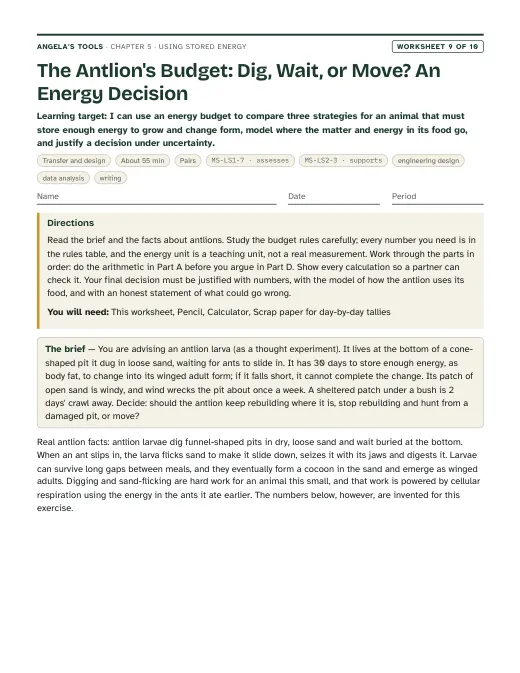
Review status: reviewed · 2026-10-18 · Re-solved every numeric and multiple-choice item in W1-W10 and Labs 1-3 (atom counts, rates, kcal and kJ totals, percentages, the antlion budget and its recomputations); all keys agreed. Rewrote the consumer definition (chapter vocabulary and slide 6), which repeated a six-word phrase from the textbook. Corrected the claim that plant oxygen comes from water (slide 5, accuracy note, W7 q6 key) to a wording that assigns only carbon to carbon dioxide and hydrogen to water. Slide 9 flow diagram no longer describes stages of the reaction (assessment boundary); reduced to four nodes with three arrow labels to match the renderer. Slide 17 note said yeast lacks mitochondria-rich tissue; replaced with 'a single cell with no lungs'. W8 Card 2 rewritten from a sealed yeast bottle (mostly fermentation, so weak evidence for reaction with oxygen) to an air-bubbled flask with limewater; Card 1 and the q4 key updated to match. W1 flask given a pinhole vent and the caption no longer calls the two-day gas readings realistic for a sealed 1 L flask (100 g of seeds would exhaust the oxygen in hours). W5 teacher note on respirometer rates softened to the range classroom respirometers actually give. Lab 1: lids snug not wrenched tight, and modelLimitations now says a small sealed jar runs out of oxygen within hours rather than days. Lab 2: pipe cleaners raised from 20 to 30 so the two-sugar scaling step can build all 24 product molecules. Labs have not been physically tested; see each lab's modelLimitations.

Source references

Verified against the student edition of Bring Science Alive! 7th Grade Integrated (Student Edition). Printed page numbers appear in the book; PDF pages are the physical pages of the 524-page scan (printed + 36). The textbook is not reproduced on this site.

SectionPrinted pagesPDF pagesUsed for
Introduction: the acorn and the squirrel; lesson question54, 5590, 91Lesson question, the stored-energy-in-a-seed idea behind the phenomenon, vocabulary list, standards listed by the publisher.
1. Consumers5692Consumer definition, the amoeba and dolphin examples, the idea that producers and consumers both use and store sugar.
2. Sources of Matter and Energy5793Producer versus consumer compare diagram, the sources-of-matter correction in accuracyNotes, W2 relationships.
3. Cellular Respiration: site, process, gases58, 5994, 95Mitochondria, the word and chemical equations, atom counting (Lab 2, W4), the breathing versus respiration distinction and the plant-oxygen correction.
Key Science Concept: Matter and Energy in Cellular Respiration6096The verified equation and the idea that the same amount of matter leaves as enters; basis for the conservation slides and Lab 2.
4. How You Get Energy and Matter: carbohydrates, fats, proteins61, 6297, 98Digestion flow, the fuel-versus-building-block idea, the three food molecule types and the W9 transfer task.
5. Comparing Photosynthesis and Cellular Respiration; lesson summary6399The paired equations, the cycle diagram, the energy-flow discussion and the synthesis slide.

External references used for accuracy checks

Related chapters