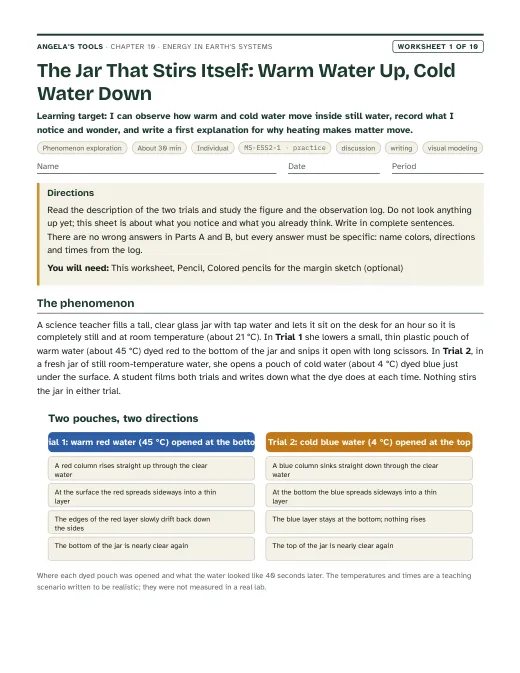
The Jar That Stirs Itself: Warm Water Up, Cold Water Down
I can observe how warm and cold water move inside still water, record what I notice and wonder, and write a first explanation for why heating makes matter move.
Chapter 10 · Unit 4: Earth's Systems · Segment 2
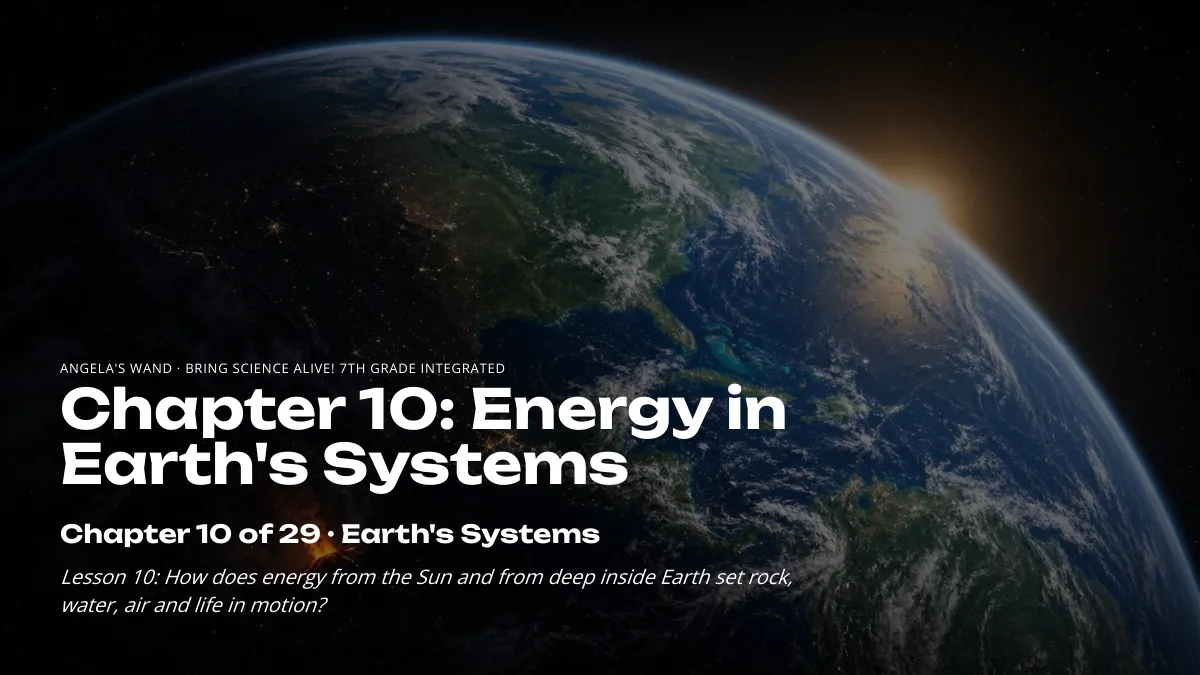
How does energy flowing from the Sun and from Earth's interior set rock, water, air and living things in motion?
Students figure out why matter keeps moving inside a planet that has no motor: energy flowing out of Earth's hot interior and energy arriving from the Sun change the density of rock, water and air, and gravity then pulls the denser material down while the less dense material is pushed up. That one mechanism, convection, turns over the solid mantle over hundreds of millions of years, drives a global loop of ocean water, and builds the air cells that carry weather. Students sort Earth into four overlapping systems, trace energy and matter across the borders between them, and see that in the living world matter cycles but energy flows through and leaves as heat. The chapter closes with Biosphere 2, a sealed physical model of Earth's systems whose falling oxygen showed how testing a model exposes what the next design must fix.
Estimated class time: presentation about 133 minutes · worksheets about 420 minutes in total · labs 3 sessions. Six to seven 50-minute periods: one for the phenomenon and the four systems; two for energy transfer, density and convection with the tank model; one for the ocean and atmosphere loops; one for the systems model across all four spheres; one for Biosphere 2 and the borehole decision; one for synthesis and mastery.
On a cold January morning the classroom heater sits against the far wall, and the window on the opposite wall is closed and locked. Still, the students in the row by the window feel a steady cold draft sliding down the glass and across their ankles. The teacher lights a stick of incense and holds it near the sill: the smoke drifts down the window, creeps along the floor toward the heater, rises up the warm wall and spreads along the ceiling back toward the window. Nothing is blowing. No fan is on. Yet the air in the room is circulating in a slow, silent loop.
Notice and wonder prompts
California NGSS, Grade 7 Preferred Integrated Course Model. Each entry says whether this chapter's work assesses the performance expectation, gives practice toward it, or supports it as background; the resource lists below repeat this for every worksheet and lab.
Develop a model to describe the cycling of Earth’s materials and the flow of energy that drives this process.
Students develop and revise models (a convection-cell diagram, a tank model in Lab 1, a string-and-card systems model in Lab 2) that describe how energy flowing from the interior and from the Sun drives the cycling of rock, water and air. The clarification statement's named processes (melting, crystallization, weathering, deformation, sedimentation) are developed in Lesson 17, so this chapter supplies evidence for the energy-flow part of the PE and sets up the materials-cycling part.
Assessment boundary: Assessment does not include the identification and naming of minerals.
Develop a model to generate data for iterative testing and modification of a proposed object, tool, or process such that an optimal design can be achieved.
The Biosphere 2 strand asks students to read oxygen data from a physical model, propose what went wrong and decide what to test next. Students analyze and propose iterations rather than building a testable model themselves (W9 asks for a design), so the role is practice.
Develop and use a model to describe how unequal heating and rotation of the Earth cause patterns of atmospheric and oceanic circulation that determine regional climates.
This is a Grade 6 PE in the California integrated sequence. The chapter explains why air and ocean water circulate (stronger sunlight near the equator, cooling near the poles) as examples of convection, but does not develop latitude bands, the Coriolis effect or regional climates, so it supports rather than assesses the PE.
Assessment boundary: Assessment does not include the dynamics of the Coriolis effect.
Develop a model to describe the cycling of water through Earth’s systems driven by energy from the sun and the force of gravity.
This is a Grade 6 PE in the California sequence. The atmosphere section traces water evaporating, rising in warm air, condensing into clouds and falling under gravity; the chapter uses it as an example of energy and matter crossing between systems and leaves the full water cycle to Lesson 18.
Assessment boundary: A quantitative understanding of the latent heats of vaporization and fusion is not assessed.
Construct an explanation based on evidence for how geoscience processes have changed Earth’s surface at varying time and spatial scales.
Volcanic eruptions and geysers appear here as surface evidence that energy and matter move outward from Earth's interior. Students do not yet construct explanations of surface change at different scales; that work belongs to Lesson 11.
Develop a model to describe the cycling of matter and flow of energy among living and nonliving parts of an ecosystem.
The biosphere section restates the Lesson 6 idea that energy enters as sunlight, passes from producers to consumers and leaves as heat, while decomposers return matter. The chapter uses it to contrast energy flow with matter cycling across all four systems rather than to assess ecosystem models.
Assessment boundary: Assessment does not include the use of chemical reactions to describe the processes.
Energy in Earth's Systems: what keeps a planet moving. Original, editable slides with speaker notes: a phenomenon opener, learning targets, the chapter's concepts with diagrams, vocabulary in context, 4 checks for understanding, 2 discussion prompts, an application task, a misconception check, a synthesis and an exit ticket.

Ten different tasks, one per instructional blueprint. Each has a student PDF (low ink, US Letter), an editable DOCX, an HTML preview, and a separate teacher answer key with reasoning.
I can observe how warm and cold water move inside still water, record what I notice and wonder, and write a first explanation for why heating makes matter move.
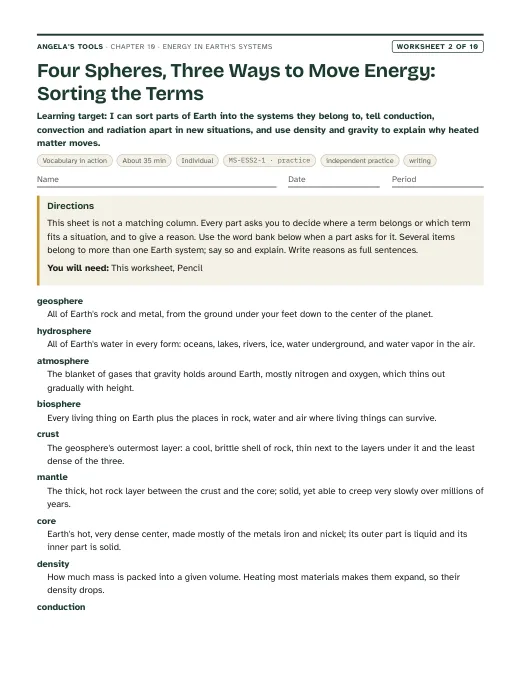
I can sort parts of Earth into the systems they belong to, tell conduction, convection and radiation apart in new situations, and use density and gravity to explain why heated matter moves.
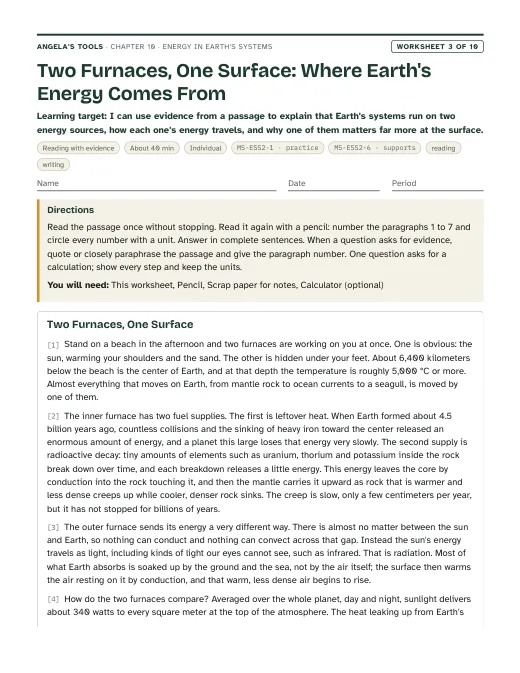
I can use evidence from a passage to explain that Earth's systems run on two energy sources, how each one's energy travels, and why one of them matters far more at the surface.
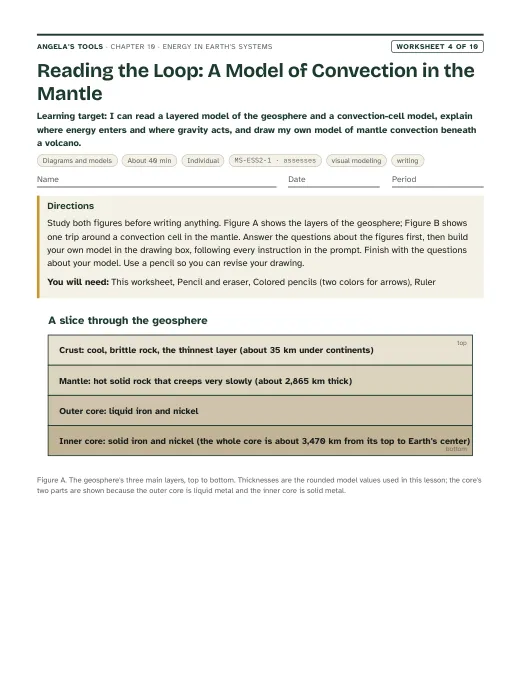
I can read a layered model of the geosphere and a convection-cell model, explain where energy enters and where gravity acts, and draw my own model of mantle convection beneath a volcano.
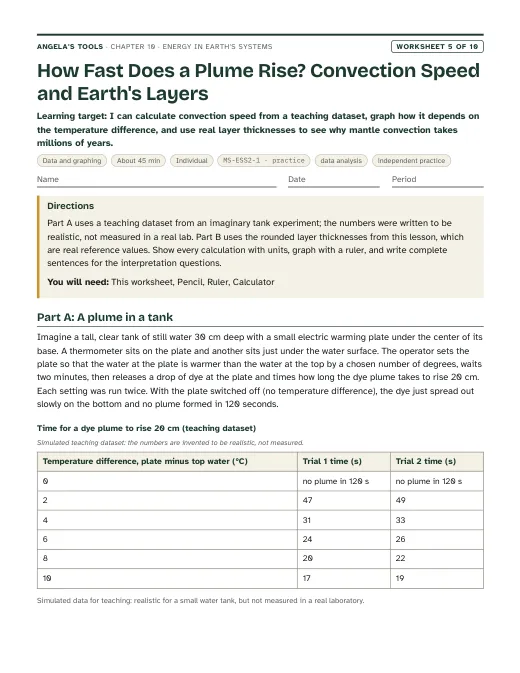
I can calculate convection speed from a teaching dataset, graph how it depends on the temperature difference, and use real layer thicknesses to see why mantle convection takes millions of years.
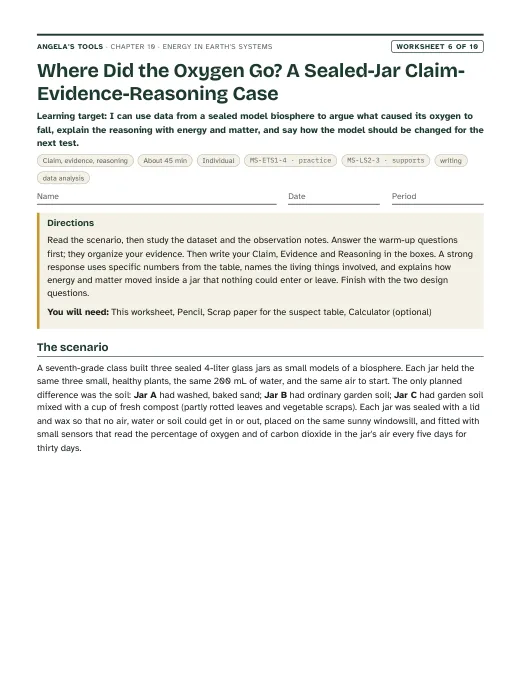
I can use data from a sealed model biosphere to argue what caused its oxygen to fall, explain the reasoning with energy and matter, and say how the model should be changed for the next test.
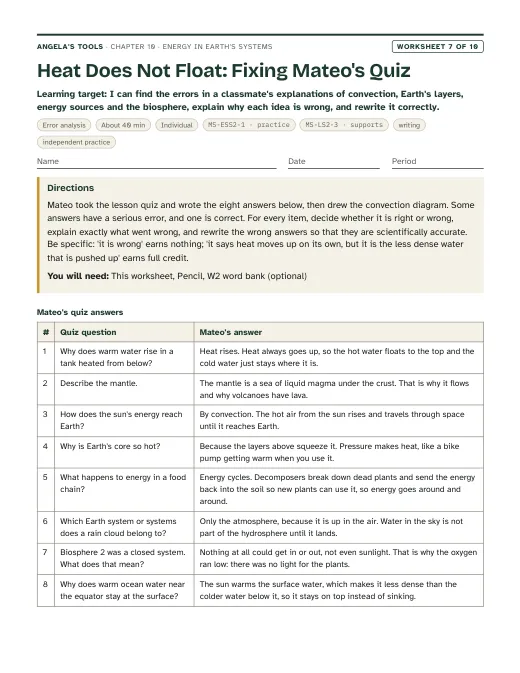
I can find the errors in a classmate's explanations of convection, Earth's layers, energy sources and the biosphere, explain why each idea is wrong, and rewrite it correctly.
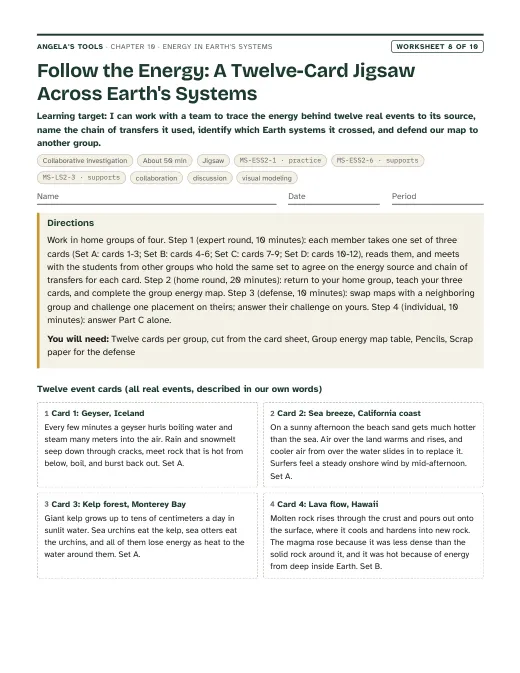
I can work with a team to trace the energy behind twelve real events to its source, name the chain of transfers it used, identify which Earth systems it crossed, and defend our map to another group.
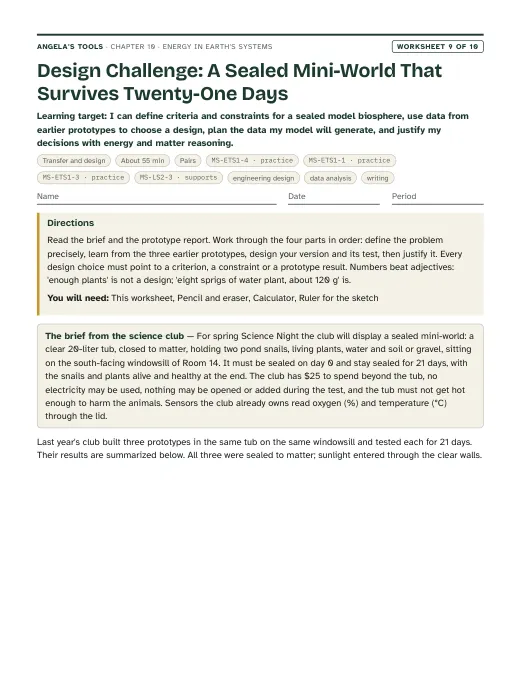
I can define criteria and constraints for a sealed model biosphere, use data from earlier prototypes to choose a design, plan the data my model will generate, and justify my decisions with energy and matter reasoning.
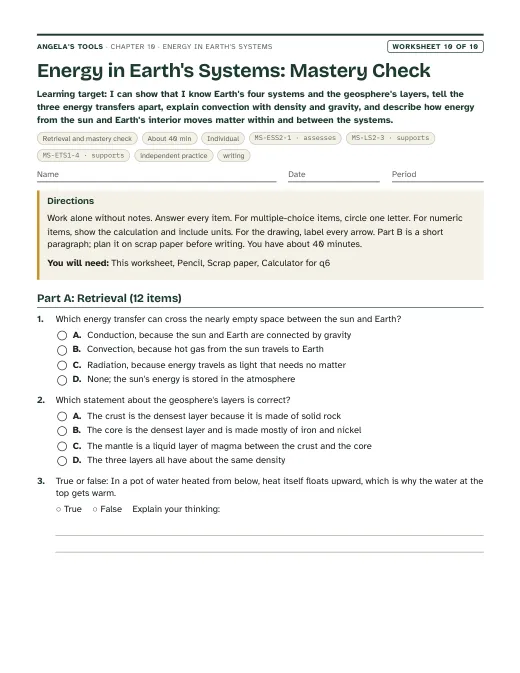
I can show that I know Earth's four systems and the geosphere's layers, tell the three energy transfers apart, explain convection with density and gravity, and describe how energy from the sun and Earth's interior moves matter within and between the systems.
Three different investigation approaches. Each has a teacher guide (purpose, materials with quantities, estimated cost, prep, safety, procedure, expected observations, debrief, answer key, assessment criteria, accessibility adaptations, low-cost alternative) and a student recording sheet.
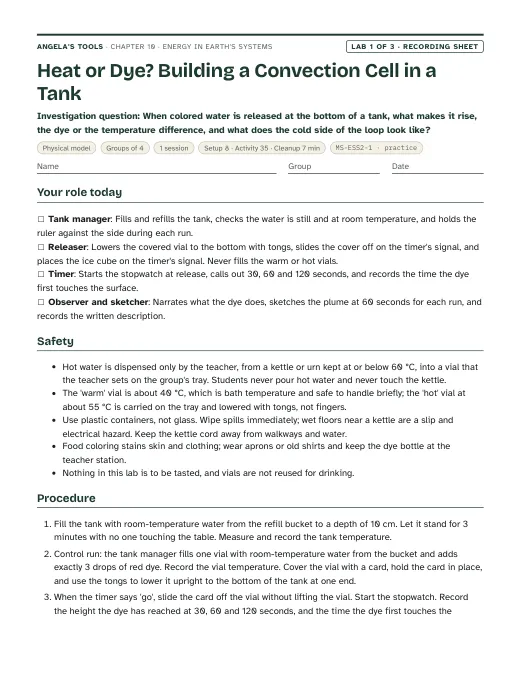
When colored water is released at the bottom of a tank, what makes it rise, the dye or the temperature difference, and what does the cold side of the loop look like?
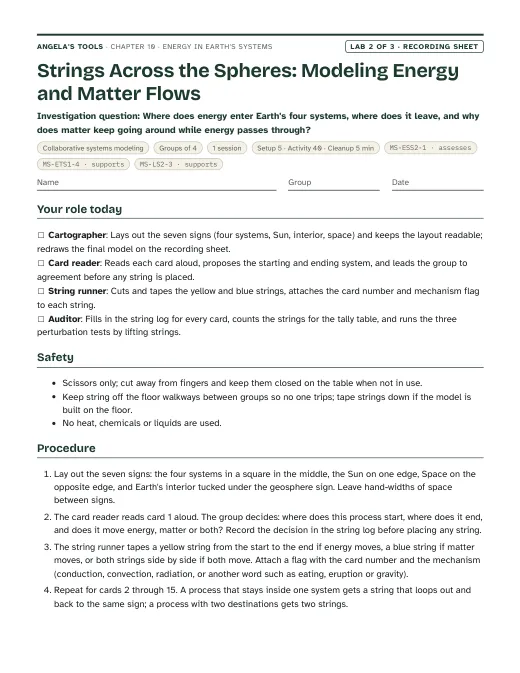
Where does energy enter Earth's four systems, where does it leave, and why does matter keep going around while energy passes through?
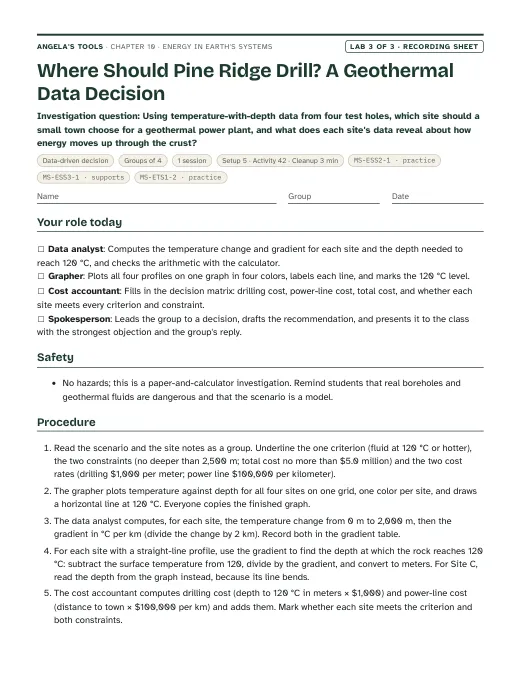
Using temperature-with-depth data from four test holes, which site should a small town choose for a geothermal power plant, and what does each site's data reveal about how energy moves up through the crust?
Materials overview: Lab 1 needs one clear container of room-temperature water per group, small vials or medicine cups with lids, food coloring, an ice tray, a thermometer and a stopwatch; the teacher dispenses warm and hot water from a kettle or urn held below 60 °C and students never handle it. Lab 2 needs index cards, two colors of yarn, tape and four printed system signs. Lab 3 needs printed data tables, graph paper and calculators. No open flames, no chemicals beyond food coloring. The incense for the phenomenon is optional; a strip of tissue paper on a pencil shows the draft direction without smoke.
Review status: reviewed · 2026-10-19 · Re-solved every numeric, multiple-choice and open item in W1-W10 and Labs 1-3; keys agree with the recomputed values. Cross-references repaired: W6 is the sealed-jar oxygen CER (not a heat-or-dye CER) and Lab 3 is the geothermal borehole decision (not a sealed-jar build); chapter sequence, SEP and evidence entries, slide links and W6/W9 teacher notes now say so. Fixed W1 q5 key (4 °C is the density maximum of fresh water, not above it), W3 q4 alternatives (rounding 0.09 to 0.1 gives 3,400, not 4,000), Lab 1 ice-melt density note (fresh melt is denser than 21 °C tank water), Lab 2 q3 entering-string count. Replaced Lab 1 q8, which duplicated W5 q8 (mantle transit time), with a tank-versus-mantle time comparison. Rewrote crust definitions that echoed the textbook's wording (chapter, slides 5-6, W2, W4) and two other short echoes (W4/W5 figure wording, W8 card 8). Slide 2 now returns to the heat-rises idea on slides 10, 11 and 19; slide 3 target links corrected. Trimmed vocabulary to 12 terms and relatedChapters to 4 per the guide; USGS bar now names salty groundwater. Added accuracy notes on fresh-water ice melt in Lab 1 and the hot-air balloon entry step in W2. Labs remain untested physically; see each lab's modelLimitations.
Verified against the student edition of Bring Science Alive! 7th Grade Integrated (Student Edition). Printed page numbers appear in the book; PDF pages are the physical pages of the 524-page scan (printed + 36). The textbook is not reproduced on this site.
| Section | Printed pages | PDF pages | Used for |
|---|---|---|---|
| Introduction: Strokkur Geyser, the boiling pot and the lesson question | 128, 129 | 164, 165 | Lesson question, the geyser as evidence of interior energy, the publisher's vocabulary list and standards box. |
| 1. The Geosphere: layers, density, conduction and mantle convection | 130, 131 | 166, 167 | Layer thicknesses for the layers diagram, the density-and-gravity mechanism of convection, Lab 1 tank model, Lab 3 borehole decision. |
| 2. The Hydrosphere: where the water is and the ocean loop | 132, 133 | 168, 169 | Water-share bar diagram, radiation as the Sun's delivery method, the ocean convection slide and Lab 2 cards. |
| 3. The Atmosphere: composition and convection cells | 134, 135 | 170, 171 | Air convection cells, the evaporation-condensation link, the phenomenon explanation, the three-systems comparison table. |
| 4. The Biosphere: food chains and energy from the Sun | 136 | 172 | Energy-flow versus matter-cycling diagram, misconception on the decomposer arrow, biosphere check. |
| Key Science Concept: The Flow of Energy and Matter Through Earth's Systems | 137 | 173 | The two energy sources, relative thicknesses of the systems, cross-system concept map, Lab 2 systems model. |
| 5. Modeling Earth's Biosphere: Biosphere 2 and iterative testing | 138, 139 | 174, 175 | Physical versus conceptual models, closed system, the oxygen-data task, the ETS1-4 strand, lesson summary. |