Chapter 12 · Unit 5: Chemical Reactions · Segment 2

Identifying Chemical Reactions

What evidence is enough to say that a new substance formed, and what evidence only looks like it?

MS-PS1-2 · assessesMS-ETS1-2 · practiceMS-PS1-3 · supports Textbook pp. 152–161 1 presentation · 10 worksheets · 3 labs

Overview

Students figure out what it means for a chemical reaction to happen: the reactants turn into different substances, the products, each with its own characteristic properties. They learn that fizzing, a new color, a solid appearing, a smell or a temperature change are clues worth noticing, but that boiling, melting and dissolving show some of the same clues without making anything new, so the only solid proof is a before-and-after comparison of properties such as solubility, melting point, density, odor and flammability. They see that a reaction depends on the substances and on the conditions (heating, cooling, mixing), that it stops when one reactant is used up, and that the same reasoning let chemists turn willow bark into aspirin and test it against criteria. The chapter leads into Lessons 13 and 14, where atoms and energy are tracked through reactions.

Estimated class time: presentation about 138 minutes · worksheets about 385 minutes in total · labs 4 sessions. Seven 50-minute periods: two for the phenomenon, reactants and products, and the reaction-versus-physical-change distinction with the mystery-powder lab; two for conditions, indicators and the six-station decision lab; one for the fizz-stops systems lab and the evidence-strength task; one for the medicine evaluation; one for synthesis and mastery. Lab 2 needs two sessions because the products saved in session 1 are tested in session 2.

Phenomenon

Three bags, three changes, one new substance?

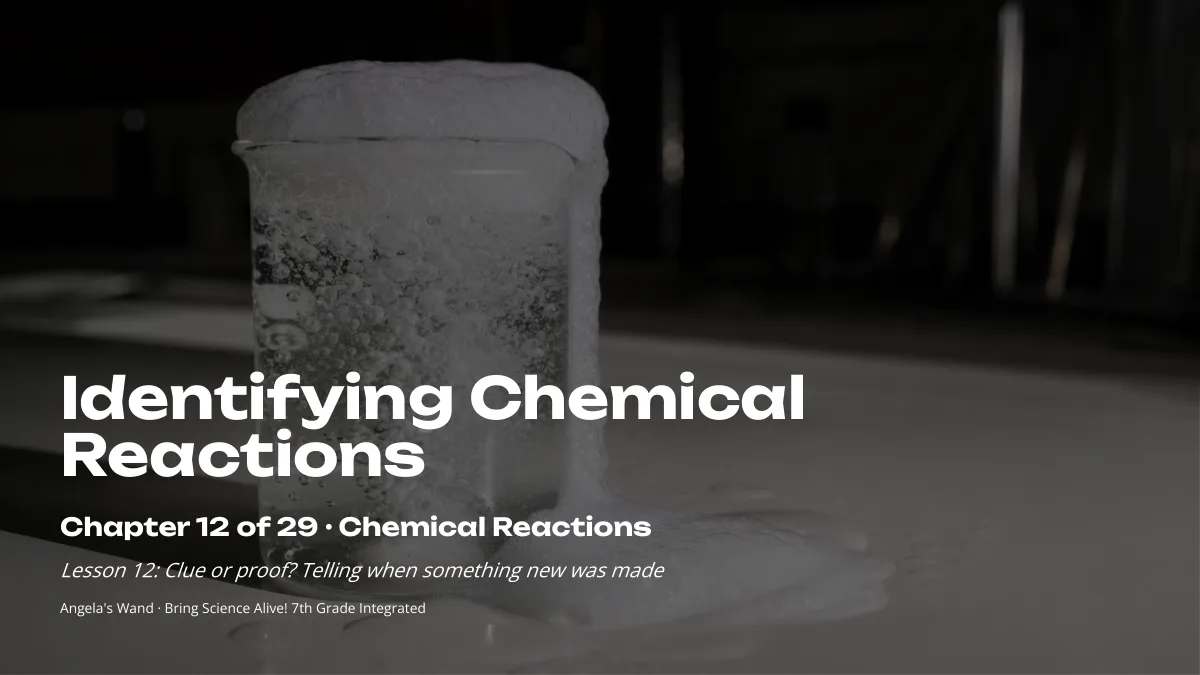
Three zip bags sit on a table. Bag A holds a spoonful of baking soda, Bag B a spoonful of calcium chloride pellets (the kind sold to melt ice), and Bag C a spoonful of Epsom salt. A student pours a little vinegar into Bag A and a little water into Bags B and C, seals them, and watches. Bag A fizzes, puffs up tight and feels cool. Bag B gets hot enough that it is uncomfortable to hold, and the pellets vanish. Bag C feels slightly cool and the crystals disappear into the water. Something changed in every bag. In which bags did a new substance form, and what would you have to test to know for sure?

Notice and wonder prompts

  • Which clues did two or more bags share, and which clue showed up in only one bag?
  • Bag B got hot and its solid disappeared. Is that enough to say a new substance formed? What else would you want to check?
  • If you let the water in Bags B and C evaporate, what do you predict would be left behind, and would it be the same stuff you started with?
  • Why did Bag A stop fizzing after a while, even though the bag was still full of liquid?

Learning targets

  • I can name the reactants and products in a described chemical reaction and explain that products are different substances with their own properties.
  • I can tell a chemical reaction apart from a physical change such as melting, boiling or dissolving by asking whether a new substance formed.
  • I can explain how heating, cooling or mixing can start a reaction, why both the substances and the conditions matter, and why a reaction stops when a reactant runs out.
  • I can analyze before-and-after data on solubility, melting point, density, odor or flammability to decide whether a reaction occurred and judge how strong the evidence is.
  • I can evaluate competing designs, such as two medicines, against stated criteria using the results of their tests.

What shows the learning happened

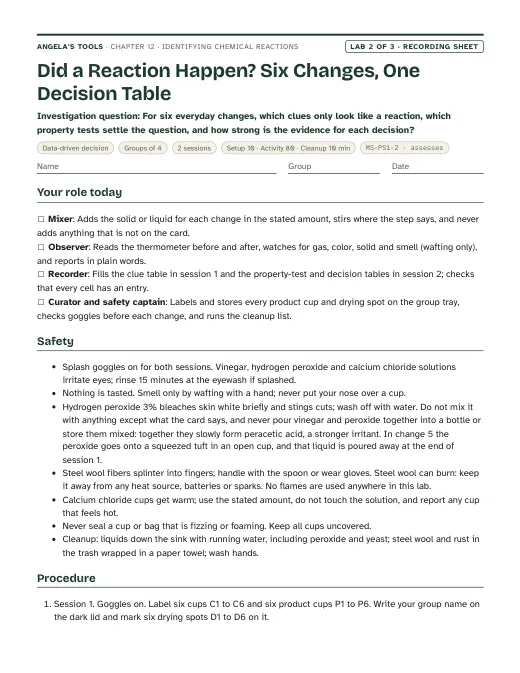
  • A completed Lab 2 decision table that classifies each of six changes as reaction or physical change, names the property test that settled it, and rates the strength of the evidence with a reason.
  • A reaction fingerprint table from Lab 1 and a correct identification of each unknown powder, with the test result that ruled out the other candidates.
  • A Lab 3 graph of mass lost against baking soda added, with the plateau explained by the vinegar running out and confirmed by the leftover test.
  • A Claim-Evidence-Reasoning paragraph (W6) that decides whether a new substance formed from before-and-after property data and says which evidence is strongest.
  • A written evaluation (W9) of three competing anti-itch cream designs against stated criteria and a cost constraint that uses trial results and names a trade-off.
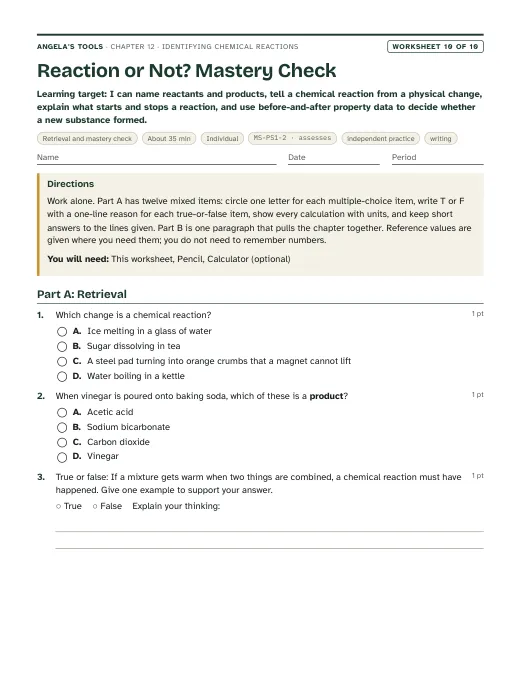
  • A mastery quiz (W10) in which the student separates indicators that only suggest a reaction from property comparisons that confirm one.

Key vocabulary 12 terms

chemical reactionA change in which one or more substances turn into one or more different substances. The atoms are rearranged into new combinations, and the new substances have their own properties.When the vinegar met the baking soda, a chemical reaction produced a gas that was not present in either starting substance.
reactantA substance that is present before a chemical reaction and is changed by it.Acetic acid, the sour substance in vinegar, is one of the two reactants in the fizzing reaction.
productA substance that is made by a chemical reaction and was not there before it started.Carbon dioxide is a product of the baking soda and vinegar reaction, which is why the bag inflated.
physical changeA change in the size, shape, state or mixing of a substance that leaves it the same substance. Melting, boiling, crushing and dissolving are physical changes.Dissolving Epsom salt is a physical change; let the water evaporate and the same Epsom salt crystals come back.
physical propertyA trait you can observe or measure without turning the substance into a different one, such as color, density, melting point, boiling point or solubility.The chemist measured the melting point of both powders because melting point is a physical property that differs between most substances.
chemical propertyA description of whether and how a substance can change into new substances, such as whether it burns or whether it reacts with an acid. You can only find it out by letting the substance react or trying to make it react.Fizzing with vinegar is a chemical property of baking soda; the liquid left after the reaction no longer has it.
precipitateA solid that forms inside a liquid, usually when two dissolved substances react to make a substance that barely dissolves.Mixing the two clear solutions produced a cloudy white precipitate that slowly settled to the bottom of the cup.
solubilityHow much of a substance can dissolve in a set amount of a liquid at a given temperature, often given in grams per liter of water.The product dissolved noticeably better in water than the reactant did at the same temperature, one sign that it was a different substance.
melting pointThe temperature at which a solid turns into a liquid. A pure substance melts over a narrow range of about a degree or two; an impure sample starts melting lower and over a wider range.A melting point about 20 °C below the reactant's, measured over a narrow range, told the chemist she was holding a different pure substance.
indicator of reactionAn observable clue, such as a gas, a new color, a precipitate, a new smell, light or a temperature change, that suggests a reaction may have happened. Indicators are not proof; some physical changes show the same clues.Heat was an indicator in the calcium chloride bag, but it turned out to be dissolving, not a reaction.
scientific evidenceObservations and measurements that back up or challenge a scientific claim.A change in solubility and a change in melting point gave two independent pieces of scientific evidence that a new substance had formed.
clinical trialA planned study that tests a medicine in people to find out how well it works and what side effects it causes. Modern trials compare groups and are checked by an ethics board.In the clinical trial, doctors recorded each patient's temperature before and after the dose to measure how well the medicine reduced fever.


Standards alignment

California NGSS, Grade 7 Preferred Integrated Course Model. Each entry says whether this chapter's work assesses the performance expectation, gives practice toward it, or supports it as background; the resource lists below repeat this for every worksheet and lab.

MS-PS1-2Assesses: analyzing before-and-after property data (solubility, melting point, density, odor, flammability) to decide whether a reaction occurredCA Grade 7

Analyze and interpret data on the properties of substances before and after the substances interact to determine if a chemical reaction has occurred.

Lab 2's decision table, the slide-19 aspirin task, W5 and W6 all put before-and-after property data in front of students and ask them to decide whether a new substance formed and how strong the evidence is. The data stay within the assessment boundary (density, melting point, boiling point, solubility, flammability, odor), with other observations treated as clues that need confirming.

Assessment boundary: Assessment is limited to analysis of the following properties: density, melting point, boiling point, solubility, flammability, and odor.

MS-ETS1-2Practice toward: judging two competing solutions against stated criteria using test resultsCA Grade 6-8

Evaluate competing design solutions using a systematic process to determine how well they meet the criteria and constraints of the problem.

The medicine strand (slides 23-25) has students weigh salicylic acid against aspirin on the criteria of relieving pain and fever with few side effects, and W9 applies the same systematic check to three fictional anti-itch cream designs with two criteria and a cost constraint. The trial results are supplied rather than generated, so this builds the practice rather than fully assessing the PE.

MS-PS1-3Supports: the idea that synthetic materials are made from natural resources by chemical processesCA Grade 7

Gather and make sense of information to describe that synthetic materials come from natural resources and impact society.

Aspirin is a synthetic medicine made by chemical reactions from a substance in willow bark. This chapter uses the story as background for evaluating designs; Lesson 15 develops the PE itself.

Assessment boundary: Assessment is limited to qualitative information.

Science and engineering practices

  • Analyzing and Interpreting Data. Students compare property data taken before and after substances interact (Lab 2, slide-19 task, W5) and decide which differences count as evidence of a new substance and which tests gave no information.
  • Engaging in Argument from Evidence. Students argue reaction or no reaction for each Lab 2 station and in the W6 CER, rating the strength of each piece of evidence, and they evaluate the aspirin and salicylic acid designs (slides 23-25) and three cream designs (W9) against criteria.
  • Planning and Carrying Out Investigations. Students run property tests on the products they saved (Lab 2 session 2), build a reaction fingerprint table to identify unknown powders (Lab 1), and run a controlled series of reactions to find where the fizzing stops (Lab 3).
  • Developing and Using Models. Students draw a box model of the vinegar and baking soda reaction as a system with inputs and outputs and use it to predict the mass lost for amounts they did not test (Lab 3).

Disciplinary core ideas

  • PS1.A Structure and Properties of Matter. Every pure substance has its own set of physical and chemical properties, which is how it is identified; that is why a change in solubility, melting point or reaction with vinegar shows a different substance is present.
  • PS1.B Chemical Reactions. In a reaction the atoms of the reactants are regrouped into new substances with different properties; the substances and the conditions (heating, cooling, mixing) together decide whether a reaction starts.
  • ETS1.B Developing Possible Solutions. A systematic comparison against criteria, such as the patient tests of salicylic acid and aspirin, shows how well each solution meets the problem's goals and where it falls short.

Crosscutting concepts

  • Patterns. A consistent change in a measurable property (a different melting point, a different solubility) is the macroscopic pattern that reveals an atomic-level rearrangement students cannot see directly.
  • Cause and Effect. Students connect conditions (heat from friction, cooling, mixing) to whether a reaction starts, and connect the stopping of the fizz to one reactant being used up.
  • Systems and System Models. Lab 3 treats a cup of reacting vinegar and baking soda as a system with inputs, outputs and leftovers, and uses mass lost to the air as a measurable output.

Presentation 28 slides

Identifying Chemical Reactions: clue or proof?. Original, editable slides with speaker notes: a phenomenon opener, learning targets, the chapter's concepts with diagrams, vocabulary in context, 4 checks for understanding, 2 discussion prompts, an application task, a misconception check, a synthesis and an exit ticket.

Worksheets 10 of 10

Ten different tasks, one per instructional blueprint. Each has a student PDF (low ink, US Letter), an editable DOCX, an HTML preview, and a separate teacher answer key with reasoning.

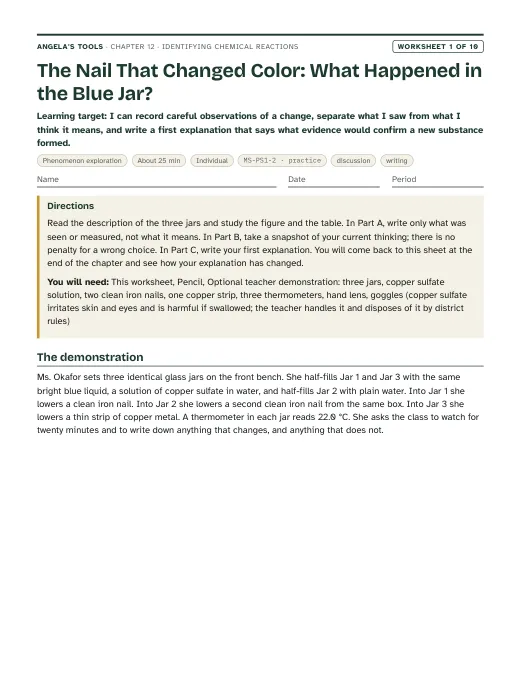
First page of The Nail That Changed Color: What Happened in the Blue Jar?
Worksheet 1 · Phenomenon exploration

The Nail That Changed Color: What Happened in the Blue Jar?

I can record careful observations of a change, separate what I saw from what I think it means, and write a first explanation that says what evidence would confirm a new substance formed.

25 minindividualActivates prior knowledgeDiscussionWriting MS-PS1-2 · practice
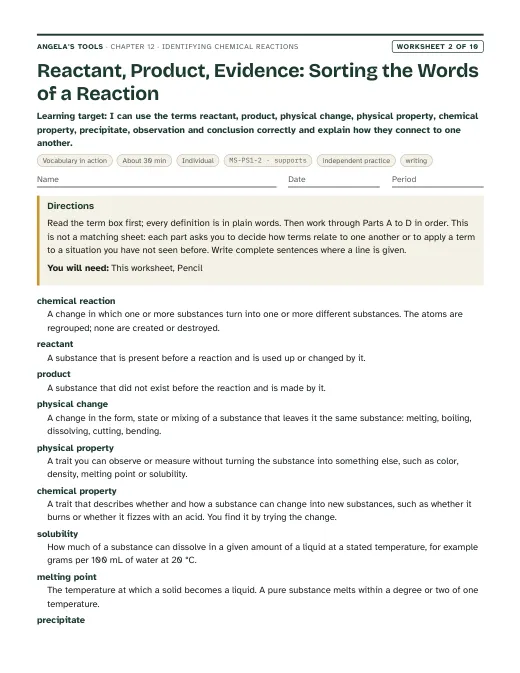
First page of Reactant, Product, Evidence: Sorting the Words of a Reaction
Worksheet 2 · Vocabulary in action

Reactant, Product, Evidence: Sorting the Words of a Reaction

I can use the terms reactant, product, physical change, physical property, chemical property, precipitate, observation and conclusion correctly and explain how they connect to one another.

30 minindividualBuilds understandingIndependent practiceWriting MS-PS1-2 · supports
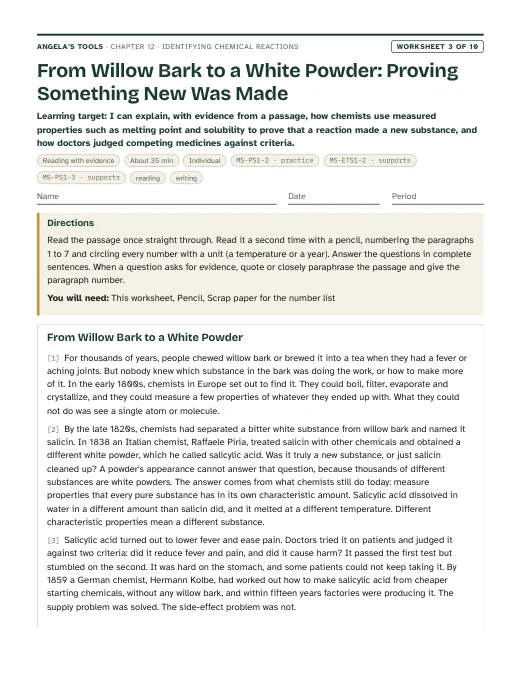
First page of From Willow Bark to a White Powder: Proving Something New Was Made
Worksheet 3 · Reading with evidence

From Willow Bark to a White Powder: Proving Something New Was Made

I can explain, with evidence from a passage, how chemists use measured properties such as melting point and solubility to prove that a reaction made a new substance, and how doctors judged competing medicines against criteria.

35 minindividualBuilds understandingReadingWriting MS-PS1-2 · practiceMS-ETS1-2 · supportsMS-PS1-3 · supports
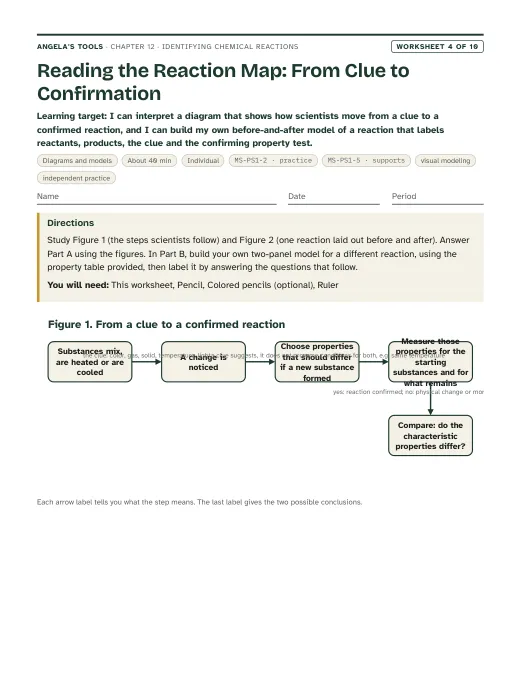
First page of Reading the Reaction Map: From Clue to Confirmation
Worksheet 4 · Diagrams and models

Reading the Reaction Map: From Clue to Confirmation

I can interpret a diagram that shows how scientists move from a clue to a confirmed reaction, and I can build my own before-and-after model of a reaction that labels reactants, products, the clue and the confirming property test.

40 minindividualBuilds understandingVisual modelingIndependent practice MS-PS1-2 · practiceMS-PS1-5 · supports
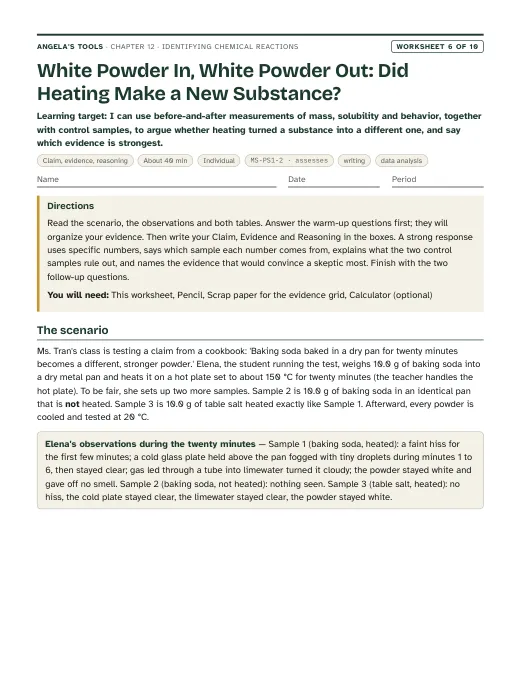
First page of White Powder In, White Powder Out: Did Heating Make a New Substance?
Worksheet 6 · Claim, evidence, reasoning

White Powder In, White Powder Out: Did Heating Make a New Substance?

I can use before-and-after measurements of mass, solubility and behavior, together with control samples, to argue whether heating turned a substance into a different one, and say which evidence is strongest.

40 minindividualAssessmentWritingData analysis MS-PS1-2 · assesses
First page of Clue, Proof or Not Yet: The Evidence Sort
Worksheet 8 · Collaborative investigation

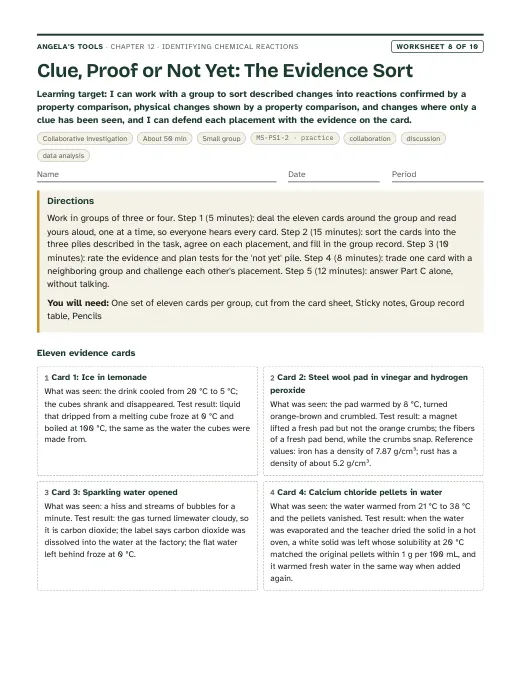
Clue, Proof or Not Yet: The Evidence Sort

I can work with a group to sort described changes into reactions confirmed by a property comparison, physical changes shown by a property comparison, and changes where only a clue has been seen, and I can defend each placement with the evidence on the card.

50 minsmall groupPracticeCollaborationDiscussionData analysis MS-PS1-2 · practice
First page of Two Creams, One Choice: Confirm the New Substance, Then Judge the Design
Worksheet 9 · Transfer and design

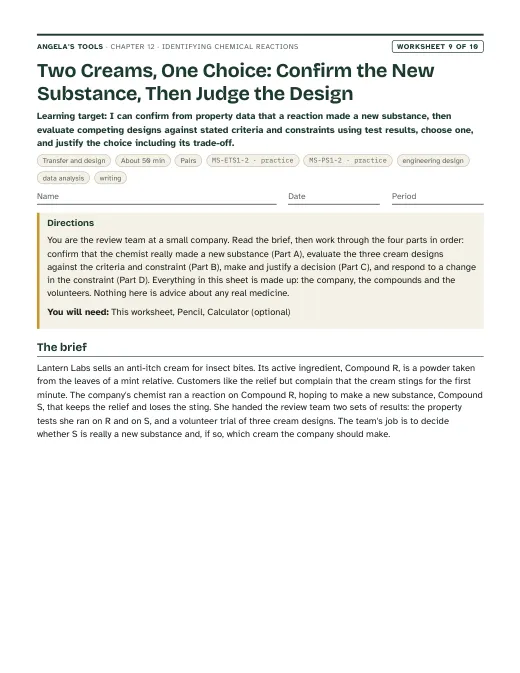
Two Creams, One Choice: Confirm the New Substance, Then Judge the Design

I can confirm from property data that a reaction made a new substance, then evaluate competing designs against stated criteria and constraints using test results, choose one, and justify the choice including its trade-off.

50 minpairsExtensionEngineering designData analysisWriting MS-ETS1-2 · practiceMS-PS1-2 · practice

Collaborative labs 3 of 3

Three different investigation approaches. Each has a teacher guide (purpose, materials with quantities, estimated cost, prep, safety, procedure, expected observations, debrief, answer key, assessment criteria, accessibility adaptations, low-cost alternative) and a student recording sheet.

First page of the Mystery Powders: Reactions as Fingerprints recording sheet
Lab 1 · Evidence-based mystery

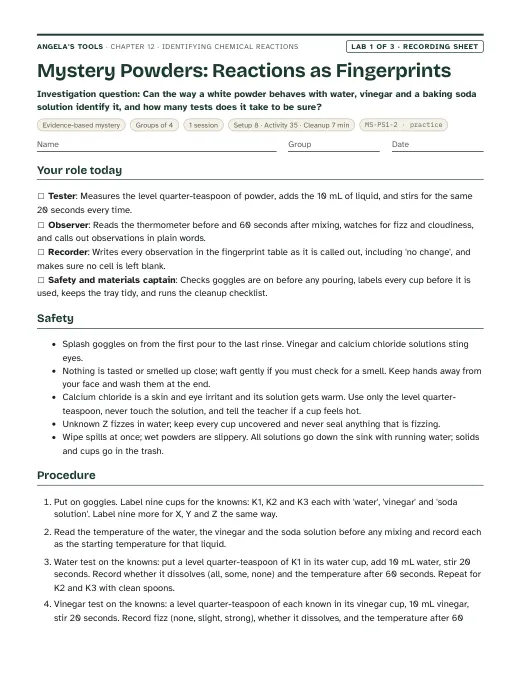
Mystery Powders: Reactions as Fingerprints

Can the way a white powder behaves with water, vinegar and a baking soda solution identify it, and how many tests does it take to be sure?

Groups of 41 session35 min activityEst. 20 to 30 per class, most of it reusableBaking soda (known K1)Epsom salt (known K2)Calcium chloride pellets (known K3) MS-PS1-2 · practice
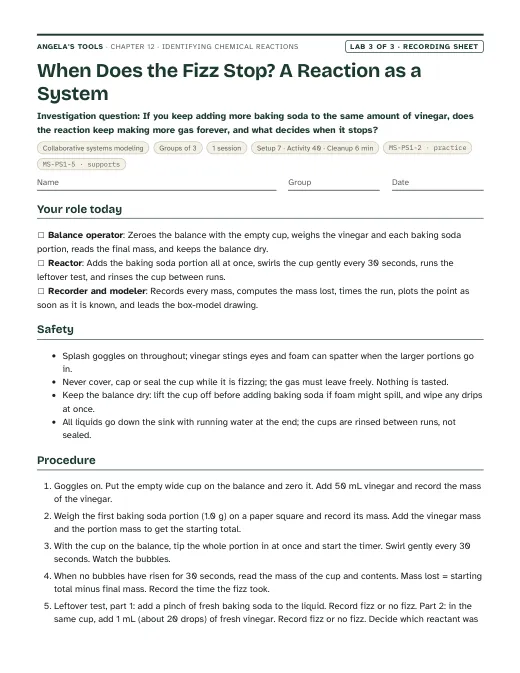
First page of the When Does the Fizz Stop? A Reaction as a System recording sheet
Lab 3 · Collaborative systems modeling

When Does the Fizz Stop? A Reaction as a System

If you keep adding more baking soda to the same amount of vinegar, does the reaction keep making more gas forever, and what decides when it stops?

Groups of 31 session40 min activityEst. 15 to 25 per class, or under 5 if balances are stockWhite vinegar (label says 5% acidity)Baking sodaDigital balance reading to 0.1 g (a kitchen scale works) MS-PS1-2 · practiceMS-PS1-5 · supports

Teacher guidance

Suggested sequence (7 steps)
  1. Period 1: Presentation slides 1-8 (three-bags phenomenon, targets, reactants and products, physical change versus reaction, first quick check). W1 phenomenon worksheet (a second notice-and-wonder case: an iron nail in blue copper sulfate solution) after the bags, and W2 vocabulary relationships to close.
  2. Period 2: Slides 9-12 (physical and chemical properties, the 'looks like a reaction' compare diagram, clue-or-proof check). Lab 1, the mystery powders, one session: students build a reaction fingerprint table for three known powders and use it to identify unknowns.
  3. Period 3: Slides 13-17 (conditions that start a reaction, the stopping discussion, indicators, the clue-to-claim flow). Lab 2 session 1: six stations, record indicators, save products in labeled cups. W3 reading passage as homework.
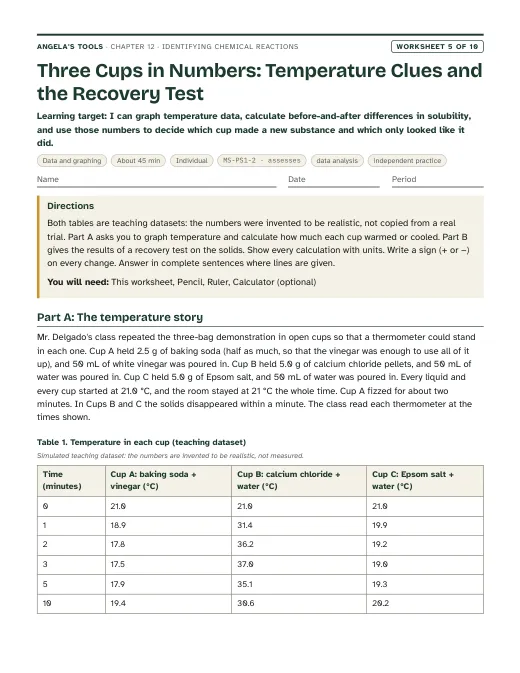
  4. Period 4: Lab 2 session 2: property tests on the saved products (solubility, recovery by evaporation, magnet, the leftover test), then the decision table and evidence-strength ratings. W4 diagram worksheet and W5 data worksheet follow the same logic and can be split between class and home.
  5. Period 5: Slides 18-21 (the six properties that count, the aspirin task with its table, strongest-evidence check, the hot-bag discussion). Lab 3, the fizz-stops systems lab, one session; W6 CER on before-and-after data as the written assessment.
  6. Period 6: Slides 22-25 (California rust connection, medicines by reaction, the aspirin timeline, the criteria check). W8 collaborative evidence sort in groups, then W9 transfer task on evaluating competing designs.
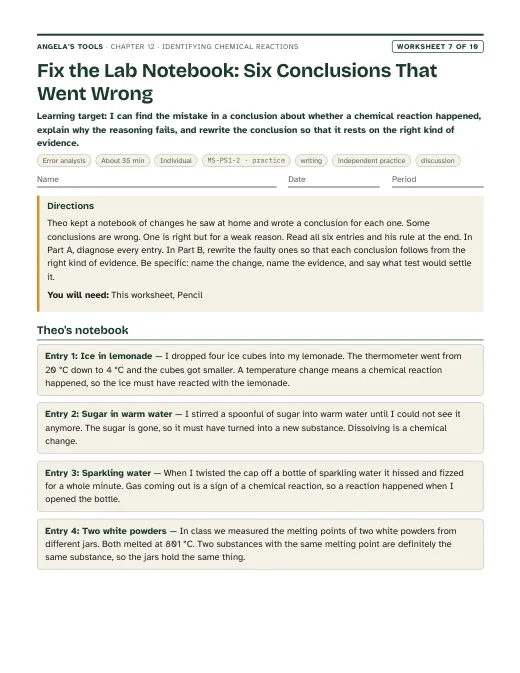
  7. Period 7: Slides 26-28 (bubbles misconception, synthesis, exit ticket). W7 misconception repair, then W10 mastery as the quiz.

Materials overview: Every lab uses household chemicals only: baking soda, white vinegar, calcium chloride ice-melt pellets (check the label says calcium chloride with no other salts), Epsom salt, fine (0000) steel wool, 3% hydrogen peroxide, and active dry yeast, plus water. Also needed: splash goggles for every student, clear cups, zip bags, plastic spoons, droppers, a digital balance reading to 0.1 g (Lab 3) or 0.01 g if available, thermometers, a small magnet, a hand lens, and paper towels. No flames, no lead compounds and no nitrogen dioxide anywhere; the textbook's lead iodide, match and smog-gas examples are described on slides only. Calcium chloride solutions get hot; keep amounts small as written.

Common misconceptions (6)
“If it bubbles, a chemical reaction happened.”
Why it happens: The fizz of vinegar and baking soda is the most memorable reaction students know, and bubbles look like something new being made.
Correction: Bubbles mean a gas is leaving the liquid. Boiling water bubbles, and a shaken soda fizzes, but the gas was already there (water vapor, dissolved carbon dioxide). Bubbles count as evidence only when the gas is a substance that was not present before, which a property test of the gas or of the leftover liquid has to show.
“If it gets hot or cold, a chemical reaction happened.”
Why it happens: Students learn that reactions release or absorb energy and reverse the logic, assuming every temperature change means a reaction.
Correction: Dissolving calcium chloride in water gets hot and dissolving Epsom salt gets slightly cold, yet evaporating the water gives the same substance back. Melting ice absorbs heat too. A temperature change is an indicator that something happened, not proof that a new substance formed.
“Dissolving is a chemical change because the solid disappears.”
Why it happens: The solid can no longer be seen, and 'the salt is gone' feels like the salt stopped existing.
Correction: The particles of the solid spread out among the water particles but keep their identity. The water tastes or conducts as if the salt were there, and evaporating the water returns the original substance with its original properties. Dissolving is a physical change.
“A chemical reaction changes every property, so if two samples look the same they must be the same substance.”
Why it happens: Textbook examples lean on dramatic color changes and the lesson summary claims products differ from their reactants in every property.
Correction: Products differ from reactants in at least some characteristic properties, not necessarily all. Salicylic acid and aspirin are both white powders with nearly the same density; it took solubility and melting point tests to tell them apart. Matching appearance is weak evidence either way.
“The fizzing stops because the reaction ran out of energy or got tired.”
Why it happens: Students picture a reaction as an event that fades, like a battery draining, rather than a process that consumes its reactants.
Correction: A reaction keeps going as long as both reactants are available. It stops when one of them is used up. Adding more of the used-up reactant restarts the fizz; adding more of the leftover one does nothing, which Lab 3's leftover test shows directly.
“The yeast in the hydrogen peroxide station is a reactant that gets used up.”
Why it happens: The yeast is added, foam appears, so students assume the yeast was consumed like the baking soda.
Correction: Yeast contains an enzyme that speeds up the breakdown of hydrogen peroxide into water and oxygen gas without being used up itself. Fresh peroxide poured onto used yeast foams again; fresh yeast added to the used liquid does nothing, because the peroxide, not the yeast, was consumed.
Differentiation suggestions (5)
  • Multilingual learners: Pre-teach reactant, product, physical change, precipitate and indicator with a picture card for each; post an anchor chart with 'clue' on one side and 'proof' on the other that stations are added to as the week goes; let Lab 2 observations be recorded with drawings and a home-language label before the English sentence; pair students so one reads the station card aloud.
  • Students who need more support: Give the Lab 2 decision table with the first station worked as an example, a word bank for the fingerprint table in Lab 1, and a sentence frame for the CER ('Before, the ___ was ___; after, it was ___, so a new substance ___ because ___'). Reduce Lab 3 to four amounts of baking soda and provide the graph axes already scaled.
  • Students ready for extension: Ask them to explain why the calcium chloride and baking soda station both fizzes and turns cloudy (two products form), to design a test that would tell the gas from Bag A apart from the gas from the yeast station without a flame, or to work out from Lab 3 how much baking soda a different volume of vinegar should use up.
  • Students who need movement or alternative output: Run Lab 2 as true walking stations with a timer; allow the Lab 2 decision to be presented as a sorted set of cards on a clue/proof floor line; accept a recorded spoken explanation for the Lab 3 model and for the exit ticket.
  • Students with limited vision or fine-motor control: Pre-measure powders into labeled cups so no student handles a balance alone; use large-print station cards and thermometers with digital readouts; let a partner pour while the student calls the observation and records on a device; magnet and temperature tests give non-visual evidence at most stations.
Accuracy notes: where the textbook simplifies (17)
  • One clue is not proof (pp. 154, 158). The book presents color change and gas formation as evidence of a reaction. Teach that bubbles, temperature changes, color changes and a solid appearing are indicators that something happened; boiling, a soda's fizz, dissolving calcium chloride (hot) and melting ice (cold) show the same clues with no new substance. Confirmation comes from comparing properties of the products with those of the reactants.
  • Dissolving is treated as a physical change in this course, and the recovery test (evaporate the water, get the original substance back) is the student-level justification. Chemists note that dissolving an ionic solid in water involves real interactions between ions and water, which is why calcium chloride solutions get hot; keep this as teacher background.
  • Recovery tests and temperature: a few dried drops of a solution are far too little to change the temperature of water measurably, and calcium chloride dried at room temperature comes back combined with water (a hydrate), which does not warm water as it dissolves the way dry pellets do; only a solid dried hot in an oven (teacher only) behaves like the pellets again. So the Lab 2 recovery test compares how the residue dissolves, whether it fizzes with vinegar and whether it clouds baking soda solution, not temperature, and in this course the hydrate still counts as calcium chloride recovered.
  • 'Entirely different properties' (pp. 154, 161): products differ from reactants in at least some characteristic properties, not all. The book's own aspirin example (p. 159) shows a product that matches its reactant in color and in measured density. Two different substances can even share a melting point, so agreeing tests make a stronger claim than one test alone.
  • The aspirin example numbers (p. 159) are the book's idealized teaching data. Reference values: salicylic acid melts at about 158-159 °C, dissolves about 2.2 g per liter of water at 25 °C and has a density near 1.44 g/cm³; aspirin melts at about 135 °C, dissolves roughly 3 to 4.6 g per liter at 25 °C depending on the source, and has a density of about 1.35-1.40 g/cm³. A packed powder contains air, so a measured 1.4 g/cm³ for a packed cube would read low in practice. A solubility comparison only means something if both measurements are at the same temperature.
  • Melting point and purity (p. 159): a melting point 23 °C lower could in principle come from an impure sample, because impurities lower and widen the melting range. A pure substance melts over a narrow range of about a degree or two. The slide task has students ask for the melting range, not just the temperature.
  • Physical versus chemical properties (p. 155): the printed sentence is garbled and says flammability is noticed only while a substance is burning. Use these definitions: a physical property can be observed or measured without the substance becoming a different substance; a chemical property describes whether and how the substance can change into new substances (flammability, reacting with an acid), so it is found by trying the reaction.
  • Lead iodide (p. 155) is described as not soluble in water. It is very slightly soluble, about 0.08 g per 100 mL at 20 °C, which is why nearly all of it drops out as the yellow solid. Lead compounds are toxic; this reaction is described only and must not be done in class.
  • Nitrogen dioxide and dinitrogen tetroxide (pp. 156-157): in a sealed tube the two gases are present together, and cooling shifts the mixture toward the colorless gas rather than converting all of it, which is why a cold tube can keep a faint yellow tint. Both gases are toxic to breathe; describe only. The word equilibrium is not required of students.
  • Heated sugar (p. 158): the caption says the sugar is burned while the text describes heating it until it turns to caramel. Caramelizing by heating and burning in air are different processes, and caramel is not made of crystals. Say 'heated until it browns' and do not treat caramel's taste as evidence; nothing in a lab is tasted.
  • PS1.B wording on p. 153 says atoms regroup into different molecules. Several substances in this lesson, such as sodium acetate and potassium nitrate, are ionic compounds made of ions rather than separate molecules. Say 'new substances' or 'new combinations of atoms' rather than molecules unless the substance really is molecular (carbon dioxide, water).
  • Aspirin history (pp. 160-161): salicin was isolated from willow bark by the French pharmacist Henri Leroux in 1829 (the book says 1826); salicylic acid was made from salicin by Raffaele Piria in 1838; Charles Gerhardt first made acetylsalicylic acid in 1853; Felix Hoffmann made it in pure form at Bayer in 1897. Bayer's German patent application was refused and a U.S. patent ran from 1900, and some historians credit Arthur Eichengrün's role, so do not assess who patented aspirin or when. Felix Hoffmann was German.
  • 'Clinical trials' in the 1800s (pp. 160-161): those patient tests lacked comparison groups, ethics review and other features of modern clinical trials, so say 'early patient tests' or 'the clinical trials of the time'. The book's 'no reports of dizziness or breathing problems' is a historical report, not a lasting difference: aspirin can irritate the stomach, cause bleeding and trigger breathing problems in some people, and doctors advise against routine use in children and teens. Never give dosing or medical advice; the chapter evaluates a design, not a treatment.
  • The yeast station: yeast is not a reactant. It contains the enzyme catalase, which speeds the breakdown of hydrogen peroxide into water and oxygen gas while remaining unchanged. The reactant that is used up is the hydrogen peroxide.
  • The steel wool station: iron reacting with oxygen and water forms rust (hydrated iron oxides); vinegar removes the protective coating on the fibers and 3% hydrogen peroxide supplies oxygen quickly, which is why the change is fast and warm. The orange product is crumbly and is not attracted to a magnet the way steel wool is. Steel wool itself is flammable; keep it away from any heat source and never use a flame in this chapter.
  • Mass lost in Lab 3 is the carbon dioxide that escaped. Some carbon dioxide stays dissolved in the liquid, so measured losses run a little below the theoretical values given in the key, and household vinegar varies between about 4% and 6% acetic acid, which shifts the plateau. Treat the numbers as expected ranges, not targets. Conservation of mass is Lesson 13's job; here the point is that the gas has mass and that the output stops growing when a reactant runs out.
  • The book says you cannot always tell a reaction happened by looking and mentions the scanning tunneling microscope (p. 153). Chemists do not normally confirm reactions with an STM; they compare properties, which is exactly what this lesson goes on to teach.

Review status: reviewed · 2026-10-19 · Re-solved every numeric, multiple-choice, true/false, fill and table item in W1-W10, Labs 1-3 and the slide checks, task and exit ticket. Keys agreed except W9 q4: the solubility gap (4.6 g) is 23 times the 0.2 g repeat spread, not 18. Recovery-test science: Lab 2, slides 12 and 21 and W8 Card 4 said the dried calcium chloride residue warms water again. Three dried drops cannot change water temperature, and calcium chloride dried at room temperature returns as a hydrate that does not warm water. Lab 2 now compares dissolving, fizzing with vinegar and clouding a drop of baking soda solution (procedure, recording sheet, expected observations, difficulties, debrief, keys q1 and q2); W8 Card 4 has the teacher oven-dry the solid; a new accuracy note explains. W5 Cup A: 5.0 g of baking soda in 50 mL of vinegar leaves about 1.5 g unreacted, so the recovered solid would still fizz, contradicting Table 2. Cup A now uses 2.5 g (vinegar in excess even at 4%), with the arithmetic in the teacher notes. Verified the W6 heating result (2 NaHCO3 -> Na2CO3 + H2O + CO2; 10.0 g leaves 6.31 g, a 37% loss) and its reference densities, melting points and solubilities; the W6 standards part no longer claims before-and-after density data. Lab 3 plateau values for 4%, 5% and 6% vinegar and the slide-19 aspirin and salicylic acid reference values checked. Household-chemical safety: Lab 2 warns never to mix or store vinegar with hydrogen peroxide (peracetic acid) and pours off the P5 liquid after session 1; Lab 3's no-balance option used a sealed zip bag against its own no-seal rule and now uses a balloon on a bottle; W7 q7 and W8 q2 keys no longer suggest cutting glow sticks open; slide 2 says sealing Bag A is a teacher demonstration only. Consistency: slide 2 sent students to W1 for the three bags (W1 is the nail-in-copper-sulfate case); W9 evaluates three cream designs, so learning target 5, slide 3, the ETS1-2 note, the argument SEP and evidenceOfLearning were corrected; slide 19 said four tests for a five-row table; the sourceReferences entry named W5 for the aspirin data (it is W3); Lab 2's note on excess baking soda had the leftover test backwards; estimatedMinutes set to the 138-minute pacing sum. Accuracy edits: slide 10 no longer gives Epsom salt a fixed melting point (it loses water when heated); slide 24 note on modern aspirin's petroleum-based feedstock; 'many' patients changed to 'some' (slide 23, W3) to match the source; W3 no longer claims how Piria verified salicylic acid; slide 27's mass preview no longer has gas leaving sealed Bag A; the solubility vocabulary example no longer says 'nearly double'; slide 19's narrow range makes impurity 'very unlikely' rather than ruled out; W1 q7 reason and Lab 2 q7 extra-test suggestion fixed. Standards: caGrade added to all 20 worksheet and lab standards entries; codes exist and roles match the MS-PS1-2 assessment boundary. Originality: rewrote nine 6-word echoes of the lesson (scientific evidence definition in the chapter and W2, two DCI sentences, slide 1 subtitle, slide 6 node, slide 13 bullet, slide 19 question, a misconception line, W4 extension, W10 key). Remaining matches are the boundary's list of property names. Renderability: W3 passage trimmed from 724 to 694 words (teacher note said about 640); chapter vocabulary cut to 12 by dropping 'criteria', already Lesson 1 vocabulary; slide text limits and diagram fields rechecked. An earlier interrupted review pass (overview, slide 9 bullet, slide 22 body, exit-ticket note) was kept. Not changed, flagged for authors: W7 and W8 reuse three scenarios (ice in lemonade, sparkling water, glow stick); the tasks differ (diagnose versus sort by test result) but the overlap could be reduced. The seven-period plan is heavier than 350 minutes if every worksheet runs in class. Labs are physically untested; temperatures and residue behavior should be checked before class.

Source references

Verified against the student edition of Bring Science Alive! 7th Grade Integrated (Student Edition). Printed page numbers appear in the book; PDF pages are the physical pages of the 524-page scan (printed + 36). The textbook is not reproduced on this site.

SectionPrinted pagesPDF pagesUsed for
Introduction: two clear liquids make a yellow solid; how do you know a new substance formed?152, 153188, 189Lesson question, vocabulary list, the publisher's standards box (PS1.A, PS1.B, ETS1.B), the 'cannot always tell by looking' idea.
1. Chemical Reactions Change Substances: vinegar and baking soda, reactants and products, lead iodide, chemical versus physical properties, the reaction stopping154, 155190, 191Reactant/product vocabulary, the named products of the vinegar reaction, the precipitate idea, the reaction-stops-when-a-reactant-is-used-up idea behind Lab 3 and the leftover test.
2. Conditions that Cause Chemical Reactions: heating (match), cooling (nitrogen dioxide), mixing156192Conditions slides and the labeled conditions diagram; the match and smog-gas examples are described only.
Key Science Concept: Characterizing Conditions that Cause Chemical Reactions157193The three-condition summary and the graded tube colors behind the cooling accuracy note.
3. Evidence of Chemical Reactions: appearance changes, heated sugar, testing properties158194Indicators versus confirmation, the list of commonly tested properties, the clue-to-claim flow diagram.
Key Science Concept: Testing Properties to Confirm Chemical Changes (salicylic acid to aspirin)159195The four-step before-and-after comparison that the slide-19 task and W3 reframe with reference values; the accuracy notes on density and melting point.
4. Evaluating Medicines in Clinical Trials: willow bark, salicin, salicylic acid, aspirin160, 161196, 197The engineering strand: criteria, patient tests, evaluating two designs; the timeline diagram with corrected dates.
Lesson Summary161197Check that every slide topic maps to a lesson section; the three distinguishing properties named in the summary.

External references used for accuracy checks

Related chapters