Chapter 08 · Unit 3: Earth Processes Through Geologic Time · Segment 1

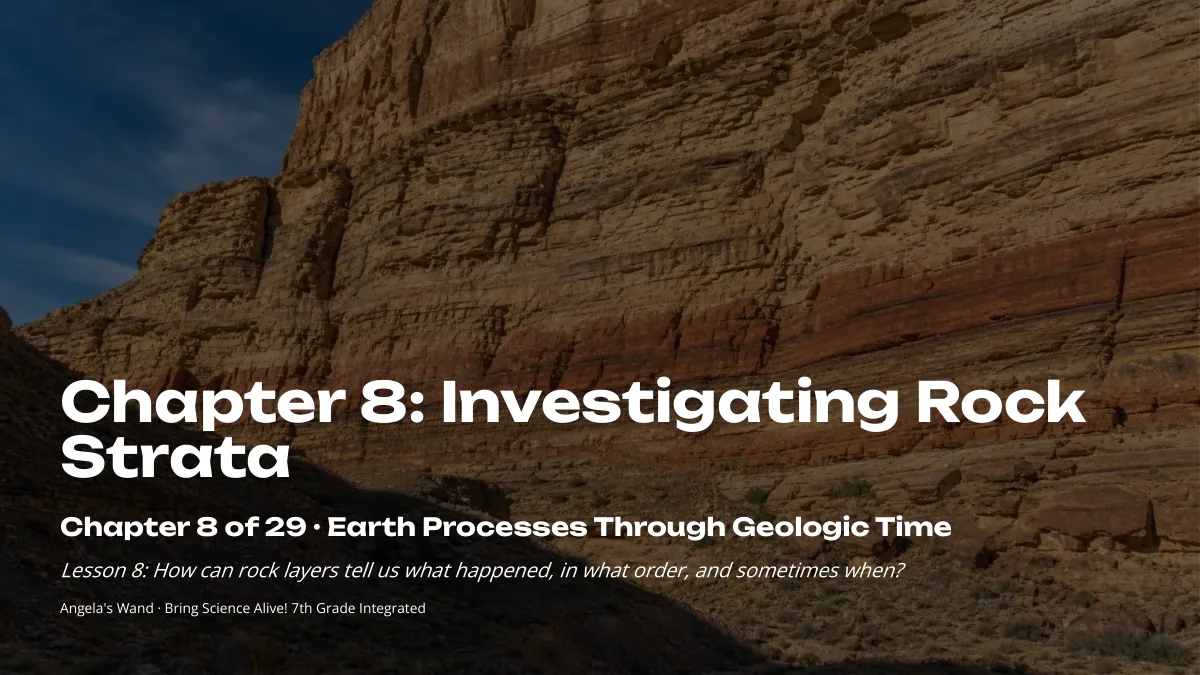
Investigating Rock Strata

How can rock layers tell us the order of events in Earth's past, and when can they tell us how long ago those events happened?

MS-ESS1-4 · practiceMS-ESS2-2 · practiceMS-LS4-1 · supports Textbook pp. 90–103 1 presentation · 10 worksheets · 3 labs

Overview

Students figure out how geologists read a stack of rock layers as a record of events that nobody watched happen. They use a small set of rules, superposition, original horizontality, lateral continuity, cross-cutting relationships and fossil succession, to put layers, folds, faults, intrusions and erosion surfaces in order, and they learn why that order is only relative. Then they see how radioactive atoms trapped in igneous crystals act as clocks, how half-life turns a measurement into an age in years, and how dated volcanic layers put numbers on the sedimentary layers between them. The chapter builds the evidence-reading skills that Lesson 9 uses to assemble Earth's history, and it reuses the weathering, erosion and deposition ideas from the rock cycle.

Estimated class time: presentation about 130 minutes · worksheets about 405 minutes in total · labs 3 sessions. Six 50-minute periods, seven if Lab 3 runs outdoors: two for the phenomenon, deposition and the three stacking rules (with Lab 1); one for folding, faults, intrusions and the cross-section task; one for the Lab 2 quarry mystery; one for fossils and radiometric dating; one for deposition and erosion in the tray (Lab 3), synthesis and mastery.

Phenomenon

The road cut with a dark stripe

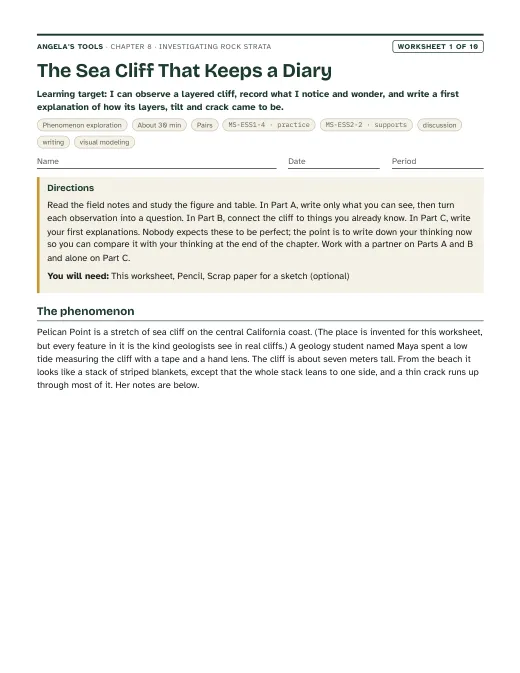
A highway crew blasts through a hillside and leaves a fresh rock wall beside the road. The wall shows a stack of striped layers, tan sandstone, gray shale and a pale limestone band, all leaning at about twenty degrees. A dark band of rock about a meter wide runs diagonally up through every layer like a stripe painted on later. Partway along, the layers on the left sit a meter higher than the same layers on the right, as if someone had sliced the wall and shifted one side. Across the top, a flat bed of loose river gravel lies on everything, and nothing cuts it. A geologist walks up, looks for a minute and says she can list the events that made this wall in order. How?

Notice and wonder prompts

  • What do you notice about the shape and direction of the striped layers compared with the gravel on top?
  • The dark stripe crosses every layer. Was it there before the layers formed, or did it come later? What makes you think so?
  • Why might the layers on one side of the break sit higher than the same layers on the other side?
  • Which part of the wall do you think is the oldest, and what would you need to see to be sure?

Learning targets

  • I can use the law of superposition and the principle of lateral continuity to tell which rock layers are older, younger or the same age, and explain why this gives an order rather than an age in years.
  • I can use original horizontality and cross-cutting relationships to show that folding, tilting, faults, intrusions and erosion happened after the layers they affect formed.
  • I can explain how fossil succession and index fossils let geologists match layers of about the same age in places far apart.
  • I can use half-life to calculate the age of an igneous rock from the fraction of radioactive atoms left, and explain how dated volcanic layers bracket the age of sedimentary layers.
  • I can reconstruct the sequence of events recorded in a rock cross section and separate what the evidence shows from what it cannot show.

What shows the learning happened

  • A reconstructed core log from Lab 1 that names the deposition order of hidden layers, identifies the fault, dike or missing layer, and states which observation revealed it.
  • An ordered list of events for the Lab 2 quarry cross section, each event paired with the rule that justifies it and the observation it rests on, plus a correct age bracket for the limestone layer.
  • A labeled tray-model sketch (Lab 3) showing the first deposit, the second deposit on top, and a channel whose walls expose matching layers, with a sentence explaining which is youngest and why.
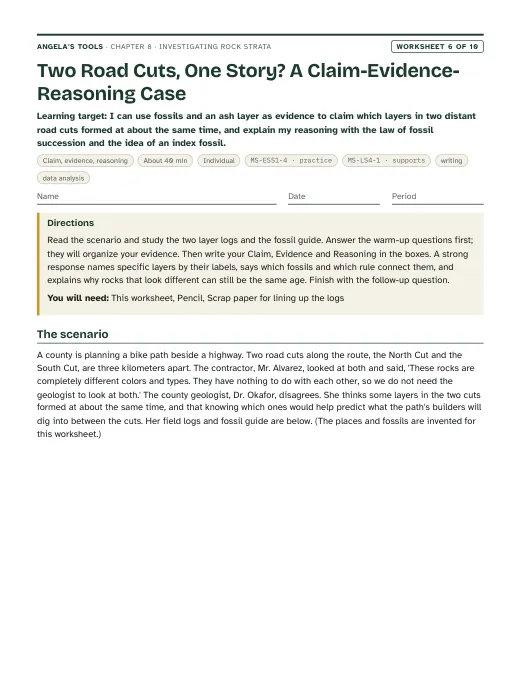
  • A Claim-Evidence-Reasoning paragraph (W6) arguing which of two cross-cutting features is older using cross-cutting relationships.
  • A correct half-life calculation (slide check, W5, W10) giving the age of a rock from the fraction of parent atoms remaining, with the steps shown.
  • A short answer that distinguishes what relative dating can show (order) from what it cannot (years) and names how a sedimentary layer gets an age range.

Key vocabulary 12 terms

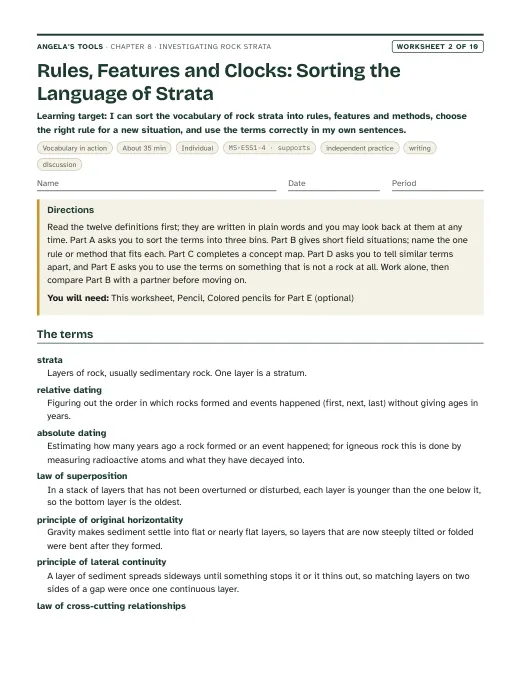
relative datingWorking out the order of rocks and events, which came first, next and last, without saying how many years ago they happened.Relative dating told the geologist that the dark dike came after the limestone, but not how many million years after.
absolute datingPutting a number of years on when a rock formed or an event happened, usually by measuring radioactive atoms in igneous minerals. The number always comes with an uncertainty.Absolute dating of the ash bed gave 150 million years, plus or minus about 2 million.
strataLayers of rock, especially sedimentary rock. One layer is a stratum; several are strata.The quarry wall exposed nine strata, each a slightly different color and grain size.
law of superpositionIn a stack of layers that has not been overturned or disturbed, each layer is younger than the one below it and older than the one above it.Because the shale lies on top of the sandstone, superposition says the sandstone formed first.
principle of original horizontalitySediment settles under gravity into flat or nearly flat layers, so layers that are now steeply tilted or folded were moved after they formed.The tilted beds in the road cut must have been laid down flat and tipped later, by original horizontality.
principle of lateral continuityA layer of sediment spreads sideways in every direction until it thins out or meets a barrier, so matching layers on two sides of a gap were once one connected layer.Lateral continuity lets geologists match the limestone on the west rim with the limestone on the east rim across the canyon.
law of cross-cutting relationshipsAny feature that cuts through rock, such as an igneous intrusion, a fault or an erosion surface, must be younger than whatever it cuts through, because the rock had to exist first.By cross-cutting relationships the fault is younger than the three layers it offsets but older than the gravel that lies unbroken across it.
intrusionA body of igneous rock that formed when magma pushed into cracks or weak zones in existing rock and cooled there. A sheet-like intrusion that cuts across layers is called a dike.The dark stripe in the road cut is an intrusion, so the magma that made it arrived after the layers were already solid rock.
law of fossil successionFossil species appear in rock layers in the same order everywhere on Earth, because life changed over time in one sequence that was never repeated.Fossil succession lets a geologist in Ohio and a geologist in Morocco agree on which of two trilobite-bearing layers is older.
index fossilA fossil of a species that lived for a short span of geologic time, spread over a wide area and is easy to recognize, which makes it a good marker for layers of about the same age.An ammonite species that existed for only two million years is a useful index fossil; a type of clam that lasted 200 million years is not.
radiometric datingMeasuring how many radioactive parent atoms in a mineral have decayed into daughter atoms, and using the known decay rate to calculate when the mineral formed.Radiometric dating of zircon crystals in the ash bed gave the age of the eruption that produced the ash.
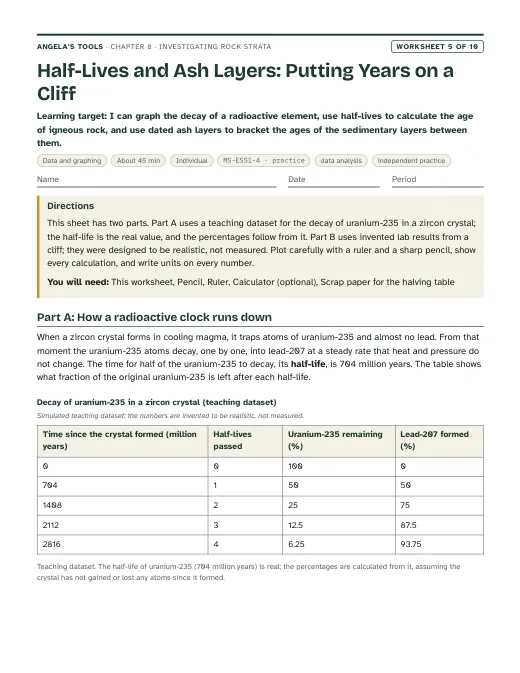
half-lifeThe time needed for half of a sample's radioactive atoms to decay. Each half-life halves whatever is left; heat and pressure do not change it.Uranium-235 has a half-life of about 704 million years, so a crystal with one quarter of its original uranium-235 is about 1,408 million years old.

Standards alignment

California NGSS, Grade 7 Preferred Integrated Course Model. Each entry says whether this chapter's work assesses the performance expectation, gives practice toward it, or supports it as background; the resource lists below repeat this for every worksheet and lab.

MS-ESS1-4Practice toward: the evidence-from-rock-strata half: reading relative ages from strata and fossils, before the geologic time scale is introducedCA Grade 8

Construct a scientific explanation based on evidence from rock strata for how the geologic time scale is used to organize Earth’s 4.6-billion-year-old history.

In California's Preferred Integrated model this PE belongs to Grade 8, so a seventh-grade class using this textbook is meeting it early; label it as a Grade 8 standard on any report. The lesson teaches the relative-dating rules and fossil succession that the PE's clarification names as the evidence base, and Lab 2 and W6 have students construct an explanation of event order from strata evidence, which is the first half of the PE. The organizing role of the geologic time scale itself is built in Lesson 9, and the assessment boundary (no recall of period or epoch names) is respected throughout.

Assessment boundary: Assessment does not include recalling the names of specific periods or epochs and events within them.

MS-ESS2-2Practice toward: explaining surface change by deposition, erosion, folding, faulting and intrusion at small and large scalesCA Grade 7

Construct an explanation based on evidence for how geoscience processes have changed Earth’s surface at varying time and spatial scales.

Every rule in this lesson is a cause-and-effect statement about a geoscience process: sediment settling, rivers cutting canyons, plates folding and faulting rock, magma intruding. Lab 3 has students produce and explain deposition and erosion in a tray at a small scale and connect it to the Grand Canyon scale, and the slides compare a fault you can step across with the San Andreas, which builds toward explanations at varying time and spatial scales.

MS-LS4-1Supports: the chronological order of fossil appearance in rock layersCA Grade 8

Analyze and interpret data for patterns in the fossil record that document the existence, diversity, extinction, and change of life forms throughout the history of life on Earth under the assumption that natural laws operate today as in the past.

A Grade 8 PE in California's sequence. The fossil-succession section gives students the idea that fossils appear in one chronological order in the rock record and that this order is the same everywhere, which is background for analyzing patterns in the fossil record later. This chapter does not ask students to analyze fossil-record data on diversity or extinction, so the role is supports.

Assessment boundary: Assessment does not include the names of individual species or geological eras in the fossil record.

Science and engineering practices

  • Constructing Explanations and Designing Solutions. Students write the sequence of events for a cross section (slide task, Lab 2, W6) and defend each step with a named rule and a specific observation.
  • Developing and Using Models. Students build hidden strata and core them (Lab 1), run a tray model of deposition and erosion (Lab 3), and use the halving model of half-life to calculate ages.
  • Analyzing and Interpreting Data. Students read core logs, measure deposit lengths and grain sorting, and compute ages from parent-daughter fractions (Lab 2, W5).

Disciplinary core ideas

  • ESS1.C The History of Planet Earth. Rock strata and the fossils in them give relative ages of events; radiometric dating of igneous rock adds ages in years; together they let geologists order Earth's history.
  • ESS2.A Earth Materials and Systems. Weathering, erosion, deposition, deformation and intrusion are the processes that create and alter strata, and each leaves a readable mark.
  • LS4.A Evidence of Common Ancestry and Diversity. Fossils appear in a consistent chronological order in rock layers, which is why fossil succession works as a dating tool.

Crosscutting concepts

  • Cause and Effect. Each dating rule is a cause-and-effect claim: gravity causes flat layers, intrusion requires existing rock, decay at a constant rate causes a predictable parent-daughter ratio.
  • Scale, Proportion, and Quantity. Students move between a 10-cm play-dough stack, a 1-m tray, a 1.6-km canyon wall and a 4.5-billion-year history, and they handle quantities like 704 million years and one eighth remaining.
  • Stability and Change. Layers record long stretches of slow deposition punctuated by faster events such as eruptions, faulting and erosion, and gaps in the record show where change removed evidence.

Presentation 28 slides

Investigating Rock Strata: reading the order of events in rock. Original, editable slides with speaker notes: a phenomenon opener, learning targets, the chapter's concepts with diagrams, vocabulary in context, 4 checks for understanding, 2 discussion prompts, an application task, a misconception check, a synthesis and an exit ticket.
Worksheets 10 of 10

Ten different tasks, one per instructional blueprint. Each has a student PDF (low ink, US Letter), an editable DOCX, an HTML preview, and a separate teacher answer key with reasoning.

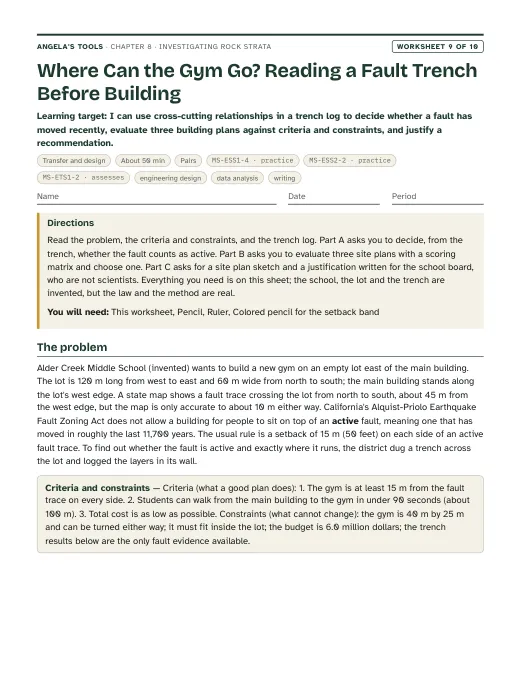
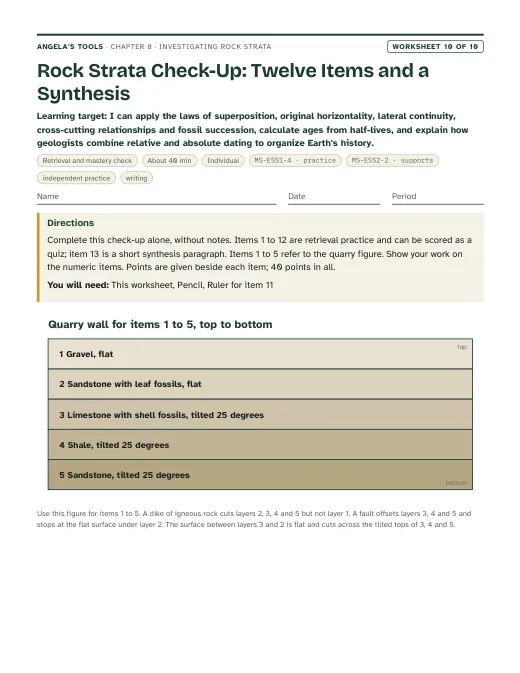
First page of Rock Strata Check-Up: Twelve Items and a Synthesis
Worksheet 10 · Retrieval and mastery check

Rock Strata Check-Up: Twelve Items and a Synthesis

I can apply the laws of superposition, original horizontality, lateral continuity, cross-cutting relationships and fossil succession, calculate ages from half-lives, and explain how geologists combine relative and absolute dating to organize Earth's history.

40 minindividualAssessmentIndependent practiceWriting MS-ESS1-4 · practiceMS-ESS2-2 · supports

Collaborative labs 3 of 3

Three different investigation approaches. Each has a teacher guide (purpose, materials with quantities, estimated cost, prep, safety, procedure, expected observations, debrief, answer key, assessment criteria, accessibility adaptations, low-cost alternative) and a student recording sheet.
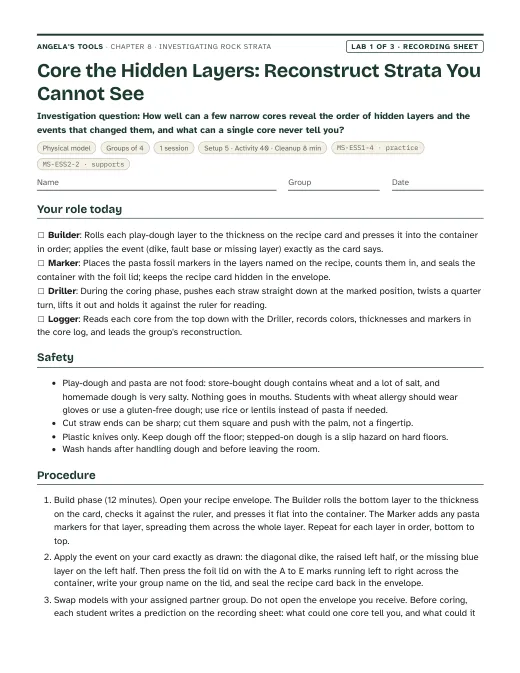
First page of the Core the Hidden Layers: Reconstruct Strata You Cannot See recording sheet
Lab 1 · Physical model

Core the Hidden Layers: Reconstruct Strata You Cannot See

How well can a few narrow cores reveal the order of hidden layers and the events that changed them, and what can a single core never tell you?
Groups of 41 session40 min activityEst. 20 to 45 per class, reusablePlay-dough in six colors (red, yellow, blue, green, white, black)Opaque plastic food container, about 10 to 12 cm across and at least 5 cm deepAluminum foil square for the lid, with five coring positions A to E marked in a line across the middle MS-ESS1-4 · practiceMS-ESS2-2 · supports
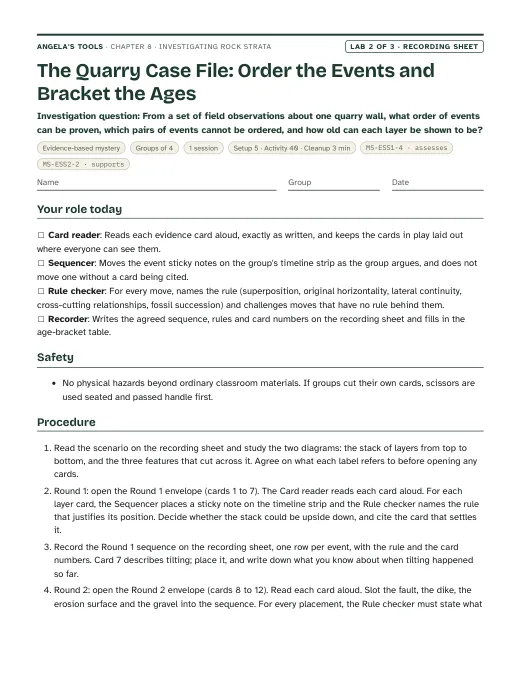
First page of the The Quarry Case File: Order the Events and Bracket the Ages recording sheet
Lab 2 · Evidence-based mystery

The Quarry Case File: Order the Events and Bracket the Ages

From a set of field observations about one quarry wall, what order of events can be proven, which pairs of events cannot be ordered, and how old can each layer be shown to be?
Groups of 41 session40 min activityEst. 3 to 5 per classEvidence card set (12 cards), printed and cutCross-section figure (the two diagrams on the recording sheet, enlarged)Sticky notes for the event timeline (one per event, 11 or 12) MS-ESS1-4 · assessesMS-ESS2-2 · supports
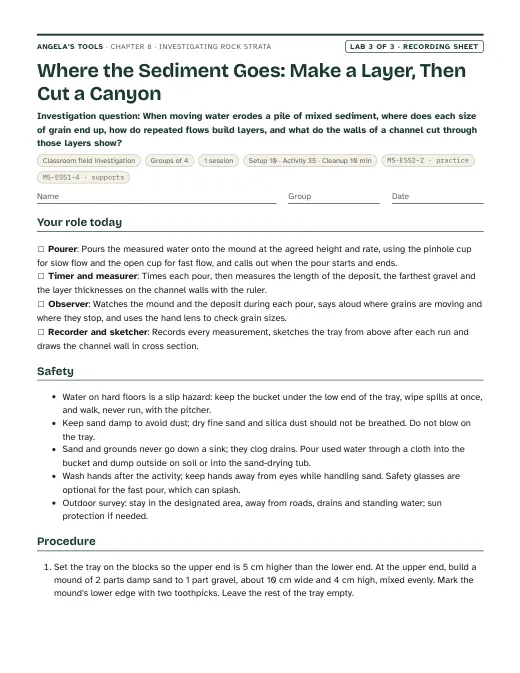
First page of the Where the Sediment Goes: Make a Layer, Then Cut a Canyon recording sheet
Lab 3 · Classroom field investigation

Where the Sediment Goes: Make a Layer, Then Cut a Canyon

When moving water erodes a pile of mixed sediment, where does each size of grain end up, how do repeated flows build layers, and what do the walls of a channel cut through those layers show?

Groups of 41 session35 min activityEst. 25 to 80 per class, mostly reusableShallow plastic tray about 60 by 40 cm with sides at least 8 cm high (under-bed storage box, large paint tray or a deep aluminum roasting pan)Damp play sandCoarse aquarium gravel, dark color, 3 to 6 mm MS-ESS2-2 · practiceMS-ESS1-4 · supports

Teacher guidance

Suggested sequence (7 steps)
  1. Period 1: Presentation slides 1-8 (road-cut phenomenon, targets, two kinds of dating, how a stratum forms, superposition). W1 phenomenon worksheet as the opener, W2 vocabulary relationships to close.
  2. Period 2: Lab 1, Core the Hidden Layers (one session): groups build strata from a recipe card, swap, core with straws and reconstruct. Follow with slides 9-10 (lateral continuity, the canyon discussion).
  3. Period 3: Slides 11-17 (original horizontality, folding, cross-cutting features, the order-the-events task). W3 reading passage in class or for homework; W4 diagram worksheet on a cross section.
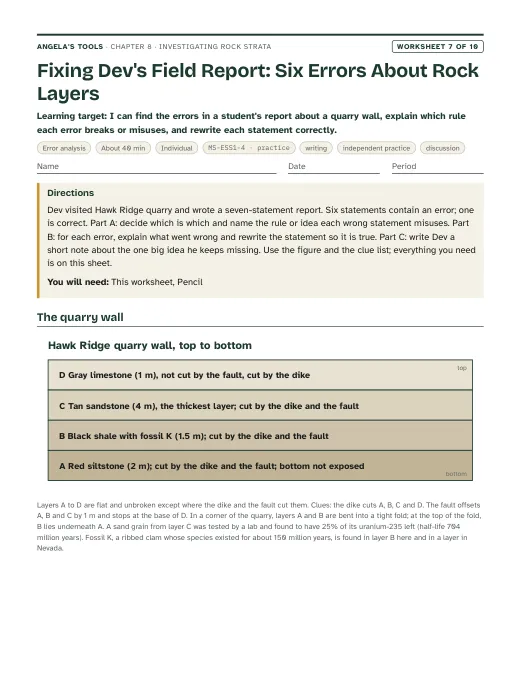
  4. Period 4: Lab 2, The Quarry Case File (one session): evidence cards, event ordering, bracketing the limestone's age. W7 misconception repair as the closer; it reuses the backward cross-cutting claim.
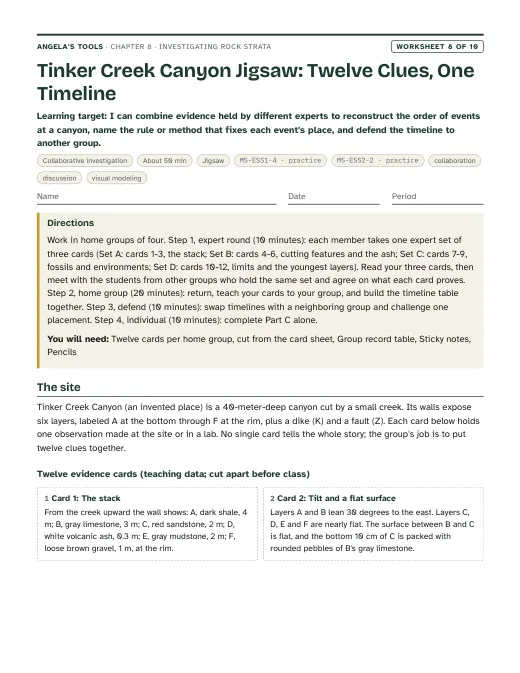
  5. Period 5: Slides 18-25 (fossil succession, index fossils, Rainbow Basin connection, radiometric clocks, half-life check, bracketing). W5 data worksheet on half-life; W8 collaborative evidence sort.
  6. Period 6: Lab 3, Where the Sediment Goes (tray model, with the schoolyard survey if weather allows). Slides 26-27 (misconception, synthesis) and W9 transfer task.
  7. Period 7 or homework: Slide 28 exit ticket, W6 CER on the cross-cutting evidence as the written assessment, W10 mastery as the quiz.

Materials overview: No chemicals, flames or sharp blades beyond plastic knives. Lab 1 uses play-dough (store-bought or homemade), opaque containers, foil, clear wide straws and small pasta shapes. Lab 2 is paper only: printed evidence cards, the cross-section figure and the recording sheet. Lab 3 uses a shallow tray, damp play sand, aquarium gravel, coffee grounds, a cup with a pinhole, a bucket and towels; it can move outdoors to a bare slope with a watering can. A set of rock samples (sandstone, shale, limestone, a dark igneous rock) helps but is optional.

Common misconceptions (6)
“The deepest layer is always the oldest, no matter what.”
Why it happens: Superposition is usually taught without its condition, and the textbook summary drops the word undisturbed. Most pictures students see are flat stacks.
Correction: Superposition applies to layers that have not been overturned or sliced apart. Tight folding can flip part of a stack so that older rock sits on top, and across a fault the same layer can sit at two different depths. Check for tilting, folding and faults before reading the order.
“A thicker layer took longer to form, so depth can be converted into years.”
Why it happens: Students assume sediment piles up at one steady rate everywhere, like sand in an hourglass.
Correction: Deposition rates vary enormously: a flood can drop a meter of sand in a day while deep-sea mud gains a millimeter in a century. Erosion also removes layers, leaving gaps. Thickness tells you nothing reliable about time; only radiometric dates on igneous layers give years.
“A fossil tells you the exact year a layer formed, and two layers with the same fossil are exactly the same age.”
Why it happens: Textbook phrasing says layers with the same fossils 'are the same age' with no qualifier.
Correction: A fossil places a layer within the span of time its species lived. For a good index fossil that span is short, so the match is tight, but it is still a range, never a single year. Fossils give relative ages; ages in years need radiometric dating.
“A dike or fault was there first and the layers formed around it.”
Why it happens: In a picture, the dike looks like a solid pillar with layers stacked beside it, and students reason from the picture instead of from how the feature forms.
Correction: Magma can only intrude rock that already exists, and a fault can only break rock that is already there. Anything that cuts across layers is younger than every layer it cuts. The textbook's Key Science Concept callout on page 101 states this backward; the body text and summary have it right.
“After two half-lives all the radioactive atoms are gone, and heating the rock speeds up decay.”
Why it happens: Students treat half-life as half of a total lifetime, and they generalize from chemical reactions, which do speed up when heated.
Correction: Each half-life halves what is left: 100% becomes 50%, then 25%, then 12.5%, and the amount never reaches zero in a fixed number of steps. Radioactive decay happens inside the nucleus and is not affected by temperature, pressure or chemistry, which is exactly why it makes a reliable clock.
“Absolute dating gives an exact, error-free age.”
Why it happens: The word absolute sounds like certain, and textbooks print single numbers.
Correction: Every radiometric date comes with an uncertainty, often around one percent, and it dates the moment the crystal formed, which for an ash bed is the eruption. Geologists increasingly say numerical dating instead of absolute dating for this reason.
Differentiation suggestions (5)
  • Multilingual learners: Pre-teach the five rule names with a one-gesture card each (stacking hands for superposition, a flat palm tipping for original horizontality, hands spreading for lateral continuity, a chop for cross-cutting, a fossil card flip for succession). Let students label core logs and cross sections in their home language first, then in English, and pair them with a partner who reads evidence cards aloud in Lab 2.
  • Students who need more support: Give a rule-reference strip for the cross-section task and Lab 2 with each rule as a question ('What does it cut? Then it is younger than that.'). Provide the Lab 1 core log template with depth lines pre-drawn, and a half-life table with the 100-50-25-12.5 chain already filled for the calculation checks.
  • Students ready for extension: Ask them to explain how an overturned fold could be detected from features inside the layers (graded bedding, ripple marks), to design a core-sampling plan that would catch a fault with the fewest cores, or to work out why a sandstone's own sand grains give a maximum age rather than the layer's true age.
  • Students who need movement or alternative output: Run the sequence-of-events task as a human timeline: students hold event cards and physically reorder themselves as evidence is read. Allow the Lab 3 report as a labeled photo sequence or a 60-second narrated video of the tray, and accept a recorded spoken explanation for the Lab 2 order.
  • Students with low vision or limited fine-motor control: Use high-contrast play-dough colors and thick layers in Lab 1 so cores read by touch; let a partner push the straw while the student logs what emerges. Provide tactile cross sections made from layered foam sheets with a string for the dike and a cut for the fault.
Accuracy notes: where the textbook simplifies (16)
  • Cross-cutting direction: the Key Science Concept callout on page 101 says an eroded surface, fault or intrusion is older than the strata it cuts. That is backward. Pages 96-97 and the summary on page 103 have it right: the feature doing the cutting is always younger. Teach from the body text and treat the callout as an error to correct (W7 uses it).
  • Superposition's condition: the lesson summary (p. 103) says the oldest layers are on the bottom 'everywhere' and two lines later says folded rock can break the pattern. Always state the condition: in layers that have not been overturned or disturbed.
  • Original horizontality: the book says sediment settles in flat, horizontal layers. Geologists say horizontal or nearly horizontal; deltas and dunes deposit gentle slopes. Only steep tilting or folding is clear evidence of later movement.
  • Lateral continuity and gaps: the summary (p. 103) says layers on either side of a gap are the same age. The accurate statement is that matching layers (same rock type, thickness and position in the sequence) on the two sides were once continuous and are the same age, and the gap itself is younger than every layer it cuts.
  • Fossils and 'the same age': pages 98, 101 and 103 say layers with the same fossils are the same age. Say about the same age: a fossil places a layer within the span of time its species lived, which is short for a good index fossil and useless for a long-lived one. Fossils never give a year.
  • Fossil group details (pp. 98-99): foraminifera are single-celled protists, not animals, and many species are alive today; ammonites were shelled cephalopods (relatives of squid and nautilus), not 'shellfish'; trilobites were arthropods but not close relatives of horseshoe crabs, and they lived from roughly 520 to 252 million years ago. None of this is assessed.
  • Absolute dating of sedimentary rock (RF4): radiometric dating works directly on igneous rock, including volcanic ash and lava flows. Sedimentary layers get an age range by bracketing between dated igneous layers above and below. Dating the sand grains in a sandstone gives the age of the older rock they came from, so at best a maximum age for the layer. Carbon-14 dating of young organic remains exists but is outside this lesson.
  • 'Absolute' means numerical, not exact: every radiometric date carries an uncertainty (often about one percent). Many geologists now say numerical dating. The method also assumes the crystal gained or lost no parent or daughter atoms after it formed; the book omits this assumption.
  • Half-life figures: uranium-235 to lead-207, about 704 million years (the book's figure); potassium-40, about 1.25 billion years; uranium-238, about 4.47 billion years. Figure 7's OCR is garbled; the figure shows 100/0, 50/50, 25/75 and 12.5/87.5 percent uranium/lead at 0, 704, 1,408 and 2,112 million years.
  • Ages of Earth and its oldest materials: Earth is about 4.54 billion years old (the book's 4.6 is the common rounding). The oldest dated rocks are about 4.0 billion years (Acasta Gneiss, Canada); single zircon grains reach about 4.4 billion years (Jack Hills, Australia). The book's 'igneous rocks more than 4 billion years old' is loose; the oldest rocks are metamorphosed igneous rock whose zircons date the original crystallization.
  • Grand Canyon numbers (p. 93): the canyon is about 1.6 km deep at most; the oldest rocks at the bottom are about 1.8 billion years old and the rim rock about 270 million years old, so the walls record roughly 1.5 billion years with large gaps, not a continuous 1.7 to 2 billion. The number of layers depends on how you count. The canyon itself was carved mostly within the last 6 million years.
  • Largest faults (p. 97): the book says the largest faults are at transform boundaries. The megathrust faults at subduction zones are at least as large and produce the largest earthquakes. The San Andreas is correctly described as a transform boundary between the Pacific and North American plates.
  • Names of the rules: the book calls superposition, cross-cutting and fossil succession 'laws' and the other two 'principles'. Geologists use both words loosely; Steno's principles (1669) and the principle of faunal succession (William Smith, early 1800s) are the usual names. Accept either word from students.
  • Gaps in the record: an erosion surface buried under younger layers is called an unconformity and represents missing time. The lesson shows the idea without the word; using the term is optional and not assessed.
  • Rules the book does not name: W4, W8 and Lab 2 use two standard geologic clues the textbook omits. Pebbles of one rock inside another (the principle of inclusions) show the source rock is older than the layer holding the pebbles; ripple-mark crests and graded bedding are 'way-up' indicators that confirm a stack is not overturned. Both are introduced as clues, not as terms to recall.
  • Young ages in W9: the trench worksheet gives charcoal ages of a few thousand years. Those are radiocarbon dates (carbon-14, half-life about 5,730 years), a method the lesson does not cover; the sheet calls it a lab method for young carbon-containing material and treats the ages as given. Uranium-235, with its 704-million-year half-life, cannot date anything that young, which W5's extension asks students to reason out.

Review status: reviewed · 2026-10-19 · Re-solved every numeric and multiple-choice item in W1-W10 and Labs 1-3 (half-life chains, brackets, offsets, ratios, dates); all keys confirmed. W5 Part B: removed shell fossils from a shale bracketed at 704-1,408 million years (shelled animals appear about 540 million years ago). W1 q7 key: the cliff does fix the tilt after the crack (layers 1 and 2 are unbroken across the crack and lean with the stack); key corrected. Lab 2 layers diagram had 8 entries; the renderer draws at most 7 and would have dropped the lowest layer. Surface E folded into the gravel entry and captions. Vocabulary definitions for absolute dating, cross-cutting relationships and half-life reworded in chapter, slide 14 and W2 to remove six-word runs shared with the textbook; slide 19 bullet reworded. W3 q8 key quote made exact; W4 q8 and W6 CER key wording tightened; caGrade added to all lab standards. Added two accuracyNotes: the inclusion and way-up clues used in W4, W8 and Lab 2, and the radiocarbon ages assumed in W9. Labs have not been physically tested; see each lab's modelLimitations.

Source references

Verified against the student edition of Bring Science Alive! 7th Grade Integrated (Student Edition). Printed page numbers appear in the book; PDF pages are the physical pages of the 524-page scan (printed + 36). The textbook is not reproduced on this site.

SectionPrinted pagesPDF pagesUsed for
Introduction: the New Zealand cliff and the lesson question90, 91126, 127Lesson question, vocabulary list, publisher's standards box; the idea of a cliff that mixes sedimentary and volcanic layers behind the phenomenon.
1. Finding the Ages of Rock Layers: relative versus absolute dating92128The two-kinds-of-dating distinction on slides 4 and 7 and in the vocabulary.
2. Reading Strata from the Bottom Up: deposition and superposition93129Flow diagram of how a stratum forms, superposition slide, Lab 1 build-and-core model, Lab 3 deposition runs.
3. Finding Continuity in Rock Strata: lateral continuity and erosion94130Lateral continuity slide, canyon discussion, Lab 1 core correlation, Lab 3 channel step.
4. Reading Folded and Tilted Strata: original horizontality95131Folding and tilting slides, the overturned-fold misconception, the tilted layers in the Lab 2 quarry.
5. Reading Features That Cut Across Strata: intrusions and faults96, 97132, 133Cross-cutting diagram, fault rules, San Andreas connection, the slide task and Lab 2 dike and fault.
6. Using Fossils to Determine the Age of Strata: fossil succession and index fossils98, 99134, 135Fossil succession and index fossil slides, the two-quarries discussion, Lab 1 fossil markers, Lab 2 fossil cards.
Key Science Concept: Evidence from Relative Dating Methods100, 101136, 137The idea of reading a whole landscape; the backward cross-cutting callout is the source of the W7 error and an accuracy note.
7. Finding the Absolute Age of Rock: radiometric dating, half-life, zircon102, 103138, 139Radiometric clock slides, half-life line diagram and check, bracketing slide, Lab 2 ash-bed dates.

External references used for accuracy checks

Related chapters