Chapter 15 · Unit 5: Chemical Reactions · Segment 2

Chemical Engineering and Society

Where do synthetic materials come from, why do people choose them over natural ones, and what do those choices cost?

MS-PS1-3 · assessesMS-ETS1-1 · practiceMS-ETS1-2 · practice Textbook pp. 182–193 1 presentation · 10 worksheets · 3 labs

Overview

Students figure out that every synthetic material, from a polyester jersey to a cancer drug, starts as a natural resource that chemists change through chemical reactions, and that each of those materials carries benefits and costs for people and for the environment. They trace petroleum into plastics, fabrics, fuels, dyes and medicines, follow corn into ethanol and PLA, and follow yew trees into paclitaxel. They weigh the trade-offs of gasoline against corn ethanol, sugar against zero-calorie sweeteners, and long-lasting plastics against plastics that break down. Finally they see how engineers revise criteria and constraints when a successful solution creates a new problem, and they practice doing the same thing with ordinary classroom materials.

Estimated class time: presentation about 142 minutes · worksheets about 405 minutes in total · labs 4 sessions. Seven 50-minute periods: one for the phenomenon and the natural-versus-synthetic distinction; one for the petroleum family and the swatch mystery lab; one for structure, properties and the history of synthetic materials; one for fuels, foods and medicines; one for the cup decision lab; two for the plastics engineering story, the produce-bag design challenge and the mastery check.

Phenomenon

Two jackets that look the same, from a cow and from an oil well

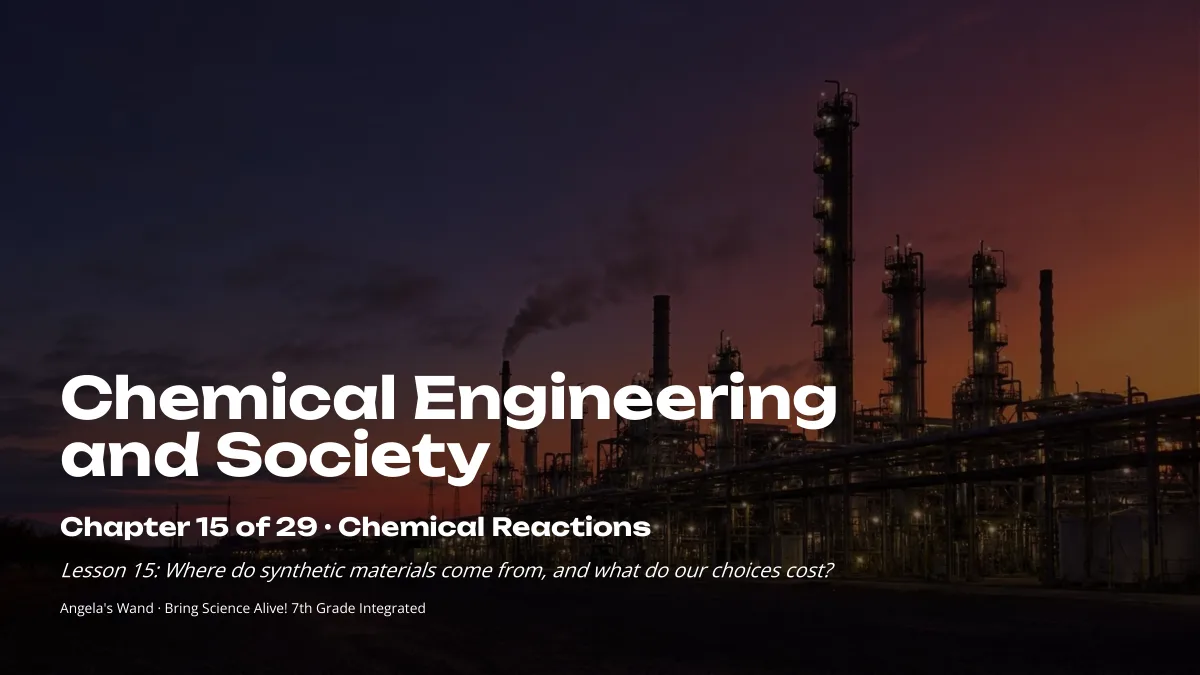
Two black jackets hang side by side in a store. Their tags read the same price. One tag says 'genuine leather'; the other says 'vegan leather, 100% polyurethane'. They feel almost the same, they bend the same way, and both shed water. One started as the hide of a cow; the other started as crude oil pumped from deep underground. No animal went into the second jacket. Chemists took a thick black liquid, broke its molecules apart and joined the pieces into long chains that can be spread into a sheet that behaves like skin. Why would anyone make a material the hard way when nature already makes one? And what does each jacket cost beyond the price on the tag?

Notice and wonder prompts

  • What would you have to test to tell the two jackets apart without reading the tags?
  • Where did the raw material for each jacket come from, and how far back can you trace it?
  • Which jacket uses up something that cannot be replaced, and which uses something that can be grown again?
  • What happens to each jacket twenty years from now, in a closet, a landfill or the ocean?

Learning targets

  • I can tell a natural resource from a synthetic material and trace a synthetic material back to the natural resource and chemical process it came from.
  • I can explain how the structure of a material's molecules gives it the properties that make it useful, using long polymer chains and the shape of sucralose as examples.
  • I can describe the benefits and costs of a synthetic material for people and for the environment using qualitative evidence from more than one source.
  • I can judge whether a source of information about a material is credible and whether its claims are supported by evidence.
  • I can define criteria and constraints for a materials design problem precisely enough to compare competing solutions fairly.

What shows the learning happened

  • A completed resource-to-product trace (W4) showing a natural resource, the chemical process and the synthetic material, with a property named for each product and its structural cause.
  • A Lab 1 evidence table and written identification of six unlabeled swatches as natural or synthetic, each justified by at least two property tests, with an honest note about which test was least reliable.
  • A Lab 2 decision matrix scoring four cup materials on the same criteria, a written choice and a paragraph explaining one trade-off the group accepted.
  • A set of criteria and constraints for a produce bag (Lab 3) that are testable, include an end-of-life requirement and are used to judge the group's own prototype.
  • A Claim-Evidence-Reasoning paragraph (W6) about whether a town should switch to a biodegradable cup, citing qualitative evidence about origin, breakdown conditions and local facilities.
  • A source-credibility rating (the W6 flyer or the W8 jigsaw cards) that names a specific reason a claim about a material is or is not supported.

Key vocabulary 12 terms

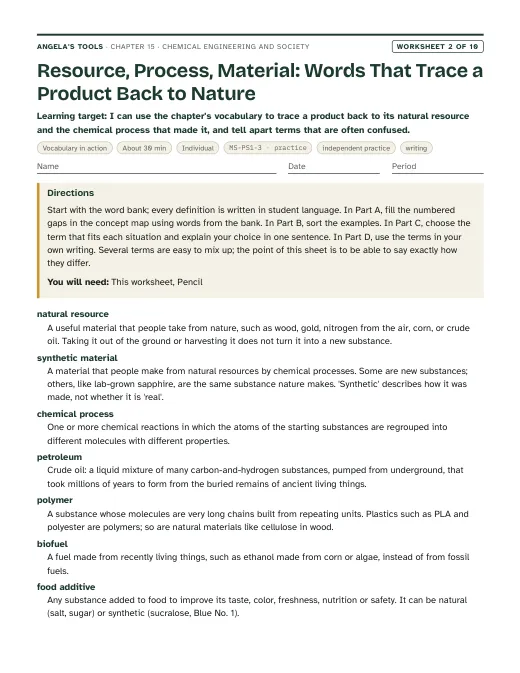
natural resourceA useful material that people take from Earth or from living things without chemically changing it into something new: ore dug from a mine, crude oil pumped from underground, nitrogen collected from the air, wood, cotton, hides or fish oil.Crude oil is a natural resource; the polyester made from it is not, because reactions changed its molecules into a new substance.
synthetic materialA material people produce from natural resources by chemical processes. 'Synthetic' describes how a material was made, not whether it is fake or harmful, and nature sometimes makes the same substance.A lab-grown sapphire is a synthetic material even though its atoms are arranged exactly like a mined sapphire's.
polymerA substance whose molecules are very long chains built from many repeating smaller units. Plastics, nylon, polyester, rubber and the cellulose in cotton are all polymers.Because polyethylene is a polymer of tangled chains, a thin bag of it stretches and resists tearing instead of snapping like glass.
petroleumCrude oil, a liquid mixture of many carbon-and-hydrogen compounds that took millions of years to form from the buried remains of tiny ocean organisms. It is pumped from underground and separated at a refinery.A single barrel of petroleum ends up as gasoline, diesel, jet fuel, asphalt and the ethylene that becomes plastic bags.
fossil fuelA natural resource that can be burned for energy and formed from the remains of organisms that lived long ago: coal, petroleum and natural gas. It is used far faster than Earth makes more.Coal is a fossil fuel and a rock, not a mineral, because it formed from ancient swamp plants.
renewable resourceA resource that nature replaces within a human lifetime, such as a crop harvested every year or leaves that regrow. Renewable does not mean unlimited; using it faster than it regrows still uses it up.Yew needles are a renewable resource for making paclitaxel because the tree keeps growing them, while stripping its bark kills the tree.
biofuelA fuel made from recently living material, such as ethanol fermented from the sugars in corn or oils pressed from algae, instead of from fossil fuels.The ethanol blended into gasoline is a biofuel because yeast produced it from corn starch that grew last summer.
food additiveAny substance put into a food to change its flavor, color, texture, shelf life, nutrition or safety. Salt and sugar are natural additives; sucralose and Blue No. 1 are synthetic ones.Vitamin C is used as a food additive to keep cut fruit from browning, and it works the same whether it was squeezed from a lemon or made in a factory.
biodegradableAble to be broken apart into simpler substances by living things, mostly bacteria and fungi. How fast this happens depends on heat, moisture and oxygen, so a material can be biodegradable in a hot compost pile and last for years in a landfill.PLA cups are biodegradable only at an industrial composting facility, so tossing one in the park does not make it disappear.
criteriaThe things a design must do to count as a success, stated clearly enough to be tested: hold two kilograms, keep water out for ten minutes, break down within a year.One criterion for the new container material was that it must still be sturdy when full, so 'breaks down quickly' could not be the only goal.
constraintA limit a design must stay within, such as a budget, the materials and tools on hand, a deadline or a law.The team's budget of fifteen material tokens was a constraint that ruled out the strongest fabric.
trade-offGiving up some of one benefit to gain more of another. Choosing a material almost always means accepting a cost to get a property you need.Choosing a fast-drying polyester shirt is a trade-off: it dries quickly but comes from a nonrenewable resource and will not rot when thrown away.


Standards alignment

California NGSS, Grade 7 Preferred Integrated Course Model. Each entry says whether this chapter's work assesses the performance expectation, gives practice toward it, or supports it as background; the resource lists below repeat this for every worksheet and lab.

MS-PS1-3Assesses: the whole PE, limited to qualitative informationCA Grade 7

Gather and make sense of information to describe that synthetic materials come from natural resources and impact society.

Every section of the lesson traces a synthetic material (plastics, polyester, ethanol, sucralose, paclitaxel) to its natural resource and the chemical process that made it, and weighs its effects on people and the environment. W3, W6, W8, Lab 2 and the task slide have students gather information from texts and sources, judge whether claims are supported (W6, W8 and Lab 2 rate sources directly) and describe origins and impacts in words; no quantitative life-cycle analysis is required, which respects the assessment boundary.

Assessment boundary: Assessment is limited to qualitative information.

MS-ETS1-1Practice toward: writing testable criteria and constraints, including effects on people and the environmentCA Grade 6-8

Define the criteria and constraints of a design problem with sufficient precision to ensure a successful solution, taking into account relevant scientific principles and potential impacts on people and the natural environment that may limit possible solutions.

The plastics engineering spread shows criteria being revised after a solution caused a new problem. Lab 3 and W9 have students write criteria and constraints for a container or bag before designing, including an end-of-life requirement; the problems are classroom-sized, so this builds toward the PE rather than fully assessing it.

MS-ETS1-2Practice toward: comparing competing solutions against criteria with a systematic matrixCA Grade 6-8

Evaluate competing design solutions using a systematic process to determine how well they meet the criteria and constraints of the problem.

Lab 2 and the presentation's task slide have students score four cup materials against the same criteria and constraints using information cards, then defend a choice. This is a systematic comparison of competing solutions; the decision is qualitative and classroom-scale, so the role is practice.

Science and engineering practices

  • Obtaining, Evaluating, and Communicating Information. Students read information cards and an original passage about where synthetic materials come from, check whether claims are supported, rate the credibility of sources (W6, W8, Lab 2, slide 24) and communicate a supported decision in writing.
  • Asking Questions and Defining Problems. Students write testable criteria and constraints for a produce bag (Lab 3) and for a container material (W9), including effects on people and the environment.
  • Engaging in Argument from Evidence. Students argue from property tests which unlabeled swatches are natural and which are synthetic (Lab 1) and write a CER about a material choice (W6).

Disciplinary core ideas

  • PS1.B Chemical Reactions. Synthetic materials are produced when chemical reactions regroup the atoms of natural resources into new substances with different properties: ethylene from petroleum into polyethylene, glucose into ethanol, a yew-needle compound into paclitaxel.
  • PS1.A Structure and Properties of Matter. The properties that make a synthetic material useful come from the structure of its molecules: long tangled polymer chains give plastics strength and flexibility, and sucralose's sugar-like shape makes it taste sweet.
  • ETS1.A Defining and Delimiting Engineering Problems. Stating criteria and constraints precisely, including environmental effects, makes a design more likely to succeed; the plastics story shows criteria being revised when evidence of landfill and wildlife harm appeared.
  • ETS1.B Developing Possible Solutions. Students compare competing materials against the same criteria in Lab 2 and combine the best features of tested prototypes in Lab 3.

Crosscutting concepts

  • Structure and Function. Students connect molecular structure (chains, rings, chlorine atoms) to the function a material serves and explain why engineers shape molecules on purpose.
  • Influence of Science, Engineering, and Technology on Society and the Natural World. Students examine how synthetic rubber, nylon, saccharin and plastics changed daily life and wartime supply, and how plastics then created new problems for landfills and wildlife.
  • Cause and Effect. Students reason about why a renewable resource can still run out, why PLA does not break down in a landfill, and why fast breakdown in a landfill is not a pure benefit.

Presentation 27 slides

Chemical Engineering and Society: where synthetic materials come from and what they cost. Original, editable slides with speaker notes: a phenomenon opener, learning targets, the chapter's concepts with diagrams, vocabulary in context, 3 checks for understanding, 2 discussion prompts, an application task, a misconception check, a synthesis and an exit ticket.

Worksheets 10 of 10

Ten different tasks, one per instructional blueprint. Each has a student PDF (low ink, US Letter), an editable DOCX, an HTML preview, and a separate teacher answer key with reasoning.

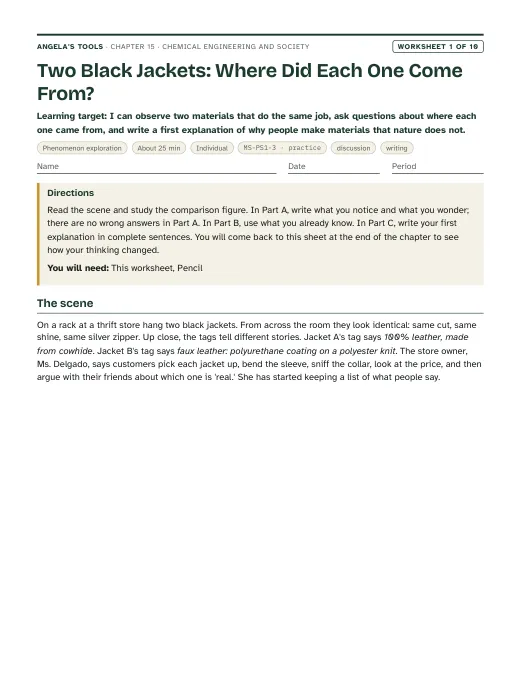
First page of From Oil Well to Jersey: Reading and Building a Resource-to-Product Trace
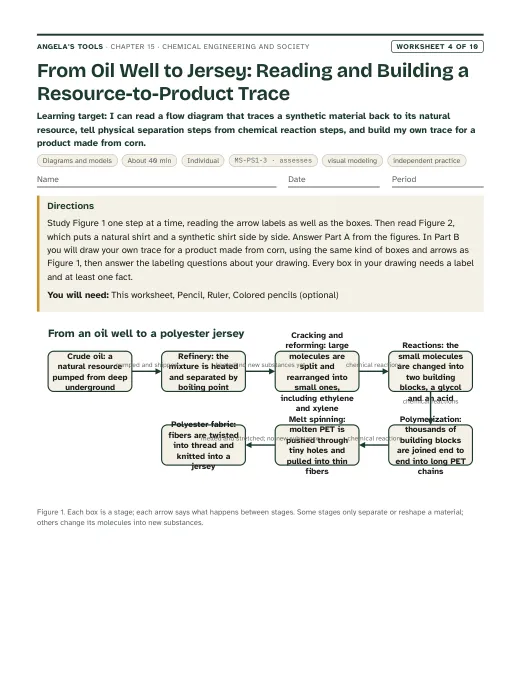
Worksheet 4 · Diagrams and models

From Oil Well to Jersey: Reading and Building a Resource-to-Product Trace

I can read a flow diagram that traces a synthetic material back to its natural resource, tell physical separation steps from chemical reaction steps, and build my own trace for a product made from corn.

40 minindividualBuilds understandingVisual modelingIndependent practice MS-PS1-3 · assesses
First page of Should the Festival Switch to Corn Cups? A Claim-Evidence-Reasoning Case
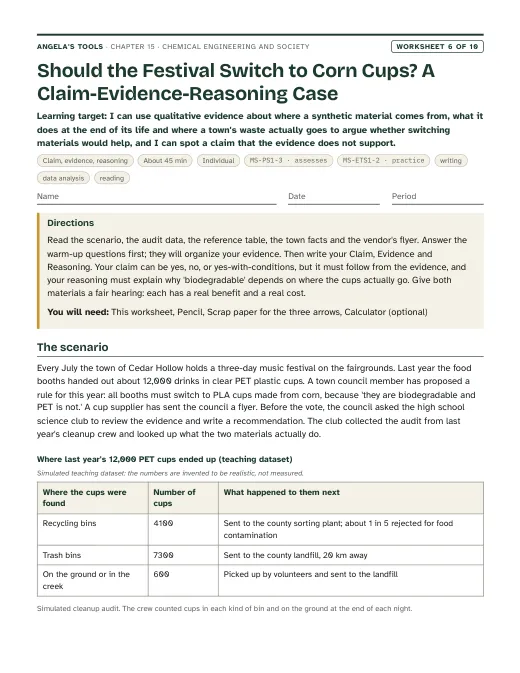
Worksheet 6 · Claim, evidence, reasoning

Should the Festival Switch to Corn Cups? A Claim-Evidence-Reasoning Case

I can use qualitative evidence about where a synthetic material comes from, what it does at the end of its life and where a town's waste actually goes to argue whether switching materials would help, and I can spot a claim that the evidence does not support.

45 minindividualPracticeWritingData analysisReading MS-PS1-3 · assessesMS-ETS1-2 · practice
First page of Fixing Marcus's Study Guide: Nine Claims About Synthetic Materials
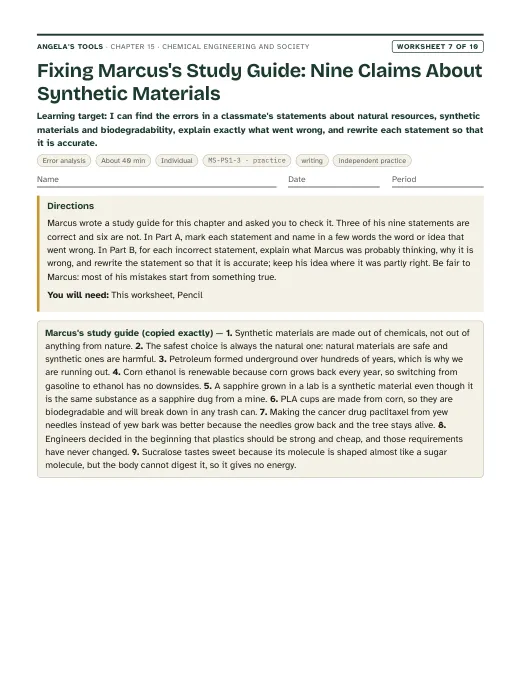
Worksheet 7 · Error analysis

Fixing Marcus's Study Guide: Nine Claims About Synthetic Materials

I can find the errors in a classmate's statements about natural resources, synthetic materials and biodegradability, explain exactly what went wrong, and rewrite each statement so that it is accurate.

40 minindividualPracticeWritingIndependent practice MS-PS1-3 · practice
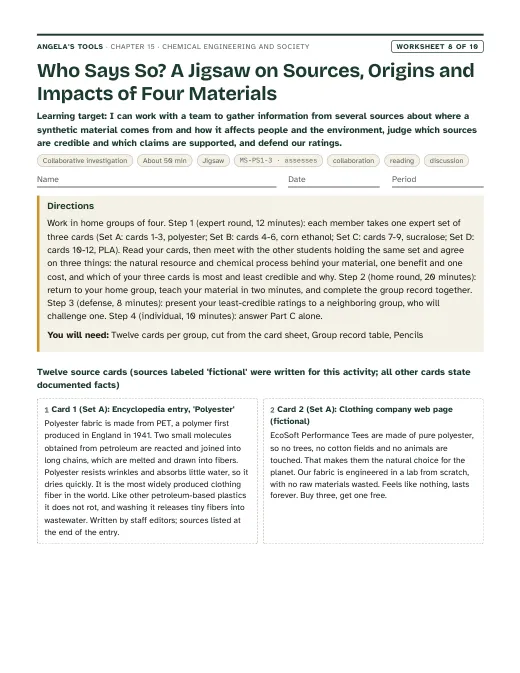
First page of Who Says So? A Jigsaw on Sources, Origins and Impacts of Four Materials
Worksheet 8 · Collaborative investigation

Who Says So? A Jigsaw on Sources, Origins and Impacts of Four Materials

I can work with a team to gather information from several sources about where a synthetic material comes from and how it affects people and the environment, judge which sources are credible and which claims are supported, and defend our ratings.

50 minjigsawPracticeCollaborationReadingDiscussion MS-PS1-3 · assesses
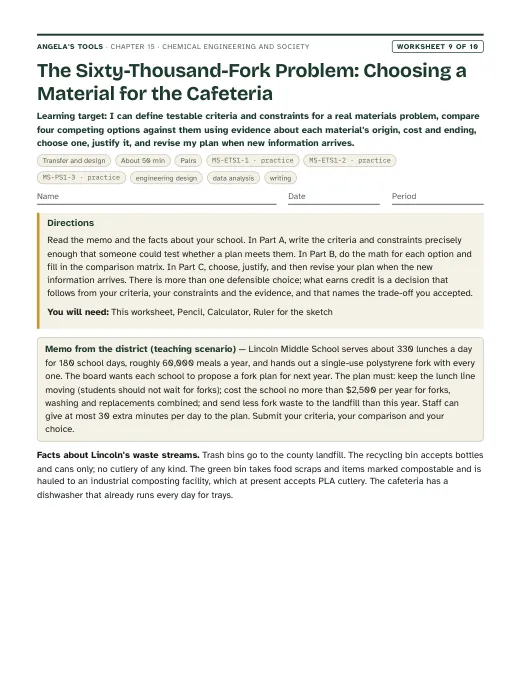
First page of The Sixty-Thousand-Fork Problem: Choosing a Material for the Cafeteria
Worksheet 9 · Transfer and design

The Sixty-Thousand-Fork Problem: Choosing a Material for the Cafeteria

I can define testable criteria and constraints for a real materials problem, compare four competing options against them using evidence about each material's origin, cost and ending, choose one, justify it, and revise my plan when new information arrives.

50 minpairsExtensionEngineering designData analysisWriting MS-ETS1-1 · practiceMS-ETS1-2 · practiceMS-PS1-3 · practice

Collaborative labs 3 of 3

Three different investigation approaches. Each has a teacher guide (purpose, materials with quantities, estimated cost, prep, safety, procedure, expected observations, debrief, answer key, assessment criteria, accessibility adaptations, low-cost alternative) and a student recording sheet.

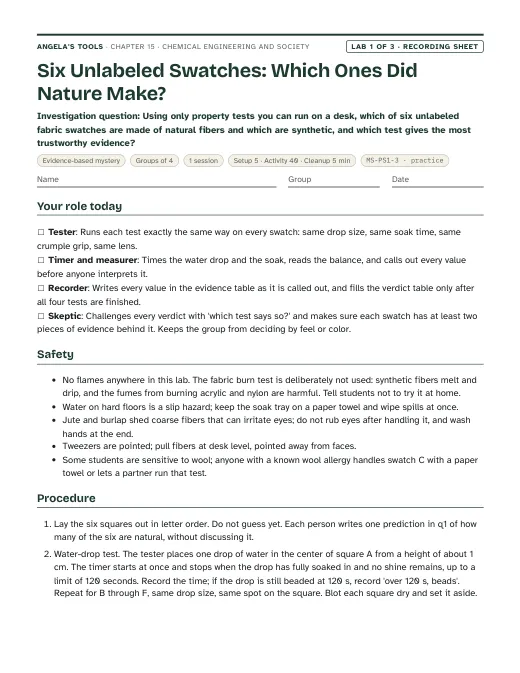
First page of the Six Unlabeled Swatches: Which Ones Did Nature Make? recording sheet
Lab 1 · Evidence-based mystery

Six Unlabeled Swatches: Which Ones Did Nature Make?

Using only property tests you can run on a desk, which of six unlabeled fabric swatches are made of natural fibers and which are synthetic, and which test gives the most trustworthy evidence?

Groups of 41 session40 min activityEst. 15 to 22 per class, far less with donated garmentsFabric swatches, about 10 cm by 10 cm, labeled A to F with a permanent marker on masking tape: woven cotton (muslin or an old T-shirt), 100 percent wool felt, jute or burlap, woven polyester (lining fabric or an old dress shirt), nylon (ripstop, an old windbreaker or nylon organza), and acrylic craft feltStrips of the same six fabrics, 2 cm by 10 cm, labeled A to F, for the soak testDropper or plastic pipette MS-PS1-3 · practice
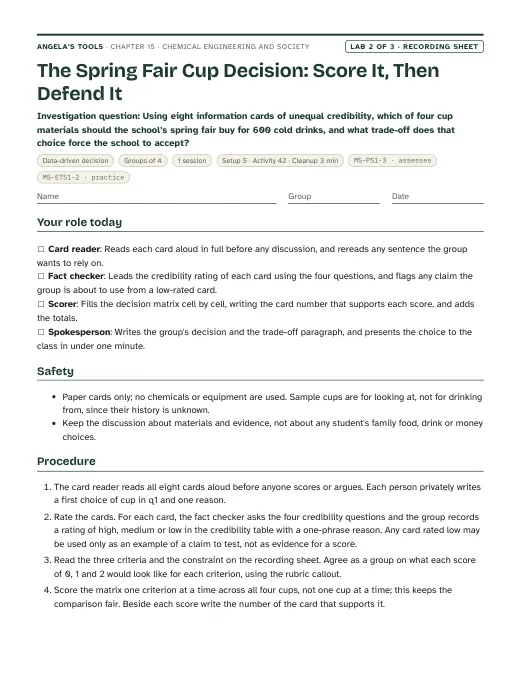
First page of the The Spring Fair Cup Decision: Score It, Then Defend It recording sheet
Lab 2 · Data-driven decision

The Spring Fair Cup Decision: Score It, Then Defend It

Using eight information cards of unequal credibility, which of four cup materials should the school's spring fair buy for 600 cold drinks, and what trade-off does that choice force the school to accept?

Groups of 41 session42 min activityEst. 3 to 5 per classInformation card set (8 cards), printed on card stock and cut apartRecording sheet with credibility table, decision matrix and questionsCalculator for the budget check MS-PS1-3 · assessesMS-ETS1-2 · practice
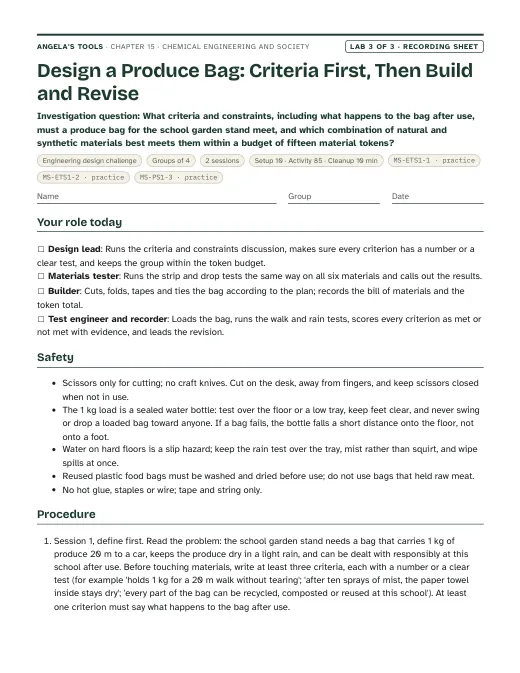
First page of the Design a Produce Bag: Criteria First, Then Build and Revise recording sheet
Lab 3 · Engineering design challenge

Design a Produce Bag: Criteria First, Then Build and Revise

What criteria and constraints, including what happens to the bag after use, must a produce bag for the school garden stand meet, and which combination of natural and synthetic materials best meets them within a budget of fifteen material tokens?

Groups of 42 sessions85 min activityEst. 10 to 18 per class, less with donated fabric and bagsKraft paper (brown wrapping or grocery-bag paper), sheets about 30 cm by 40 cmNewspaper, full sheetsCotton muslin, 30 cm by 30 cm squares MS-ETS1-1 · practiceMS-ETS1-2 · practiceMS-PS1-3 · practice

Teacher guidance

Suggested sequence (7 steps)
  1. Period 1: Presentation slides 1-8 (the two jackets, targets, natural resources, what synthetic means, the petroleum-to-plastic flow, first vocabulary, sort check). W1 phenomenon worksheet opens the period; W2 vocabulary relationships closes it.
  2. Period 2: Lab 1, the unlabeled swatch mystery (one session). Groups test six swatches for water beading, water uptake by mass, wrinkle recovery and fiber look, then argue which are natural. Follow with slide 9 (the petroleum family) and reveal the swatch identities.
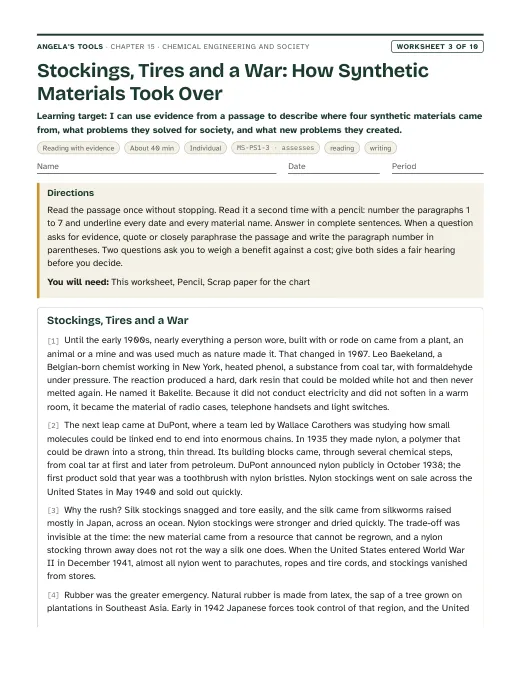
  3. Period 3: Slides 10-13 (timeline of synthetic materials, the wartime discussion, structure and properties, structure check). W3 reading passage on Bakelite, nylon, synthetic rubber and PET, in class or for homework. W4 diagram worksheet on the resource-to-product trace.
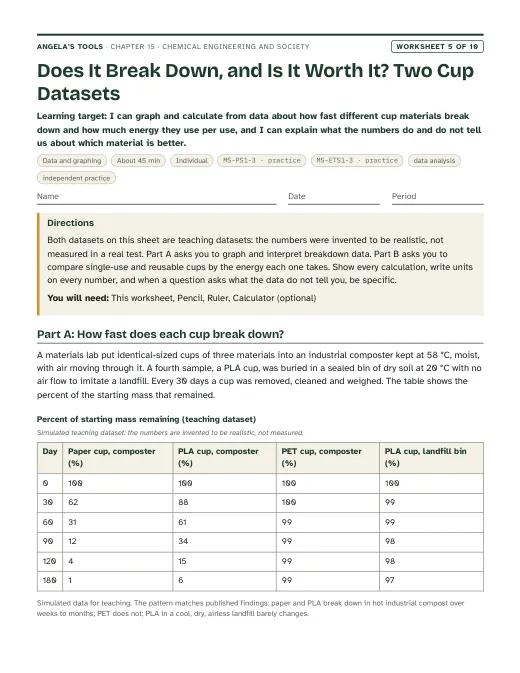
  4. Period 4: Slides 14-19 (gasoline versus ethanol, the California connection, sweeteners and additives, second vocabulary, the paclitaxel story, the renewable-but-not-unlimited discussion). W5 data worksheet on simulated cup breakdown and energy data; W7 misconception repair.
  5. Period 5: Lab 2, the spring-fair cup decision (one session). Groups read eight information cards, score four materials on shared criteria and defend a choice. Slide 22 task can be the warm-up or the debrief. W6 CER on the biodegradable-cup question follows as individual work.
  6. Period 6: Slides 20-21, 23-24 (plastics' success and new problem, the design cycle, the criterion-or-constraint check, judging sources). Lab 3 session 1: write criteria and constraints for a produce bag and test candidate materials. W8 collaborative jigsaw on sources of synthetic materials fits here if Lab 3 is shortened.
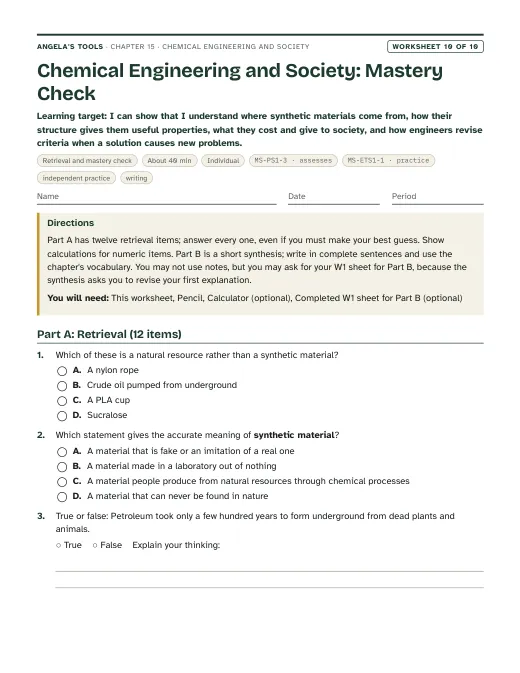
  7. Period 7: Lab 3 session 2: build, test, compare designs across groups and revise. Slides 25-27 (misconception, synthesis, exit). W9 transfer task as an alternative to the build for groups short on time; W10 mastery as the quiz.

Materials overview: No open flames and no hazardous chemicals anywhere in the chapter; the classic fabric burn test is deliberately left out. Lab 1 uses fabric swatches (cotton, wool felt, jute or burlap, polyester, nylon, acrylic felt), water, droppers, tweezers, hand lenses and a balance. Lab 2 uses printed information cards and a scoring matrix. Lab 3 uses kraft paper, newspaper, cotton muslin, polyester fabric from old garments, plastic film cut from reused grocery bags, wax paper, tape, string, scissors and weights for load testing. The jacket phenomenon can be shown with any real and faux leather items or described from the chapter text.

Common misconceptions (5)
“Natural materials are safe and synthetic materials are harmful.”
Why it happens: Advertising uses 'natural' as a selling point and 'chemical' as a warning, and students rarely hear about toxic natural substances or life-saving synthetic ones.
Correction: Safety depends on the substance, the amount and the use, not on where it came from. Poison hemlock and lead ore are natural; aspirin and sucralose are synthetic. Each material must be judged by evidence about its own properties and effects.
“Synthetic means fake, or means a substance that does not exist in nature.”
Why it happens: Everyday speech uses synthetic to mean imitation, and the lesson summary defines it as something not found in nature.
Correction: Synthetic describes how a material was produced: by chemical processes from natural resources. A lab-grown sapphire or synthetic vanillin has the same molecules as the natural version; it is synthetic because people made it.
“Plant-based plastics will break down anywhere, so they solve the plastic waste problem.”
Why it happens: 'Made from corn' and 'biodegradable' sound like 'disappears', and compostable logos on cups suggest they can go in any bin.
Correction: PLA breaks down in weeks to months only at an industrial composting facility that keeps it hot and moist. In a landfill, a backyard pile or the ocean it can last for years, and it contaminates PET recycling. Bio-based and biodegradable are different properties; some petroleum-based plastics biodegrade and some plant-based ones do not.
“A renewable resource cannot run out.”
Why it happens: Renewable sounds like unlimited, and the contrast with fossil fuels makes crops and trees seem endless.
Correction: A renewable resource is one that regrows on a human timescale. If people take it faster than it regrows, it still disappears: Pacific yew bark was renewable in principle, but stripping it killed trees that take about a century to mature.
“Switching from gasoline to a biofuel has no downsides.”
Why it happens: Students learn that corn regrows every year and petroleum does not, and stop there.
Correction: Corn ethanol uses farmland and water, competes with food and feed, and takes fossil energy to grow, harvest and distill. Whether it returns more energy than it uses depends on farming and processing methods, so it is a trade-off, not a free win.
Differentiation suggestions (5)
  • Multilingual learners: Pre-teach natural resource, synthetic, polymer, criteria and constraint with picture cards that show the resource on the left and the product on the right; allow the swatch identifications in Lab 1 to be spoken before they are written; provide the Lab 2 cards with key terms bolded and a bilingual word list.
  • Students who need more support: Give Lab 1 a partly filled evidence table with the expected pattern for one known swatch, provide a two-column origin chart (petroleum / living things) for W4, and supply sentence frames for the CER ('The cup should be ___ because the card says ___, which matters because ___').
  • Students ready for extension: Ask them to find out how PET bottles are turned into polyester fleece and what limits that recycling, to compare the energy balance debate over corn ethanol using two sources with different conclusions, or to research how paclitaxel is now produced in plant cell culture and why that counts as greener chemistry.
  • Students who need movement or alternative output: Run the natural-or-synthetic sort as a four-corners activity with product cards; let Lab 3 prototypes be judged in a walking gallery; accept the Lab 2 decision as a 90-second recorded pitch instead of a paragraph.
  • Students with limited fine-motor control or low vision: Provide larger swatches and a partner to handle the tweezers in Lab 1, high-contrast large-print information cards for Lab 2, and let a teammate do the cutting and taping in Lab 3 while the student directs the design and records the test results.
Accuracy notes: where the textbook simplifies (20)
  • How petroleum formed: the lesson says 'millions of years' in one place and 'hundreds of years' in another. Petroleum took millions of years to form from the buried remains of tiny marine organisms, mostly plankton. Never say hundreds of years.
  • What 'synthetic' means: the lesson summary says a synthetic material does not occur in nature, but the vocabulary box and the sapphire example define it by how it is made. Teach the production definition: made by chemical processes from natural resources. Lab-grown sapphire and synthetic vanillin are chemically identical to the natural versions.
  • Gasoline is refined, not synthesized: the lesson calls gasoline a synthetic material and speaks of mining petroleum. Crude oil is drilled and pumped; a refinery separates it by boiling point and also cracks large molecules into smaller ones, then blends the streams. Gasoline is a processed mixture; keep it out of strict natural-or-synthetic sorting and describe it as 'refined from petroleum'.
  • Coal is not a mineral: the lesson lists coal among minerals. Coal is an organic sedimentary rock formed from ancient plant remains. Use gold, iron ore or salt as mineral examples.
  • Ethanol fermentation: the lesson says scientists ferment glucose 'in corn'. Corn kernels store starch; enzymes first break the starch into glucose, then yeast ferment the glucose, producing ethanol and carbon dioxide (C₆H₁₂O₆ → 2 C₂H₅OH + 2 CO₂). Yeast do the chemistry; people run the process.
  • Ethanol's energy balance: the lesson states as fact that making ethanol takes more energy than it gives back. Published USDA estimates since the 1990s find corn ethanol returns more energy than it uses, and the balance depends on farming and distilling methods. Teach that the answer is measured, debated and depends on method, and never assess either side as fact.
  • Corn used for ethanol is not entirely lost to food: ethanol plants return part of the corn as dried distillers grains, a major livestock feed. Say 'competes with food and feed', not 'cannot be used as feed'.
  • Sweeteners and health: the lesson says a person with diabetes can use sucralose without worrying about high blood sugar or other medical problems. That is health advice and an overstatement. Say only that zero-calorie sweeteners let people enjoy sweet tastes while limiting sugar and calories, and that regulators reviewed their safety before approval (FDA approved sucralose in 1998).
  • Paclitaxel is a natural compound: the lesson calls it a synthetic material. Paclitaxel itself was extracted from Pacific yew bark (first collected in 1962 during a National Cancer Institute plant screening program). The needle-based method extracts a related compound from European yew needles and converts it into paclitaxel by chemical steps, which is semisynthesis. Later, a manufacturer switched to yew cells grown in culture tanks, recognized by a 2004 EPA green chemistry award.
  • Pacific yew figures: 'bark of up to six trees per patient' and 'a century to mature' are rough historical estimates; present them as estimates. The species also grows inland in the northern Rockies, not only along the Pacific coast.
  • Aspirin's origin: the lesson says aspirin is made from a substance in willow trees. Willow bark contains salicin; chemists made acetylsalicylic acid (aspirin) by modifying salicylic acid, which Bayer sold from 1899, and the starting compound can be synthesized from smaller molecules. Say aspirin was inspired by willow, not made from it.
  • PLA's properties: the lesson says PLA's chains let objects be bent and squeezed without breaking, with a water bottle as the example. PLA is fairly stiff and brittle at room temperature; PET is the usual bottle plastic. Say that long chains give plastics strength and let thin pieces flex, and that how far a plastic bends before cracking depends on which plastic it is.
  • Biodegradable depends on conditions: the lesson says PLA needs a facility that keeps it heated 'for several days'. Industrial composting of PLA takes weeks to months; a common standard is 90 percent of the carbon converted to carbon dioxide within 180 days. PLA does not break down in a landfill, a backyard pile or the ocean on any useful timescale, and it contaminates PET recycling streams.
  • Bio-based is not the same as biodegradable: the lesson contrasts petroleum plastics with biodegradable plastics as if plant origin caused biodegradability. Some plant-based plastics (bio-PET) do not biodegrade, and some petroleum-based ones (PBAT) do. Biodegradability depends on the chemical structure, not the source.
  • Fast breakdown in a landfill is not a pure good: landfills become oxygen-poor, and the bacteria that break down waste there release methane, a strong greenhouse gas. Many landfills capture some of it. Present 'breaks down in a landfill' as the textbook's design criterion, and raise the methane point in discussion.
  • Cost is a constraint: the lesson lists 'inexpensive' among the new criteria for plastics. In NGSS usage cost is usually a constraint (a limit), while criteria describe success. Lab 3 and W9 keep the two separate.
  • Recycling claims: in the United States, roughly 9 percent of plastic waste was recycled in 2018 according to EPA figures, and the rate for PET bottles alone was higher but still under a third. Avoid implying that putting plastic in a blue bin guarantees it becomes a new product; what is accepted and actually processed varies by community.
  • Synthetic rubber history: natural rubber comes from the latex of the rubber tree, grown mostly in Southeast Asia. During World War II the United States lost access to most of that supply and built an industry making styrene-butadiene rubber; in 1943-44 most of the butadiene came from alcohol fermented from grain and the rest from petroleum, and after the war petroleum became the main feedstock; today more than half of the rubber used worldwide is synthetic. Natural rubber is still preferred for some uses, such as aircraft tires, because of its properties.
  • Historical dates used in this chapter: Bakelite, the first fully synthetic plastic, was developed by Leo Baekeland in 1907 from phenol and formaldehyde; nylon was first made by Wallace Carothers' team at DuPont in 1935, went on sale as toothbrush bristles in 1938 (the year DuPont announced it publicly, in October) and as stockings nationwide from May 1940; early nylon stockings cost about what good silk ones did, so chapter materials do not call them cheaper; polyester (PET) was first made by Whinfield and Dickson in England in 1941; PET soft-drink bottles followed Nathaniel Wyeth's 1973 patent and were common by the late 1970s; saccharin was discovered in 1879 and became popular during World War I sugar shortages; sucralose was discovered in 1976; large-scale PLA production began in the early 2000s.
  • OCR note: the chemical formulas on pp. 187-188 lost their subscripts in the text file. The printed pages read glucose C₆H₁₂O₆, sucrose C₁₂H₂₂O₁₁ and sucralose C₁₂H₁₉Cl₃O₈, which match reference databases.

Review status: reviewed · 2026-10-19 · Re-solved every numeric, multiple-choice, true/false, fill and table item in W1-W10, Labs 1-3 and the slide checks; keys agree except W1 q3 (prompt said faux leather wears out 'three to four times faster' while the owner's 20 versus 3-5 years gives four to seven), W5 q9 (steel versus PLA breaks even at 60 uses, not 75) and W9 q7 (15 percent of 700 forks is about 3 lost per week, not per day); all three fixed. W3 passage trimmed from 724 to 698 words without altering any sentence a question, key or extension quotes. History checked: Bakelite 1907, nylon first made 1935, announced October 1938, toothbrush 1938, stockings May 1940, PET 1941, Wyeth's PET bottle patent 1973 and PET soda bottles by the late 1970s, WWII synthetic rubber. Removed two unsupported claims (nylon stockings 'cheaper' than silk; synthetic rubber 'cheaper' than natural after the war), noted that much wartime butadiene came from grain alcohol as well as petroleum, softened 'outlast its owner by centuries' and 'cannot be recycled', and fixed q1 (formaldehyde is not a natural resource), q2 (quoted 'electric age' no longer in the passage) and q5; keys q4-q6 and q8 updated to match. Slide 10 timeline: PLA reached large-scale production in the early 2000s, not the 1990s; the 'four million pairs sold on the first day' nylon claim replaced with a supported statement; wartime rubber feedstock corrected. Slide 11 no longer says the U.S. 'never went back' to natural rubber. California bag-law statement (slide 15, slide 21 and Lab 3 q8) checked against SB 1053 (Chapter 453, Statutes of 2024): from January 1, 2026 covered stores may not provide plastic carryout bags of any thickness at checkout, and recycled paper bags are allowed; SB 270's thin-bag ban took effect after Proposition 67 in November 2016. Statement kept; the E10 notes now give the energy reason instead of a warranty claim. Lab 2 cards: recycling and PLA claims checked against EPA 2018 data (PET bottles and jars about 29 percent) and the UF/IFAS bioplastics bulletin (58 °C, 90 percent in 180 days, not in landfills or backyard piles); 'spoils the batch' softened to 'can spoil' here, in W6 and slide 20; the lined-paper compost sentence corrected; a farmland, water and fertilizer cost added to the PLA card (and both resource cells in W6) so renewable origin is not presented as cost-free; Card 8's brand renamed so it does not repeat W6's flyer. Penicillin (produced by a mold) removed as an example of a synthetic substance in the chapter misconceptions, slide 25 and the W7 key; aspirin used instead. Phenomenon text no longer says nothing in the faux jacket 'ever lived' (petroleum came from ancient organisms). Consistency: W3 rates no sources, so credibility evidence now points to W6 and W8 (standards note, SEP, evidenceOfLearning, slides 3 and 24); stale slide links fixed (W5 has no stretch or fuel dataset, W8 has no milestone or paclitaxel card, Lab 1 has no polyethylene fiber); slide 6 flow had five edge labels for four arrows; slide 22 budget aligned with Lab 2 ($75); slide 27 token budget aligned with Lab 3 (15); estimatedMinutes set to the pacing sum (142); caGrade added to all six lab standards entries. Smaller science fixes: W2 q21 reworked (PLA fits both 'plant-based' and conditionally 'biodegradable', so it could not be the one-but-not-the-other example), W4 drawing box 2 no longer calls starch breakdown 'no new substance', W8 Card 9 saccharin sales and Card 12 attribution, Lab 1 debrief no longer cites a stretch test, slide 26 sucralose bullet, slide 9 tire and PET wording. Originality sweep: no 6-word runs shared with the lesson text remain outside sourceReferences (rephrased 'formed over millions of years from the...', 'able to be broken down into', 'a useful material or substance that' and 'the bark of the Pacific yew' in 12 places). Not changed, flagged for authors: W5, W6, Lab 2 and the slide 22 task all center on single-use cups, and W6 and Lab 2 share the same PET-versus-PLA setup (composter 140 km away, a flyer to debunk); they differ in task (CER writing versus credibility rating and a scoring matrix) but a student doing both repeats much of the reasoning. Labs remain untested physically, as each lab's modelLimitations states.

Source references

Verified against the student edition of Bring Science Alive! 7th Grade Integrated (Student Edition). Printed page numbers appear in the book; PDF pages are the physical pages of the 524-page scan (printed + 36). The textbook is not reproduced on this site.

SectionPrinted pagesPDF pagesUsed for
Introduction: PLA cups from corn and the lesson question182, 183218, 219Lesson question, vocabulary list, the publisher's standards box, the idea that people must research claims about natural versus synthetic materials.
1. Synthetic Materials Come from Natural Ones184220Definitions of natural resource and synthetic material, copper alloys and synthetic sapphire as examples, the origin of petroleum.
Key Science Concept: Synthetic Materials Made from Petroleum185221The petroleum family diagram: polyester, medicines, food coloring, flavoring, rubber and plastics; the structure-to-property idea for polymers.
2. Fuels and Society: Biofuels186, 187222, 223Fossil fuels, gasoline refined from petroleum, corn ethanol and fermentation, the trade-offs of biofuels; the W5 extension on E10 energy and the fuel slide.
3. Food and Society: Sucralose188, 189224, 225Food additives, the sucrose and sucralose structures, saccharin during World War I, why people and societies choose sweeteners.
4. Medicines and Society: Paclitaxel190, 191226, 227Medicines found in nature, the Pacific yew bark problem, the European yew needle solution, renewable versus nonrenewable harvesting.
5. Engineering and Improving Plastics, and Lesson Summary192, 193228, 229Plastics as a solution that created new problems, revising criteria, biodegradable plastics and PLA's limits; the design-cycle diagram and Lab 3.

External references used for accuracy checks

Related chapters