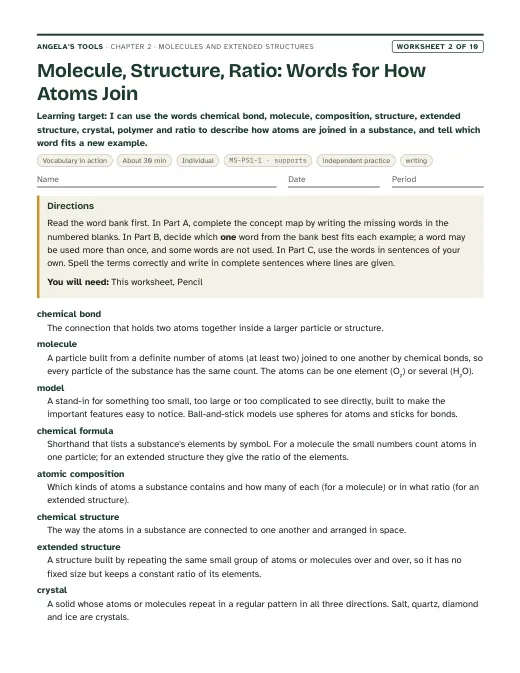
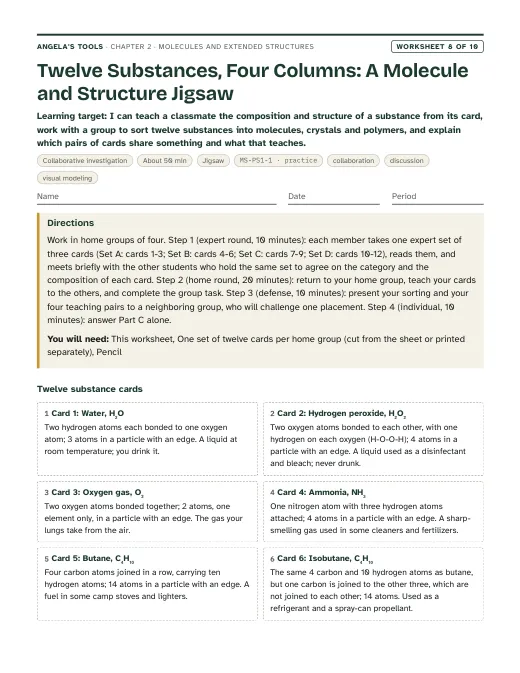
chemical bondA strong connection that holds two atoms together inside a particle. Bonds are what turn separate atoms into a molecule or an extended structure.Each of the two bonds in a water molecule joins one hydrogen atom to the oxygen atom; the two hydrogens are not bonded to each other.
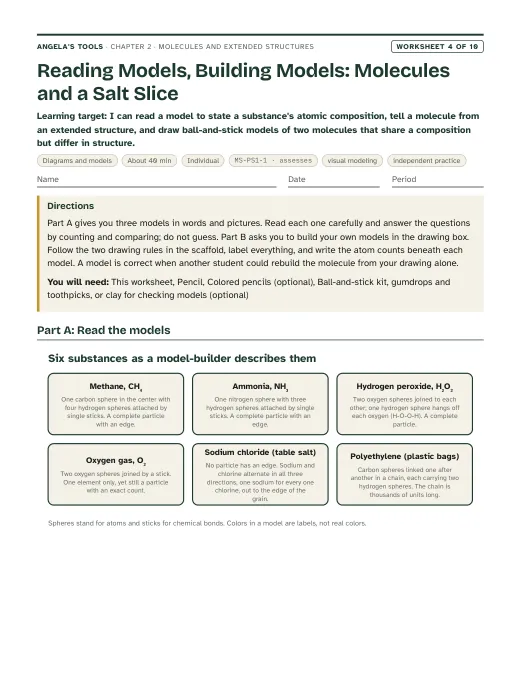
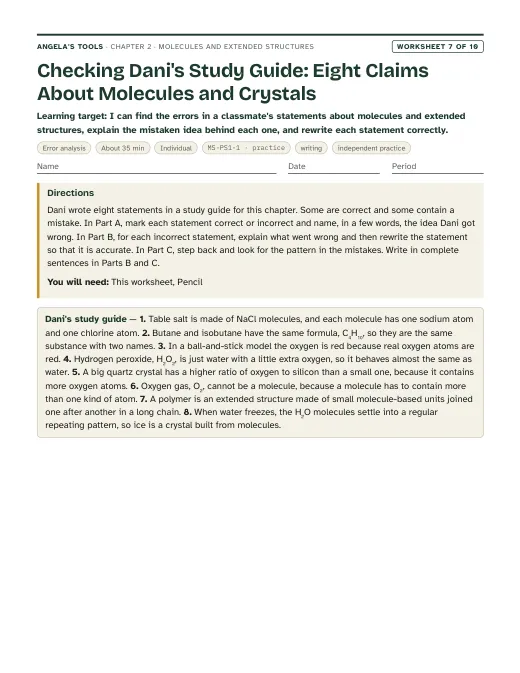
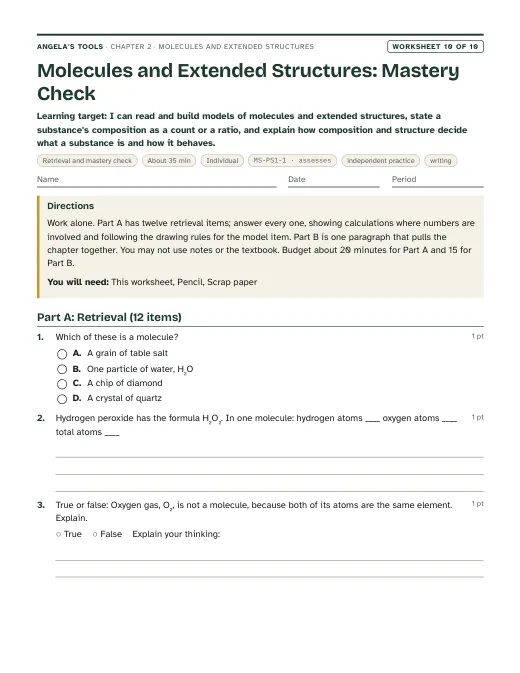
moleculeA particle built from a definite number of atoms (at least two) joined to one another by chemical bonds, so every particle of a substance has the same count of each kind of atom. The atoms can all be one element (O₂) or several elements (H₂O).Every molecule of carbon dioxide has exactly one carbon atom and two oxygen atoms, no matter where the gas came from.
chemical formulaShorthand that lists a substance's elements by symbol. For a molecule the small numbers count the atoms in one molecule (no number means one); for an extended structure the numbers give the ratio of the elements instead.The formula CH₄ tells a chemist that one methane molecule holds one carbon atom and four hydrogen atoms.
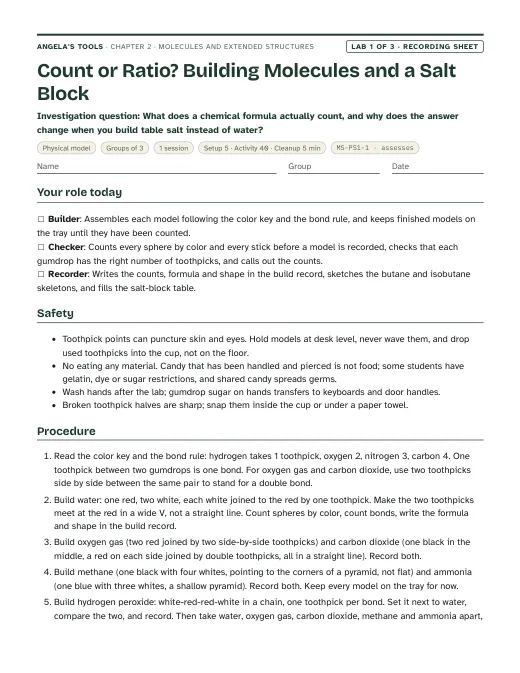
modelA simplified stand-in for something too small, too large or too complex to see directly, built to make the important features easy to notice and reason about.A gumdrop-and-toothpick model of ammonia shows which atoms are bonded, even though real atoms are not sticky spheres.
ball-and-stick modelA model of a molecule or extended structure in which spheres stand for atoms, sticks stand for bonds, and a color key tells which element each sphere represents.In the ball-and-stick model of methane, four white spheres surround one black sphere, and each stick marks one carbon-hydrogen bond.
atomic compositionWhich elements a substance contains and how many atoms of each (for a molecule) or in what ratio (for an extended structure).Water and hydrogen peroxide have the same two elements but different compositions: two hydrogens per oxygen in water, one per oxygen in hydrogen peroxide.
chemical structureThe way the atoms in a substance are connected and arranged in space.Butane and isobutane share the composition C₄H₁₀, but their structures differ: a straight chain of carbons versus a central carbon with three branches.
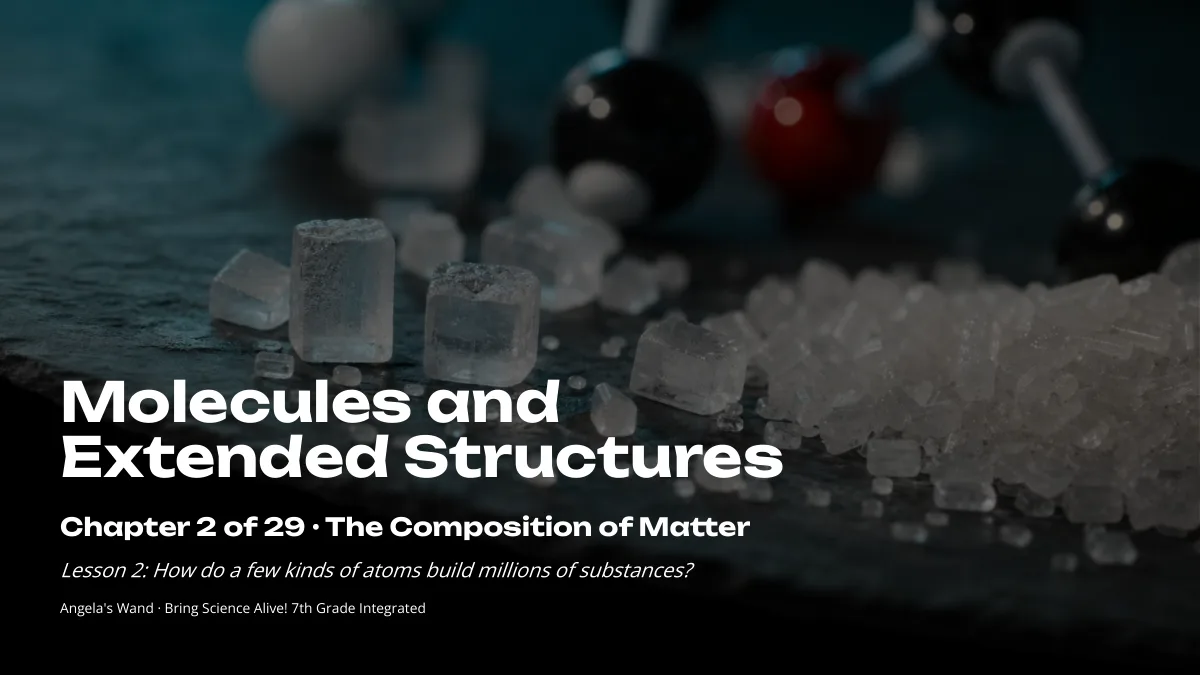
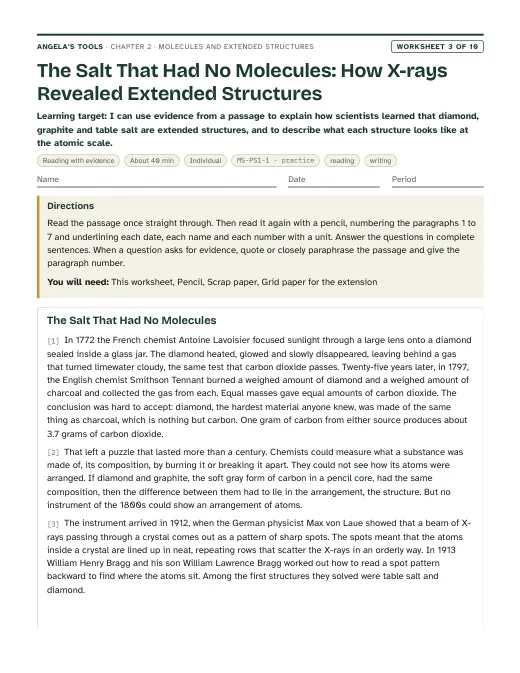
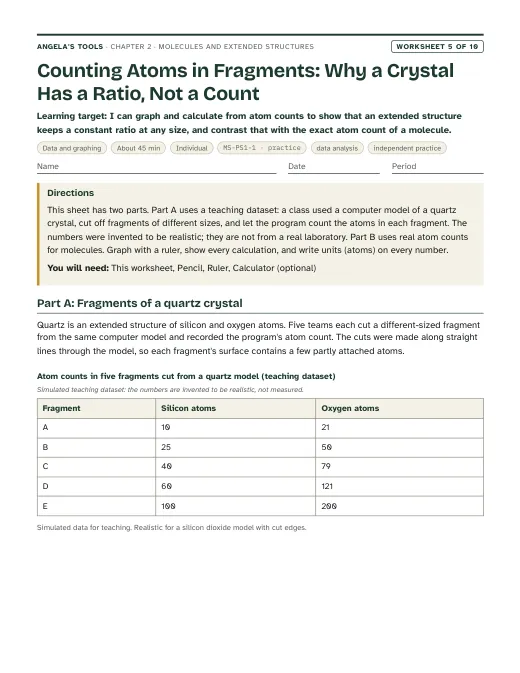
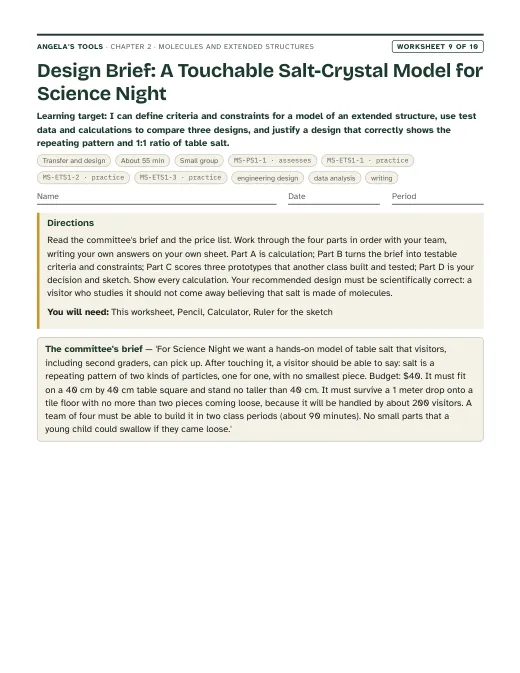
extended structureA structure built by repeating the same small subunit over and over, so it has no fixed size but keeps a constant ratio of its elements. Crystals and polymers are extended structures.A grain of salt is one extended structure; a bigger grain simply repeats the sodium-chlorine pattern more times.
repeating subunitThe small group of atoms or molecules that is copied again and again to build an extended structure.The smallest cube of table salt holds four sodium and four chlorine particles, and that subunit repeats in every direction.
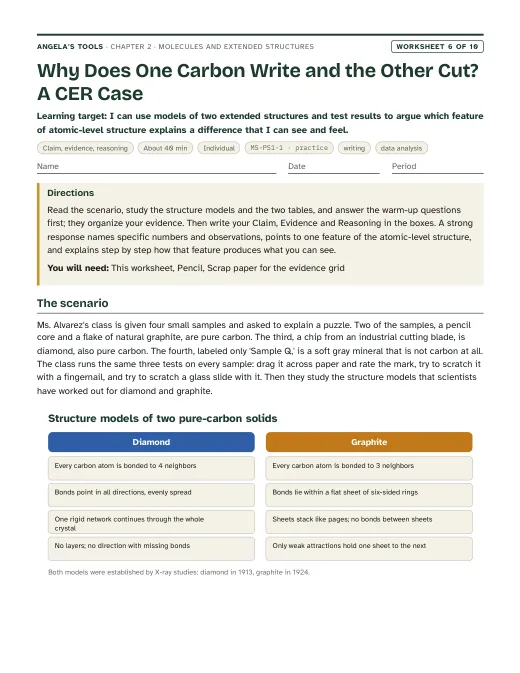
crystalA solid whose atoms or molecules sit in a regular pattern that repeats in all three directions. Diamond, quartz, salt, ice and table sugar are all crystals.Salt grains are little cubes because the crystal pattern inside them repeats at right angles.
polymerAn extended structure made of many small repeating units linked into a long chain. Polyethylene bags, PET bottles and PVC pipes are polymers.When you stretch a polyethylene bag, its long polymer chains straighten and line up, which is why the strip gets narrower and turns whitish.
ratioA comparison of two amounts, written with a colon. In quartz the silicon-to-oxygen ratio is 1:2, so any quartz crystal has twice as many oxygen atoms as silicon atoms.A chemist who counts 500 silicon atoms in a quartz fragment expects about 1,000 oxygen atoms, because the ratio is fixed.